



4 min readJul 30, 2026 04:19 PM IST
First published on: Jul 30, 2026 at 04:17 PM IST
By Ragini Nayak
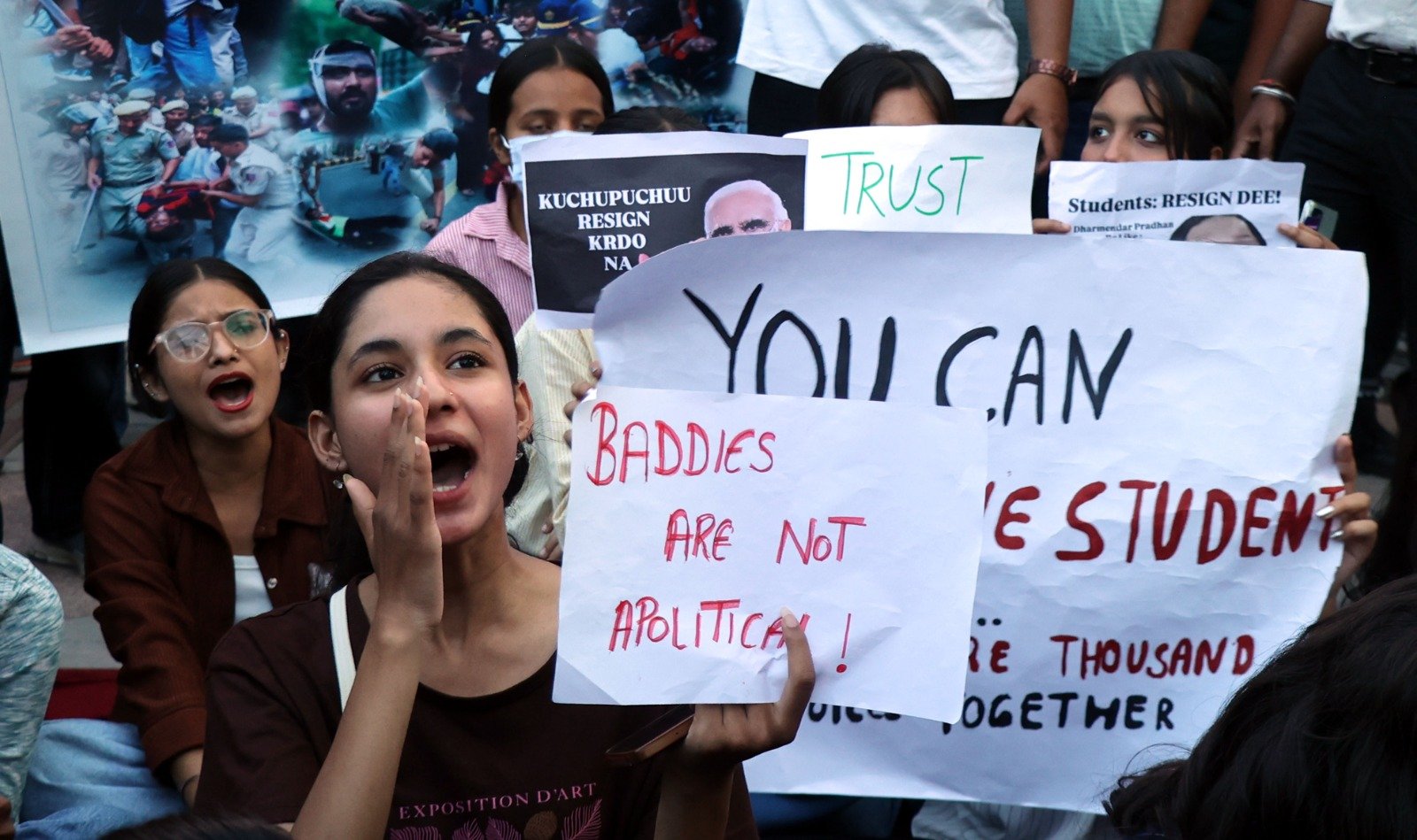
Dharmendra Pradhan has resigned. The students have prevailed. The movement achieved what was initially thought to be impossible. The protestors may have dispersed, but their images will linger.

A young woman protestor stands with her arms outstretched in a protective gesture, instinctively shielding fellow students. She isn’t posturing for the camera; she is positioning herself to protect. Elsewhere, on one side, is the state wrapped in armour, carrying a shield and baton, wearing a blue helmet and the authority of law. On the opposite side stands a female student. No helmet, no armour, no weapon. Only a blue dupatta wrapped around her face and a raised hand that seems to ask, “Is this what democracy has come to?” In a different setting, a young woman is standing alone on a rain-soaked street. She stops the police vehicle towering over her with one hand on the cold metal and the other placed casually on her waist.
Feminist movements across the globe are fighting against the exclusion of women from public spaces, discourses, and protests. This student protest was entirely different. Female protestors, instead of coming across as marginalised victims, emerged as the vanguard. They subverted and transformed the historical insult of weakness, embedded in the idiom “fight like a girl”.
The images of modern young women standing against barricades or blocking police vehicles does not exist in a historical vacuum. Long before feminist theory gave them the language to critique patriarchy, Indian women were already rewriting its assumptions through their lives.
Savitri defeated Yama not through physical force, but through moral courage and intellectual brilliance. Draupadi resisted quiet submission and public humiliation in the Kaurava court by asking a question that shook the legitimacy of power itself: Could a man who had already gambled away his own freedom continue to claim ownership over his wife? Savitribai Phule walked with unyielding resolve every morning to India’s first school for girls, enduring stones, mud, and cow dung hurled at her. Aruna Asaf Ali fought colonial rule, went underground, and hoisted the national flag in 1942 during the Quit India movement. These women are connected by a single thread. Each rejected silence, passivity, and victimhood. They fought against injustice, but they were not attempting to “fight like men”. They were feminising the very meaning of valour.
Contemporary student protests reveal a radical linguistic departure from how brave women have been traditionally honoured. When the legendary poet Subhadra Kumari Chauhan penned her immortal tribute to Rani Lakshmi Bai’s unparalleled bravado — “Khoob ladi mardani, wo to Jhansi wali Rani thi” — she had to call Rani Lakshmi Bai “mardani”, “like a man”. Today, young women stand before the power of the state in their dupattas, spectacles, and backpacks — unapologetically female, fiercely protective, and absolutely defiant. Before the pan-India organic eruption of the student protest, this linguistic reclamation found a modern legislative vocabulary in Priyanka Gandhi Vadra’s campaign anthem for the 2022 Uttar Pradesh assembly elections — “Ladki Hun, Lad Sakti Hun”.
When, on the streets and in Parliament, women fiercely champion the rights of the student community, question their systematic betrayal by institutional paper leaks and brutal police lathi charges, and challenge the extreme apathy of the government, they prove that to “fight like a girl” is not an antithesis, but a synonym of courage.
The writer is national spokesperson, Congress, and former president of the Delhi University Students Union
