



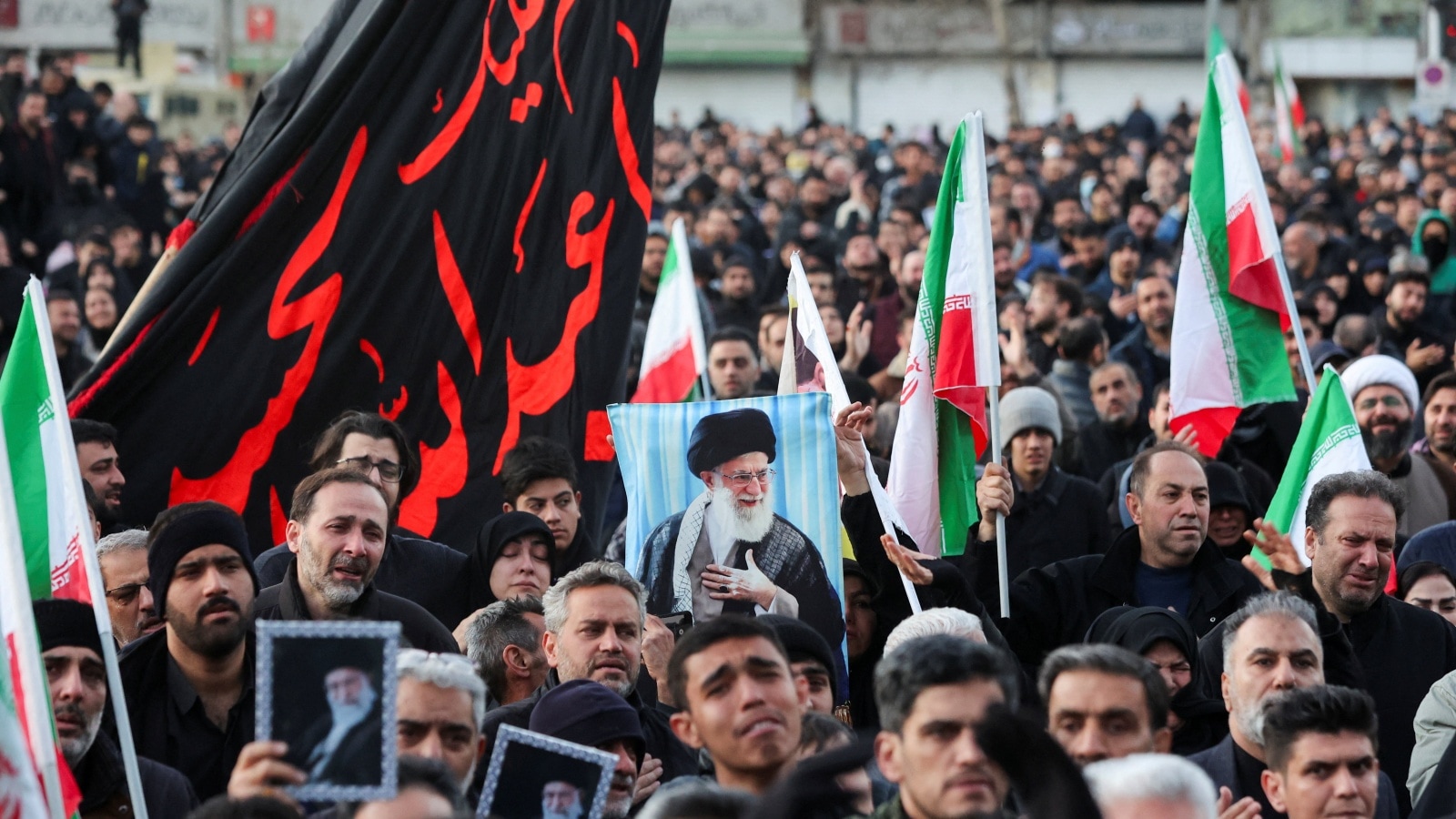
The assassination of the Supreme Leader of the Islamic Republic of Iran, Ayatollah Ali Khamenei, on Saturday in a joint US-Israeli military operation is a dramatic and seismic event in the turbulent Middle East, even by the region’s standards of unpredictable violence. The killing of the octogenarian is likely to trigger a wave of cascading effects both within Iran and across the wider region. Apparently, US President Donald Trump prevented Prime Minister Benjamin Netanyahu from targeting Khamenei during the previous round of conflict last June. This time, Trump went along and took the lead.
Will the post-Khamenei Middle East remain the same? The answer must be an emphatic no. Beyond that, what are the possible scenarios? Forecasting is a high-risk approach in the ever-turbulent Middle East. However, a few questions are reasonable and relevant.
One, will the regime survive? Along with the Supreme Leader, dozens of senior political, military, and intelligence figures were killed in the early hours of this current conflict. The near decapitation of the top echelon has not caused an immediate and dramatic collapse of the clerical regime or its strongholds, and the surviving leaders have been quick to assemble alternative arrangements. Despite some internal dissent and external hopes, the clerical control remains strong — at least for now. However, there are differences between 1989, when Khamenei became the Supreme Leader, and now. Widespread popular anger exists within the country over a range of religious, political, and economic issues. Unless there are significant political and religious concessions, the clergy’s hold will not endure.

Two, will the post-Khamenei dispensation be stable? The sudden loss of leadership — both political and military — appears to have decentralised and localised decision-making powers. Within hours of Khamenei’s assassination, the number and severity of airstrikes against Israel increased sharply. These attacks were faster and came in larger waves than those last June. They were also spread out geographically and were more dangerous. One Iranian missile struck an area not far from the al-Aqsa mosque, the third-holiest site in Islam. If haram-al-Sharief, home to the Golden-domed Temple Mount — the rock from which Prophet Mohammed is believed to have ascended to heaven — becomes an unintended target of Iranian missiles, armed drones, or Israeli defences, the consequences could be catastrophic and worldwide.
Three, will there be a civil war? Another indication of the decentralisation of military power appears in the responses to American bases in the region. The Iranians did not differentiate between friends and enemies in the Arab world, and their missiles and drones hit all six GCC countries, including Oman and Qatar. Since 1979, Oman has refused to join the anti-Iranian chorus of its Arab neighbours and has become a key mediator between the US and Iran. Qatar, on the other hand, faced heavy consequences for its perceived support of Iran during the Saudi-led Arab boycott from 2017 to 2021. The widespread response to Khamenei’s killing shows both an emotional outburst and the reckless attitude of those holding the trigger. Indeed, senior Iranian officials have indicated that the army is acting “independently”, but if this continues, a militant civil war could happen. There is also a chance that the prolonged power struggle between moderates and hardliners could turn into an open internal conflict.
Four, will there be a regime change? If regime change rarely comes from outside, people usually get what they deserve. Revolutions are never free lunches, and those seeking change must work for it with their own blood and sweat, not others’. The Islamic Revolution of 1979 was not handed on a platter; the masses fought for years. Similarly, any overthrow of the clergy’s rule — despised by many Iranians — will not be easy either. This requires a dramatic outpouring of people into the streets against the clergy, and there are no signs of that yet.
Five, what will be the legacy of Khamenei? While funeral details are still not available, as in similar past events — such as Qasem Soleimani in January 2020 — the clergy will turn the 40-day mourning for Khamenei into a major event. His long tenure — first as president (1981-1989) and since June 1989 as Khomeini’s successor — gave him enough time and power to shape the Islamic Republic. His brutal death also reinforces the justice and resistance narrative of Shiism. Since many Iranians viewed him as a victim of the enemies of Islam, several are already comparing him to Imam Ali.
Six, will the post-Khamenei Iranian response reignite sectarianism? Within hours of his assassination, the Middle East was engulfed in a violent Iranian response. Besides Israel, Iran targeted six Gulf Arab countries, Jordan, Cyprus, and northern Iraq. Officially, Iranian attacks were aimed at American bases in these countries, but missiles and drones are not politically driven, and they hit several civilian populations in these areas. The reprisal attacks on Arab countries have reignited and widened Arab-Persian divisions, which will require significant time and effort by Iran to mend. Simply blaming Israel for all the region’s problems will not be enough to justify or explain Iranian attacks on civilian targets in Gulf Arab nations.
Seven, will the office of velayat-e-faqih survive Khamenei’s death? Senior Shia clerics have faced significant theological disagreements and issues ever since Ayatollah Khomeini declared himself the Guardian of the Jurist. Therefore, even if a successor is appointed, the long-term viability of this institution remains uncertain.
Eight, what will be the endgame? Wars seldom end smoothly or cleanly. The US and Israel have unleashed the genie. The reckless Iranian responses have been emotional, fuelling longstanding but centuries-old Arab-Persian and Sunni-Shia rivalries. While Shias in the region and beyond might feel abandoned by Khamenei’s death, the Iranian reprisal attacks have upset the citizens and residents of the Gulf Arab countries.
All three main parties — Iran, Israel, and the US — have committed to intensifying and expanding their military actions, so there is no immediate end in sight to the ongoing conflict. The Trump-Netanyahu duo has opened a Pandora’s box, and there’s no easy end to this violence.
The writer teaches contemporary Middle East at Jawaharlal Nehru University, New Delhi
