



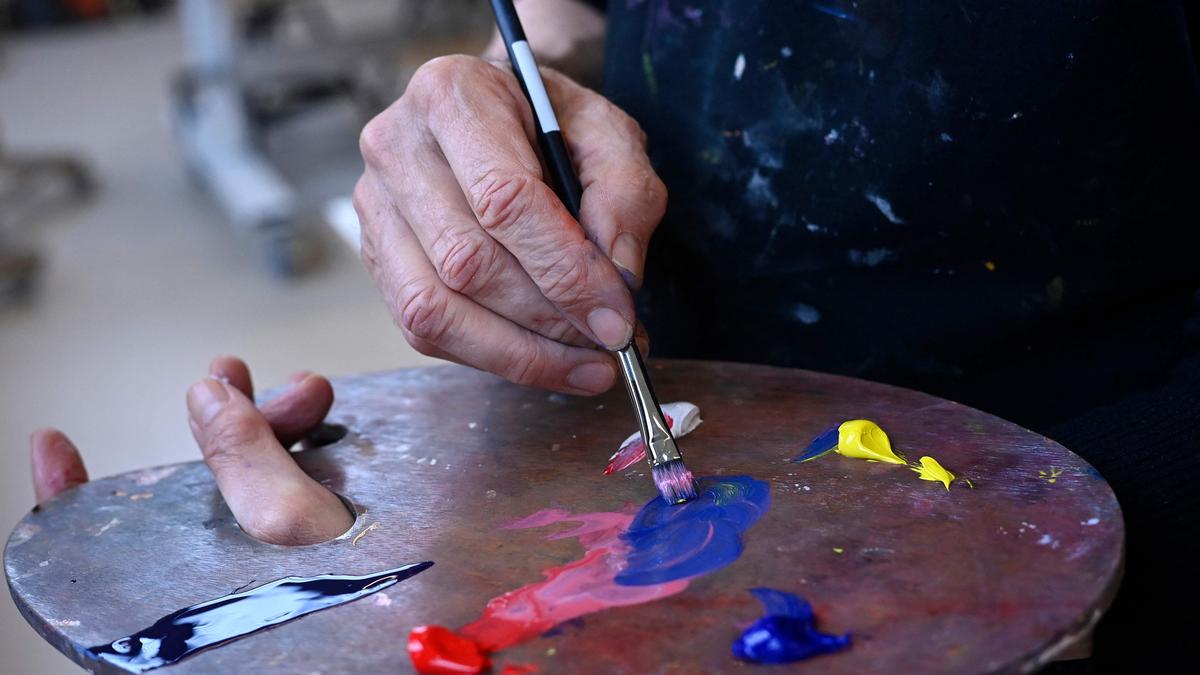
From the lapis-laden trade routes of the Bronze Age, blue travelled east and west, carrying with it power, devotion, and value. By the Kushan period, between the 2nd and 4th centuries CE, ultramarine pigment was extracted from Afghan lapis lazuli through a complex and painstaking process of crushing it carefully and treating it with beeswax to extract its colour. The famous Kushan Buddha sculptures, known as the Bamiyan Buddhas, were colossal figures, carved into cliffs and painted with deep, lustrous blue. They were not merely artistic creations — they were cosmological statements. Blue marked divinity, enclosing sacred space, linking material effort with spiritual authority. The pigment was painstakingly prepared, expensive, and treasured; value was precisely tied to measurement.
Also Read | The importance of blue
By the Renaissance, blue had crossed continents and centuries to enter Europe’s ateliers. Ultramarine was the most coveted pigment: Michelangelo applied it only sparingly, Raphael and Leonardo reserved it for the Virgin Mary’s robes, while Titian used it to heighten divinity in his compositions. Papal and noble patronage dictated its use, and painters could afford it only for top coats or sacred highlights. In this world, blue carried both economic and symbolic weight: to see it on canvas was to witness power, sanctity, and painstaking labour distilled into a single hue.

In the early 19th century, the Napoleonic Wars transformed this relationship. Blue, still precious, was no longer solely symbolic. The blue of European woad, cultivated locally for centuries, was pale, inconsistent, and labour-intensive. Indigo, imported through colonial routes, yielded a deeper, stable blue and could be scaled to mass armies. In choosing indigo, Napoleon aligned colour with efficiency, durability, and control. Blue had become a matter of supply. European culture came to signify this break from sentimentality to the steadfast pursuit of utilitarian values.

Uniforms were technologies of discipline. They rendered bodies legible, ranks visible, and allegiance unmistakable. Blue functioned less as a bearer of meaning than as an instrument of order. This marks a pivotal moment in colour history: value was judged by performance under pressure rather than rarity, ritual, or resonance. Napoleon’s indigo exemplified this separation, as a pigment which gave divine legitimacy to governance became a resource of secular statecraft.
Napoleon’s eventual defeat only intensified this logic. Britain’s victory consolidated access to indigo plantations in India and the Caribbean and this coincided with a surge in large-scale historical painting. The Royal Academy of Arts exhibited canvases of battles, regiments, and fleets, skies heavy with smoke, uniforms rendered in precise blue. Painters required volumes of ultramarine far beyond natural supplies. The pigment that had once been reserved for sacred imagery now strained under the weight of national memory and artistic ambition.
Necessity drove innovation. Between 1815 and 1825, the Royal Academy, as well as the French Société d’Encouragement, offered a prize for the creation of a synthetic ultramarine as brilliant as lapis but affordable. Jean-Baptiste Guimet succeeded within four years, with Christian Gmelin independently developing a parallel process in Germany. Synthetic ultramarine entered the market, stable, scalable, and less dependent on distant mines. Its creation marked the first major moment when colour production became industrial, yet motivated by artistic need.
Goethe was the earliest to see the possibility of industrial production of synthetic colours. In 1786, Goethe abruptly left his home in Weimar and abandoned courtly life to ponder some philosophical problems that were troubling him. As he travelled coastal Italy in 1787, he noticed a blue hue in the smoke that emerged from the chimneys of lime-burning brick kilns. When he examined the walls of the chimney, he noticed that Lazurite, the active chemical which produced the Ultramarine pigment, was being unintentionally created in the quicklime factories.
His colour theory provided the breakthrough which cascaded into broader industrial colour manufacture. By the late 19th century, chemists produced dyes at unprecedented scale; synthetic indigo followed in 1897, ending centuries of local cultivation. Blue, once a marker of divine authority, ritual power, and scarcity, had become widely reproducible. Its value was now linked to economic and utilitarian criteria as much as aesthetic or symbolic ones. Colour had become functional, industrial, and predictable. Blue’s journey illustrates how colour evolves at the intersection of craft, belief, and administration. In tracing its arc, we see not only the material history of a colour but the ongoing dialogue between meaning and utility, between what we revere and what we rely on.
Satwik Gade is a Chennai-based writer and illustrator. This article is part of a series on the history and development of colours.
Published – March 03, 2026 07:30 am IST
