



5 min readMar 4, 2026 06:07 PM IST
First published on: Mar 4, 2026 at 06:07 PM IST
By Qin Jie
March 3 was the Lantern Festival (also called Yuanxiao Festival) in China. It marked the last day of Chinese New Year celebrations. Falling on the 15th day of the first month in the Chinese lunar calendar, the Lantern Festival dates back more than 2,000 years to the Han dynasty (206 BC-220 AD), when the Chinese Emperor Liu Zhuang, a devout Buddhist, promoted the learning of Buddhism in China and adopted the practice of lighting lanterns in temples to worship and honour Buddha. As the night of the Lantern Festival sees the first full moon following the Spring Festival, it symbolises the end of winter and the return of spring. The full moon also symbolises harmony and family unity. People decorate their homes as well as public places with colourful lanterns, eat yuanxiao — a traditional Chinese glutinous rice ball filled with sweet ingredients like sesame, jujube, peanuts, walnut, and red bean paste. People wish for this round, sweet delicacy to bring them happiness and sweetness in the future. People also watch and participate in various folk dances, creating an exciting festive atmosphere.

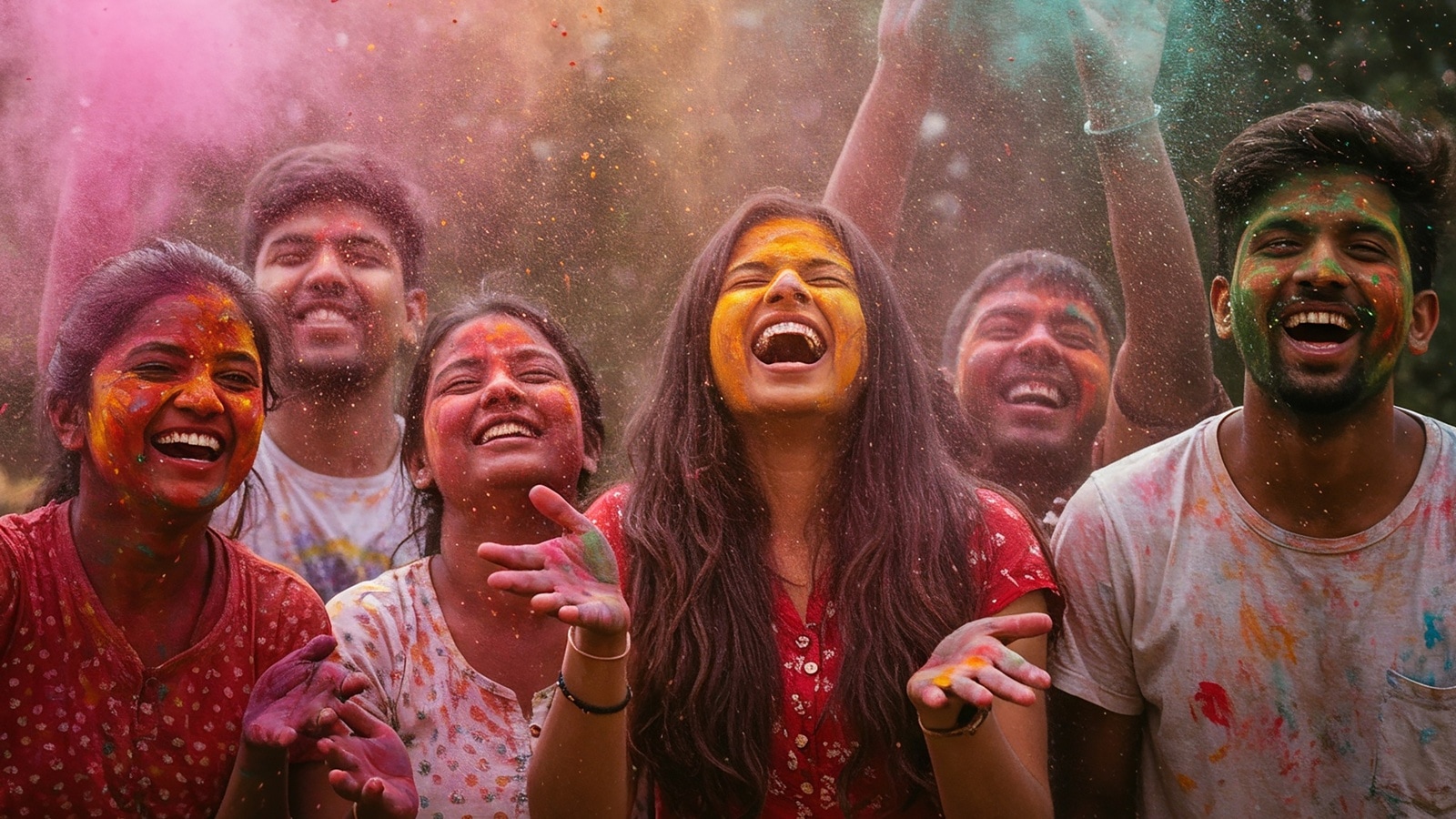
The same day when Chinese people are celebrating the Lantern Festival, our Indian friends are immersed in the Holi festival. My Indian friends told me that Holi is rooted in Hindu mythology and has been observed for thousands of years. Also known as the festival of colours, it is celebrated on the full moon in the lunar month of Phalgun, a time of transition which usually occurs in March. The night before Holi, I saw my neighbours light bonfires, dance to music, and pray to bid farewell to winter and welcome spring. I got to learn that this ancient cultural practice also symbolises the triumph of good over evil. During Holi, families prepare and share gujiya at home, a typical, dumpling-like sweet with fillings of dried fruit and nuts spiced with cardamom. I also found that the real fun and “craze” starts on the very day of Holi, when people throw gulal — coloured powders — and water at literally anybody and everybody. Friends told me that each colour represents a distinct meaning: Red for love, yellow for knowledge, green for new life, blue for God Krishna and divinity, etc. With a riot of colours, people’s faces and clothes are transformed into beautiful works of art.
This March 3 is the first time I have celebrated the Lantern Festival and Holi, two-in-one, along with some Mumbaikars. Beyond excitement, the two fascinating festival activities make me think how similar they are in multiple dimensions: Cultural connotation, symbolic significance, observance of natural laws, and even in food choices. As two ancient civilisations, although separated by mountains and rivers, our ancestors have lived on the same planet, observed the same sky, and formed similar wisdom and practices. Thousands of years down, the wisdom and culture have turned into invaluable assets. We both love family and friends. We both cherish peace and harmony. We both value the unity of humanity and nature. Both our peoples desire happiness and the sweetness of life.
The two-in-one festive vibe makes me further think that, facing a turbulent and increasingly uncertain world, we shoulder a historic responsibility to unswervingly enhance cultural exchanges and promote civilisational dialogue and communication among all the countries of the world. Three years ago, President Xi of China raised the Global Civilisation Initiative in Beijing, emphasising that countries need to uphold the principles of equality, mutual learning, dialogue, and inclusiveness among civilisations, and let cultural exchanges transcend estrangement, mutual learning transcend clashes, and inclusiveness transcend any sense of superiority.
As the BRICS summit is to be held this year in India, we should seize the opportunity to jointly advocate robust international people-to-people exchanges and cooperation among the member countries. We should encourage all peace-loving countries and people to contribute to the ever-increasing inter-civilisational learning and sharing. We should consistently enrich the content of exchanges and expand avenues of cooperation to promote mutual understanding and friendship, and advance the progress of human civilisation by building a shared future.
As China’s NPC and CPPCC are convening in Beijing to deliberate on the 15th Five Year Plan and the priorities of social, economic development for 2026, China will pledge again to the world that its path toward modernisation is on the right course of peaceful development. With peace and harmony at the very core of its civilisation, in pursuing Chinese modernisation, China will neither tread the old path of colonisation and plunder, nor the crooked path of seeking hegemony, but continue to innovate faster and open wider to share development opportunities with the world.
The writer is Chinese Consul General in Mumbai
