



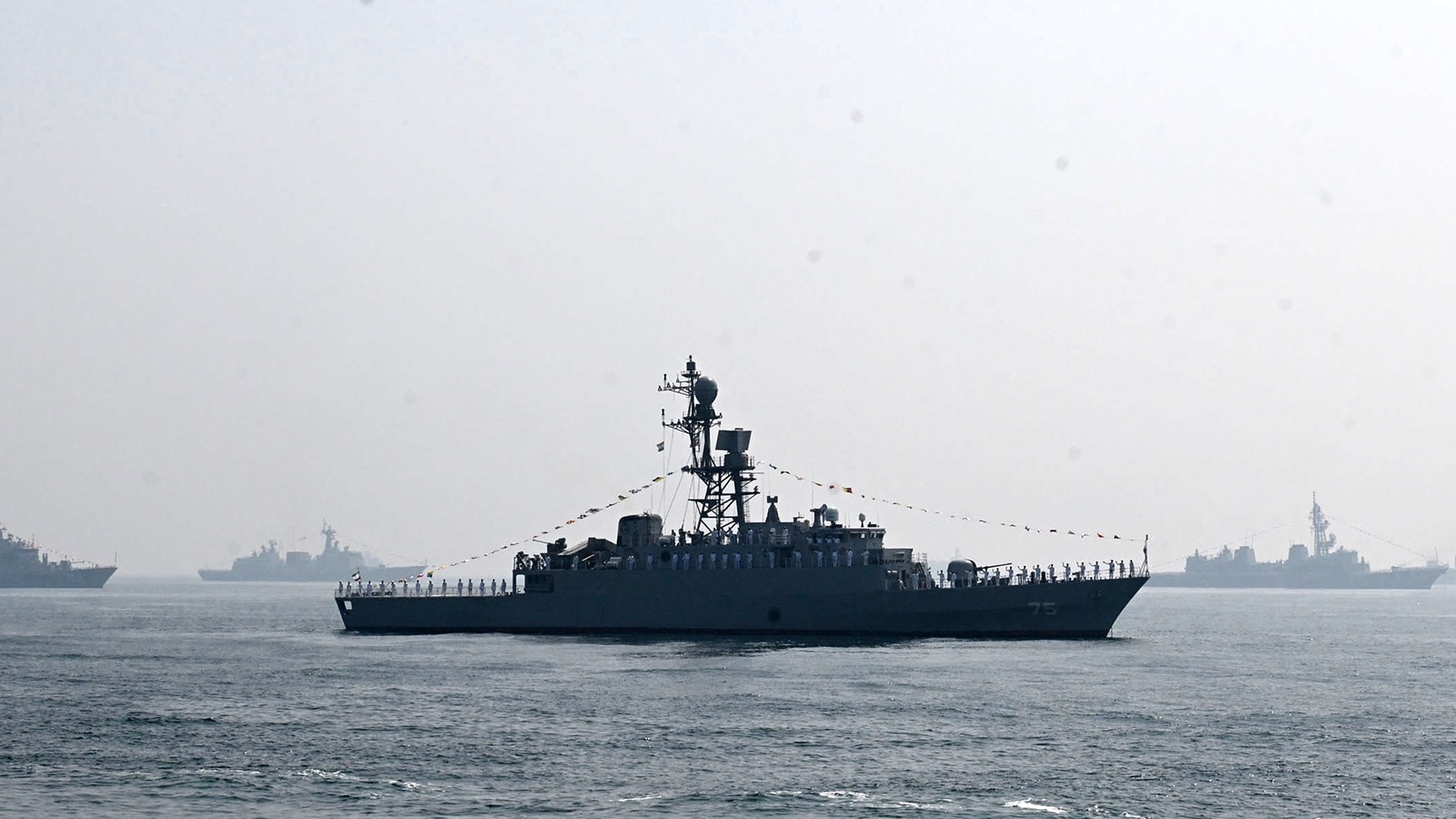
Understanding why a US submarine sank an Iranian frigate in the Indian Ocean, and why this will not be the last such incident, requires an examination of the military logic of maritime conflict and the ideology driving it.

Wars expand differently across the three domains. On land, mountains and borders limit army movement. Air power reaches further but is limited by bases and tankers. The maritime domain is different: Sea lanes are largely boundless, and naval operations flow with them. As Iranian missiles struck US bases across the Gulf — Bahrain, Al Udeid, Al Dhafra — American forces’ dependency on Diego Garcia, 1,800 kilometres south of India and the one major US installation beyond Iran’s ballistic missile range, increased. The Indian Ocean sea lines to that atoll will increasingly be central logistically.
A solitary Iranian frigate did not pose a major kinetic threat, even carrying Noor anti-ship missiles with a range of 120 kilometres. But it was a valuable platform for electronic surveillance and surface search radars that could track shipping far beyond the horizon. It could feed real-time targeting data to the Islamic Revolutionary Guard Corps (IRGC) long-range missile systems that have already attacked an Arleigh Burke destroyer in the North Arabian Sea. No naval commander will tolerate such a platform, armed with standoff weapons and powerful sensors, astride their supply routes.
Military rationale accounts for the Indian Ocean’s emergence as a theatre. The nature of escalation requires a different explanation: Pete Hegseth’s systematic removal of the constraints governing American military operations.
Since January 2025, Hegseth has marginalised judge advocate generals and eliminated civilian protection from the National Defence Strategy. The 2025 National Security Strategy states explicitly that the multilateral architecture built since 1945 is an impediment, not a foundation.
Speaking at the Pentagon on March 2, Hegseth declared: “America, regardless of what so-called international institutions say, is unleashing the most lethal and precise air power campaign in history. All on our terms, with maximum authority. No stupid rules of engagement … No politically correct wars. We fight to win, and we don’t waste time or lives.” This is not posture. The US will act in its interests without heeding diplomatic fallout; partners manage the consequences.
India’s legal sovereignty ends at 12 nautical miles. Beyond lies the ocean, governed by norms, not law. Indian commentary has treated the Dena sinking as a violation of international norms. But Hegseth’s America barely observes international law; expecting it to honour norms is a category error. The ocean beyond 12 miles is, for this administration, simply operational space.
The innermost circle is diplomatic. India has deep equities on both sides: Chabahar, historic and energy ties with Iran, and defence and economic agreements with the US. The IRIS Dena had just attended India’s MILAN exercise. Iran may not take kinetic action against India, but Chabahar and the broader relationship will be in doubt every time Washington asks New Delhi for something.
The second circle is domestic politics. The Opposition has accused Prime Minister Narendra Modi of silence in the face of a war in India’s backyard, of failing to call Tehran, and of compromising strategic autonomy, the foreign policy identity he has most carefully cultivated. Parliament resumes on March 9; the ambush is prepared. Among India’s 200 million Muslims and its large Gulf diaspora, the political costs are rising.
The third circle is strategic. The Logistics Exchange Memorandum of Agreement (LEMOA) was designed for conditional interoperability. In an active Indian Ocean theatre, it becomes a framework for wartime demands, such as replenishment, repair, and operational access, that challenge Indian sovereignty. When the UK hesitated over Diego Garcia, the White House response was immediate and public. India will face equivalent pressure, framed as a treaty obligation, not a diplomatic request.
The outer circle is economic. The Strait of Hormuz is closed; Maersk is rerouting around the Cape. The Arabian Sea, through which 80 per cent of India’s crude oil flows, is a combat zone. The disruption to energy supplies, shipping, and costs will dwarf the Houthi actions that cost India billions.
The Hegseth doctrine offers India no room for its usual studied ambiguity. What India requires is a clear, public position on what it will and will not accept in its own waters on the use of its facilities, on the protection of its sea lanes, and on the rules that govern this ocean. A line clearly drawn may command respect that quiet diplomacy cannot.
The writer is a research fellow at the Takshashila Institute

