



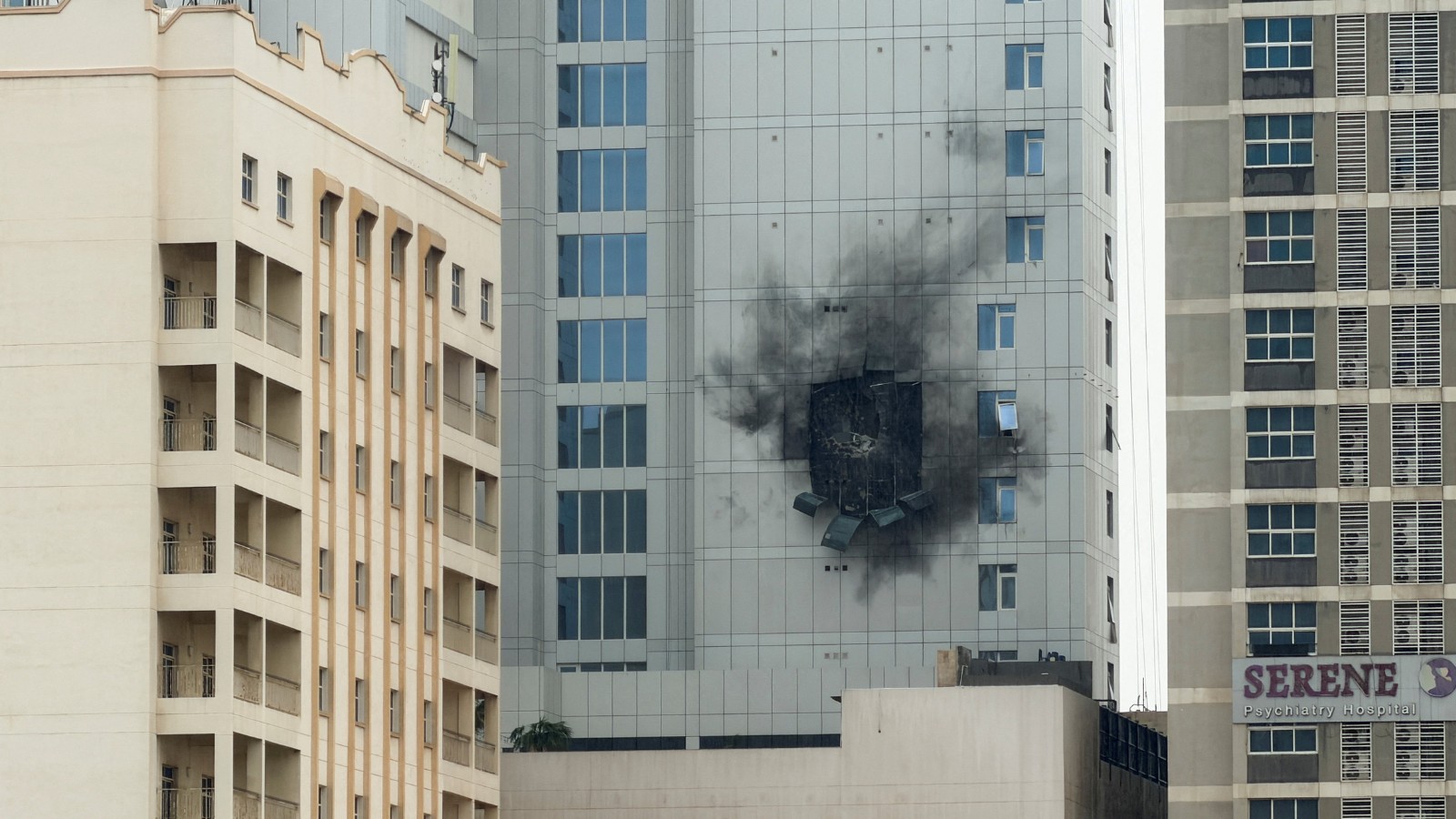
It is 2:47 in the morning. The siren begins not with a wail but with a moan — low, almost apologetic — before it crescendos into the sound that has colonised the dreams of hundreds of thousands of people across Bahrain and Qatar. In the apartment blocks of Juffair, in the gleaming towers of Lusail, in the villa compounds of Al Wakra, families jolt awake. Phones light up simultaneously. WhatsApp groups erupt. Somewhere, a child begins to cry.

This is not a drill. This is a grotesque normalisation of what would, anywhere else in the world, constitute an emergency beyond comprehension.
The Gulf has always lived with geopolitical tension as a background hum. But the current climate — with Iran and the United States locked in a spiral of targeted strikes and counter-posturing — has transformed that background hum into a foreground scream. For the roughly 3.1 million expatriates who call Bahrain and Qatar home, the question is no longer abstract: How close is too close? And how long can you live in a place where the answer changes every day?
Geography, in this conflict, is not merely context. It is fate. The Arabian Gulf is, in geological terms, barely a lake — a shallow, warm body of water that separates Iran from the Gulf states by distances that a commercial aircraft covers in under forty minutes. For a ballistic missile, the mathematics are grimmer still.
The Patriot missile defence batteries positioned at NSA Bahrain and Al Udeid Air Base in Qatar represent the United States’ primary shield for its forces and — by extension — the surrounding civilian population. Military analysts are candid about the limitations. At distances under 300 kilometres, the intercept window compresses to a point where everything depends on perfect detection, perfect positioning, and — frankly — a measure of luck that no military planner will admit to relying upon.
Here is where the situation grows complicated — morally, psychologically, and analytically. Iran’s documented strikes since the escalation began have exhibited a pattern that is, by any military accounting, remarkably deliberate. The targets have been consistently and specifically United States military assets: The air bases, the naval facilities, the logistical hubs that represent American power projection in the region.
This precision is, for those living here, the slender thread from which normality dangles. It is also a source of profound ambivalence. To be grateful that the warhead is calibrated to destroy a radar installation rather than your apartment block is a genuinely strange psychological position — a gratitude that tastes of ash.
The debris, however, does not share its parent munition’s discriminating logic. When Patriot interceptors destroy an incoming ballistic missile at altitude, the resulting fragmentation scatters across unpredictable radii. Shrapnel does not read ZIP codes. It has landed on rooftops in Juffair. It has pockmarked the facades of residential towers. It has shattered the windscreens of cars parked outside the kind of ordinary supermarkets where ordinary people buy groceries and try not to think about arcs of fire overhead. The psychological toll is immeasurable.
Ask expatriates what has changed most, and they will not, at first, mention the missiles. They will mention the sirens. The way time has been restructured around them. The way sleep — deep, restorative, unconscious sleep — has become something that happens to other people, in other time zones, in countries whose skies are merely skies. Schools have adopted shelter protocols. Many international schools now hold regular drills and have converted basement spaces into designated safe rooms, stocked with bottled water and first-aid supplies. Children in Year 4 know the difference between an alert drill and a live alert. Some of them know it because they have experienced both.
The economy of fear has reshaped the cityscape. Grocery stores report a persistent pattern of panic buying — not dramatic, but constant, a low-grade hoarding behaviour that strips shelves of bottled water, canned goods, and portable battery chargers every few days. Restaurant footfall has dropped by an estimated 34 per cent since January. The malls remain open but are quieter than they have been in years, the communal luxury of idle time having somehow lost its lustre when the sky outside cannot be entirely trusted.
The expatriate experience of conflict is qualitatively different from that of a citizen. A citizen’s identity is tethered to a place; they belong to its fate, for better or worse, and that belonging — however uncomfortable — carries a certain kind of clarity. The expatriate belongs to the danger without belonging to the country.
And behind every one of those 3.1 million people is a constellation of people elsewhere — parents in Mumbai and Manila and Manchester, siblings in Lahore and Lagos and Lyon — who are watching the news with a specific terror that is entirely different from the generalised anxiety of the global observer. For the family and friends of the expatriate, the headline “MISSILE STRIKE IN GULF” is not geopolitics. It is a sentence about someone they love.
The phone screen has become a secondary battlefield. In the information environment surrounding this conflict, accuracy has often been the first casualty, and the expatriate community — dispersed across global time zones, speaking dozens of languages, operating across WhatsApp chains and Telegram groups and community Facebook pages — has proven catastrophically vulnerable to misinformation.
Each of these headlines detonates in family WhatsApp groups across South Asia, Southeast Asia, and the Western world. The effect — even when the story is subsequently corrected, retracted, or contextualised — is irreversible. The panic has already propagated. The phone calls have already been made. The tears have already been shed.
The psychological burden of being simultaneously inside the danger zone and outside the full terror of it — of being calmer than your loved ones about your own potential death — is one of the strangest aspects of this crisis.
The question that hangs over every dinner table, every school pickup, every office conversation is: Why are you still here? The answers are as varied as the people giving them, and they reveal the complex matrix of obligation, economics, identity, and inertia that governs expatriate life in crisis conditions.
Some stay because their companies require it. Gulf business has not stopped — Qatar’s LNG exports continue, Bahrain’s financial sector continues to function, construction projects remain active — and the economic architecture of the region is not designed to accommodate mass expatriate withdrawal without catastrophic consequences.
Some stay because leaving is not the uncomplicated refuge it appears from the outside. Accommodation has been surrendered, children are midway through the school year, savings are calibrated against Gulf salaries, and the life that was left behind may not be waiting with open arms and equivalent opportunity.
And some — perhaps the most quietly remarkable — stay because they have made peace with the risk.
Each week brings a new set of signals: A statement from Tehran suggesting restraint, followed by a strike; an American de-escalation posture, followed by a retaliatory drone sortie; a European diplomatic initiative, followed by silence. And yet there is, in this community, a resilience that is neither naïve nor defiant. It is the resilience of people who have chosen — or been placed — in extraordinary circumstances and found that ordinary life persists within them.
For the 3.1 million expatriates who constitute — in the most literal sense — the demographic majority of the countries they call temporary home, the question that matters is simpler and harder: Can I live, fully and decently, in the space between the last all-clear and the next?
For now, the answer — repeated daily, quietly, without ceremony — is yes. And in that “yes” is everything: The refusal to be reduced to a statistic, the insistence on continuity, the persistent, stubborn, luminous hope that the theatre of war will eventually, mercifully, lower its curtain.
The writer is chairman, Aurion Group

