



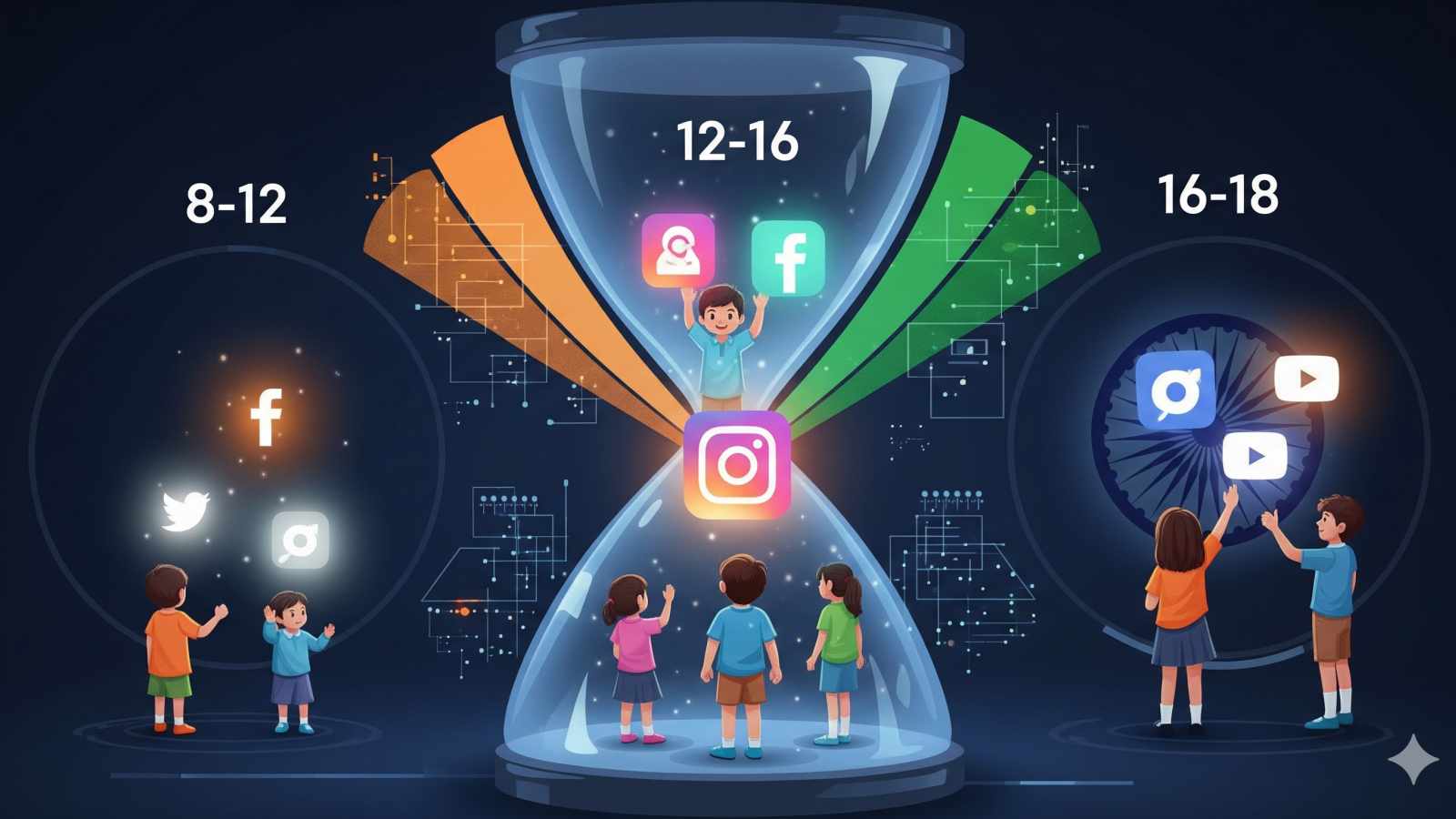
On March 6, Karnataka Chief Minister Siddaramaiah announced a ban on social media use for children under the age of 16 years during the state’s annual budget presentation. In parallel, the Andhra Pradesh government announced intentions to introduce measures to restrict social media access for children below the age of 13.

This comes amid the broader discourse surrounding social media bans and the restriction of children’s online access, both globally and in India. Australia set a landmark precedent in 2025 by banning social media use for children under 16. Since then, countries including France, Germany and Indonesia have also expressed plans to ban social media for children, albeit with differing age thresholds. More recently, French President Emmanuel Macron, during his keynote address at the India AI Impact Summit, urged India to “join the club” and consider banning social media for children.
To replicate such a ban in India may pose new challenges, including questions on whether it is a state or the Centre that introduces legal measures, as well as the feasibility of a blanket ban on social media access.
While the Andhra Pradesh government has specified that it will introduce regulations to bring the social media ban into effect soon, it is currently unclear how the Karnataka government plans to initiate the ban. With law-making power relating to internet and communications governance typically falling under the purview of the Central government under the Union List, it is unclear whether states can, in fact, regulate children’s access to social media through legislation.
Furthermore, fragmented approaches to social media bans can present challenges in applicability and precisely, in the case of non-uniform age thresholds across states. It is also unclear how different states may intend to assign the onus. For instance, will users only have to self-declare their age and provide ID verification, or will regulations require social media platforms to take greater accountability in ascertaining the age of users through technical detection mechanisms? It can also be challenging to identify an appropriate age threshold for this purpose, as it can be onerous to ascertain the extent of agency and evolving capacity an individual child may demonstrate.
Additionally, online age verification raises several privacy concerns, with studies finding that more accurate mechanisms often contravene data protection principles through the collection of excessive data. This would be particularly concerning since social media bans for children would result in virtually every individual trying to use social media needing to verify their age through mechanisms that have not been fully specified.
Moreover, a ban also fails to account for challenges such as shared device usage, a reality in India. Such a move may also further limit online expression for girls and young women, whose access to digital spaces is already curbed by gender norms. These gender norms can often hinder access to digital spaces, both in terms of the physical device itself and with respect to parental consent required under the data protection law. A ban may also inhibit the articulation of personal identity for LGBTQIA+ communities, including children, for whom online spaces are critical for self-expression.
Moreover, social media bans, coupled with existing parental consent requirements under data protection frameworks, may shift the narrative entirely towards restricting children’s access, whereas the real question is how we can safeguard children from very actual harms that present themselves online. For instance, in spite of age restrictions, children often misrepresent their age online, either by false declarations or through the use of VPNs. Indian parents have often been found to be aware of such misrepresentation (with some even assisting their children in accessing these platforms). This can result in the crux of the problem remaining unaddressed, with children continuing to be exposed to inherent platform design choices that can foster safety harms such as addiction and mental health challenges. This can occur even in the case of parents consenting to their child’s access to social media platforms (either in the absence of a ban in their state or after the child has reached the threshold).
Social media platforms are often a critical avenue for children’s self-expression, and children must therefore be empowered to navigate these platforms safely. Rather than restricting access, policies and legal frameworks should instead enable safer online spaces for children. In doing so, it is key to specify the kind of harms intended to be accounted for through the framework. Concerns about grooming, sexual content, addiction, mental health challenges, AI-related harms and misinformation, while all significant, would require different prongs to meaningfully tackle them, as opposed to a sweeping social media ban.
The Centre is reportedly looking to introduce a law that attempts to take a “nuanced and graded approach” to regulating access to social media for children through graded bands of age groups, and safeguards such as time-based login limits. However, it is imperative that consultative processes towards developing this law take a multi-stakeholder approach, with the participation of civil society and academia, to meaningfully enshrine what autonomy and agency can look like for children within safeguards for their online safety. The law must also then create pathways towards equipping children, parents and educators with tools for responsible social media use.
It would also be important to acknowledge factors such as India’s multilingual diversity. This is crucial because it may not only impact how platforms detect children’s accounts, but can also dictate the accuracy with which safety measures used by platforms (such as automated content moderation) work. Further, a narrow focus on social media platforms alone ignores safety challenges that may present themselves on gaming platforms such as Roblox and Minecraft, as well as through AI tools such as ChatGPT. Upcoming policies and legal frameworks must therefore also safeguard the best interests of children in a manner that accounts for emerging technologies and India’s unique challenges.
Angelina Dash is a Project Officer at the Centre for Communication Governance at National Law University Delhi
