



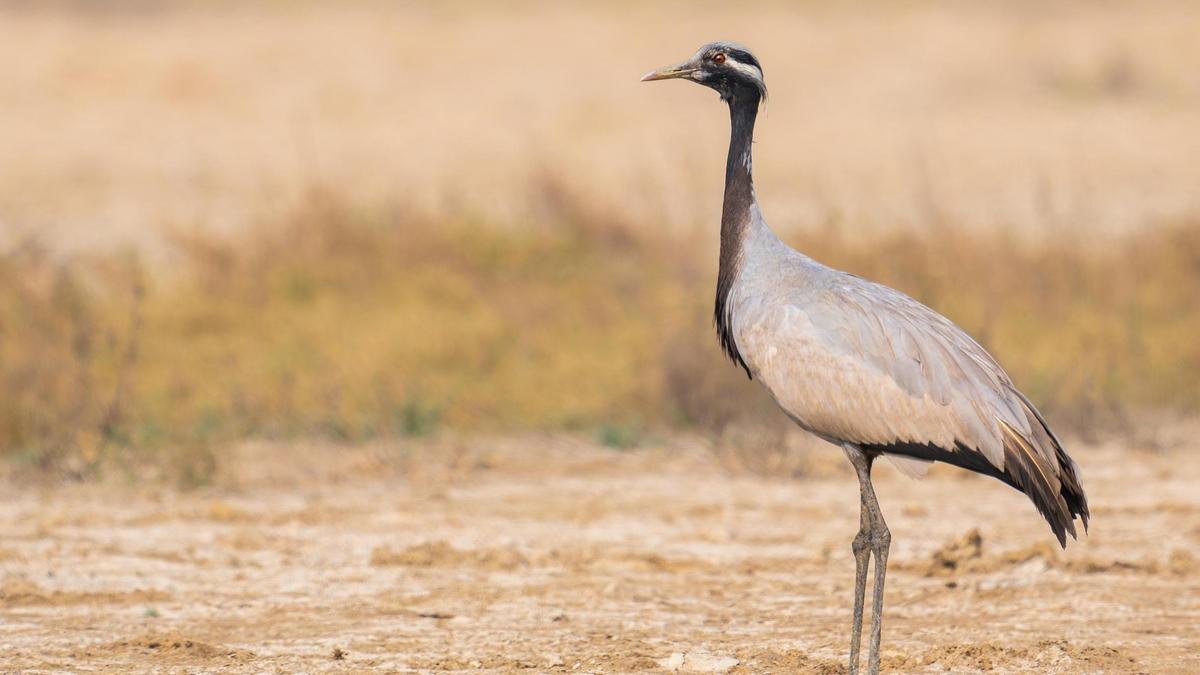
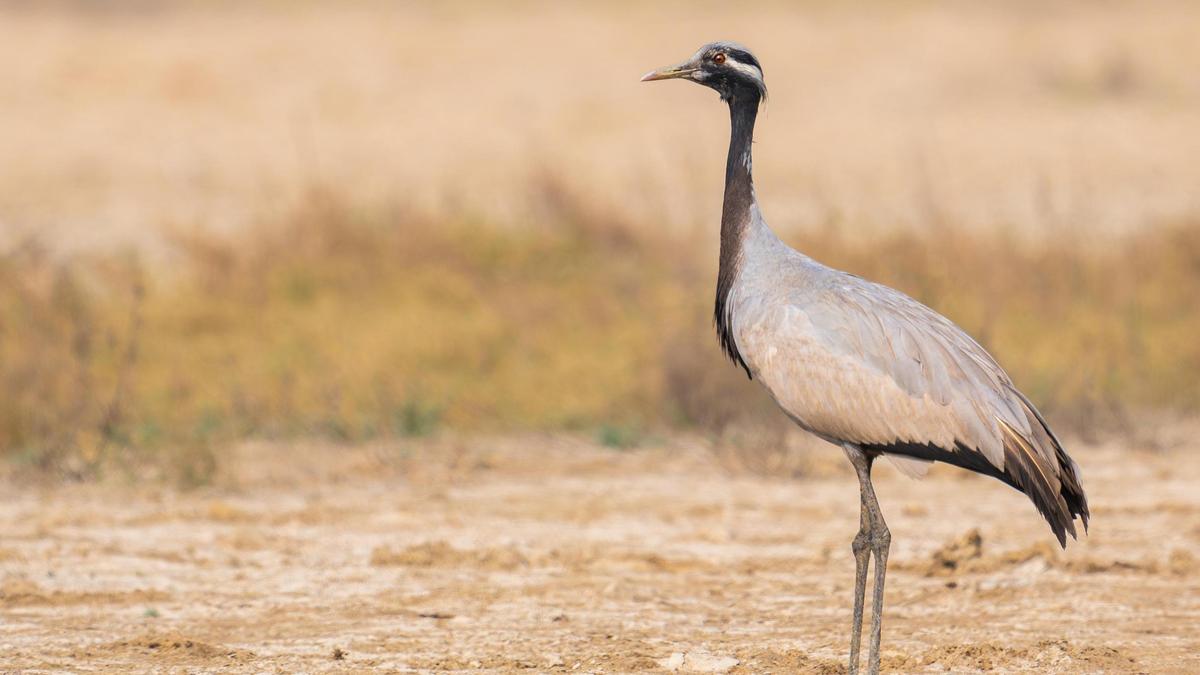
A vagrant Demoiselle Crane photographed at Nemmeli salt pans on March 1, 2026 by Naman Bora.
| Photo Credit: Naman Bora
Marie Antoinette’s image has been shaped by words not her own, but consistently put in her mouth through the centuries. Two things she did not say continue to be misattributed to her. One, the suggestion that the poor French peasants could have cakes if they lacked bread. And the other, oddly, has to do with ornithology. She is believed to have given Demoiselle Crane its name impressed by its uber-feminine movements, largely dance-like. Anyone in India faintly familiar with the French language having taken it up to bump up the aggregate in their higher secondary board exams, as this writer did decades ago, would realise Demoiselle is from French and a variant of Mademoiselle, denoting a young lady. Back to Marie and her putative bird-christening abilities, this bird was given that name for its ultra-feminine demeanour but not by her. Here is why.
The infamous French queen was born in 1755, and an account of why the bird goes under the name Demoiselle Crane is found, with an illustration, in George Edwards’s A Natural History of Uncommon Birds, its various volumes written between 1743 and 1751. Even if the account about the Demoiselle Crane spilt out of the quilt-pen in 1751, it is a good four years before Marie arrived. The book is in the public domain, accessible at Biodiversity Heritage library (biodiversitylibrary.org).
The truth in fact runs deeper, the bird’s name and its significance preceding the writing of the book.
Why harp on Marie Antoinette and the Demoiselle Crane now? Here is answering this question nagging the reader. On the evening of February 28, 2026, two youngsters from Chennai were treated to a ballet performance by the “mademoiselle” at the Nemmeli salt pans. Naman Bora, a sophomore-student at VIT on Kelambakkam-Vandalur High Road and Amoghh Chatty, a Class X student of PSBB Millennium at Semmancherry, both members of Madras Naturalists Society (MNS) sighted and photographed a lone vagrant Demoiselle Crane (Grus virgo) while it was feeding among the reeds and while it was in flight.
The record of the sighting is up on eBird; and it is the first documented sighting of the bird in Chennai.
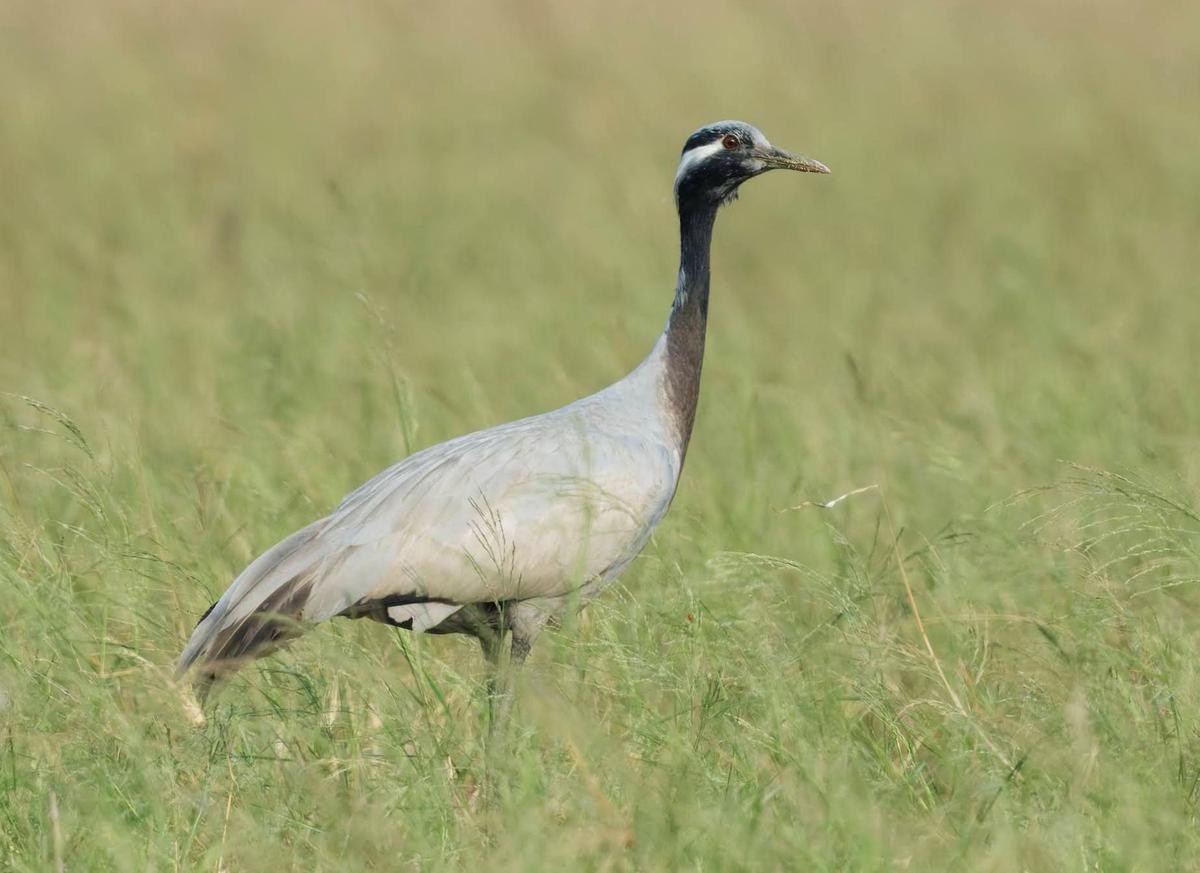
A vagrant Demoiselle Crane photographed in the reeds at the Nemmeli salt pans by Amoggh Chatty on February 28, 2026.
| Photo Credit:
Amoggh Chatty
Gnanaskandan Kesavabharathi, a senior reviewer at eBird, confirms it and places this individual bird in its life stage based on its features: “It is a sub-adult bird considering the white near throat and forehead, short white ear tufts and the brownish orange iris versus a reddish iris in full adults.”
That this bird is a lone vagrant and no “relative” was keeping lockstep with its peregrinations into uncharted territory was confirmed the following morning. Naman observes that on Sunday morning (March 1) he went with wildlife photographer Sudharshan Kuselan to the Nemmeli salt pans and the duo found the Demoiselle Crane around the same spot. Naman displayed greater tenacity, returning to the spot for another two days (March 2 and 3) and found the bird matching his tenacity. Naman observes that the bird was tenaciously clinging on to its feeding spot in the reeds, being found within 100 metres of the spot it was first seen at. “After roosting, it would return to this feeding spot,” Naman adds.
During winter, the Demoiselle Crane travels from Eurosiberia to certain parts of North India; and their sightings in much of South India, particularly Tamil Nadu, are a result of vagrancy. Gnanaskandan notes two earlier records of Demoiselle Crane sighting for Tamil Nadu exist. Both have come from Vijaynarayanam Tank in Tirunelveli: two birds sighted in 2006, and one in 2007.
Weighing in on this sighting at Nemmeli, ornithologist V. Shantaram places it in perspective: “A majority of Demoiselle Crane sightings are from western India, specifically Gujarat and Rajasthan. At Khichan Village in Rajasthan, sighting a flock of 4,000-5,000 Demoiselle Cranes is not uncommon. Those are the places they normally visit, but they do move around. These birds are great wanderers. I mean they come from Central Asia and fly down to Gujarat and for them to come down south is not a big thing, but they do not have to unless there is a drought or there is some other reason for their movement. It could be one of those reasons, or just that some of the birds are more adventurous. There are a lot of possibilities; they probably come in here regularly in small numbers (during winter) and we have missed them out.”
On the Demoiselle Crane’s forays into the south, Shantaram points out there are “records near Bangalore and around Mysore; in Tirunelveli; and “in northern Karnataka, it seems to be fairly regular”.
On habitats the Demoiselle Crane is drawn to, Shantaram says: “They are found near waterbodies, but they feed in the fields where different kinds of crops are grown. They also feed in the open areas around tank shores that are drier.”
Published – March 04, 2026 01:29 pm IST
