



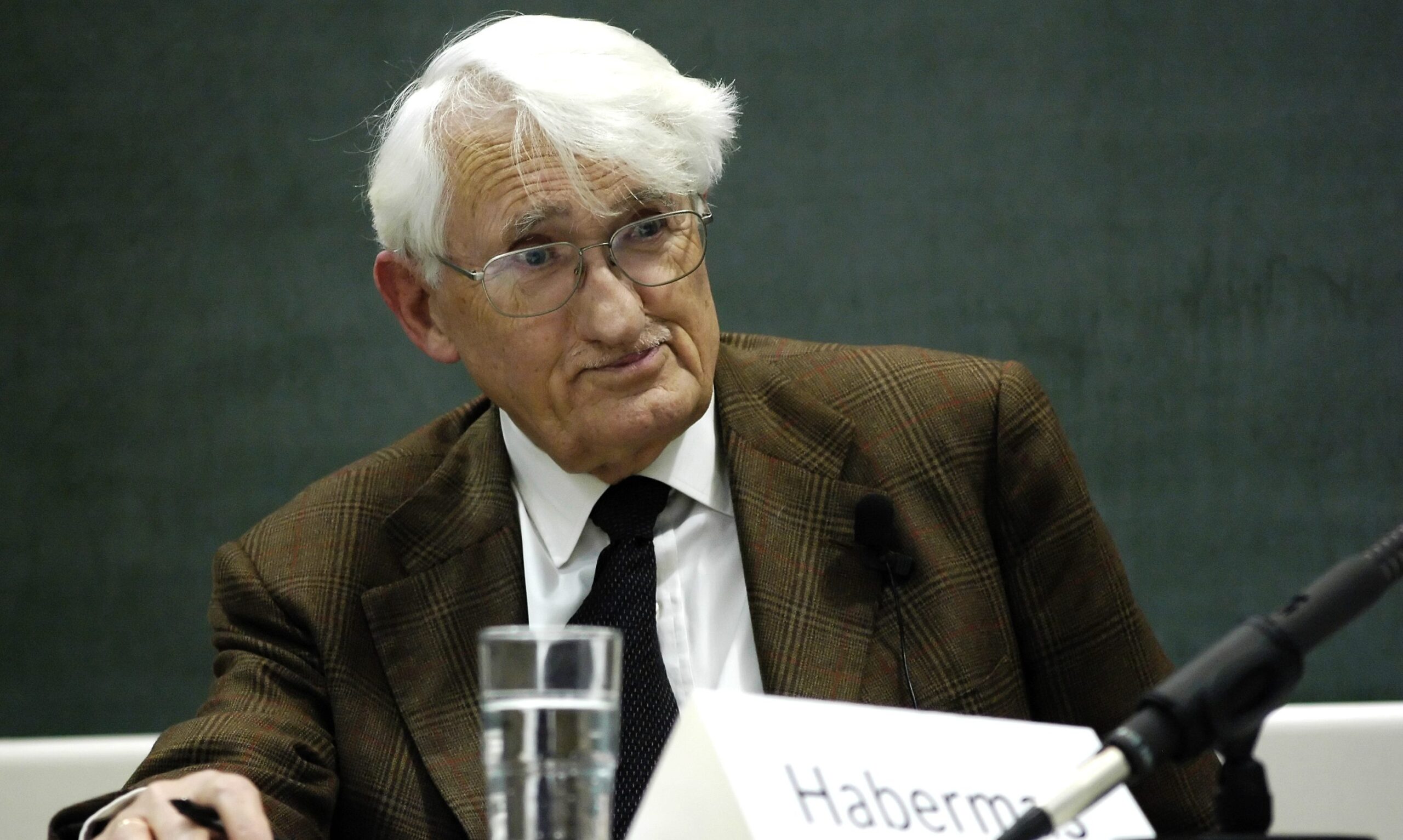
Jürgen Habermas, one of the most celebrated and influential thinkers and social theorists of our time, died on March 14 in the town of Starnberg, near Munich in Germany. As Stefan Dege and Stuart Braun wrote, Habermas, Germany’s greatest post-war intellectual, who till recently used to come out with political positions with critical rigour, stood firmly for a creative and deliberative democracy. Some of his recent significant pronouncements include the right to asylum during the contemporary refugee crises, his arguments in favour of a unified European Union against the surge of right-wing populism and nationalism, and his deeply cherished ideal of democratic cosmopolitanism.
As the second-generation representative of the Frankfurt School of Sociology and Philosophy, Habermas spotted and refashioned with a renewed vigour philosophical themes like rationality-communicative rationality, decentred knowledge, emancipation and emancipatory interest, legitimation crisis, critical religiosity, public sphere, critical modernity, moral consciousness and communicative action, post-metaphysical thinking, post-national constellation, discourse theory of law and democracy, otherness and inclusion, and social dialogue as discourse ethics.

Habermas was born in Düsseldorf, Germany, in 1929. He was 15 when Germany lost the war to the Allies in 1945. As Martin Matuštík wrote, Habermas had served in the Hitler Youth and had been sent to defend the western front during the final months of the war. The Nuremberg trials and the release of documentary films depicting the activities in the concentration camps proved to be tough moments of self-critical realisation, a breaking point for discernment and political awakening for Habermas. “All at once we saw that we had been living in a politically criminal system,” he said.
This horrific realisation was to have a lasting impact on his philosophy, a vigilance against the repetition of such politically criminal behaviour. All of Habermas’s later theoretical efforts are moulded by this strong feeling of how to be aware of and check a system of action and thought that hegemonises and controls through irrational means. Many contemporary thinkers who sympathise with Habermas have pointed out that such a feeling could be the core and the gist of Habermas’s theoretical project.
The contemporary denials of that feeling make Habermas uneasy as a thinker and human being, as explained by Richard Bernstein, “When you begin flirting with irrationalism and nihilism, for him, it evokes horrible memories. It evokes the Hitler period.” As Habermas himself says, there is a strong personal element in his thought. “Philosophers live finally from their own intuitions,” he suggests. “And those intuitions are not acquired by reading philosophical texts. They are acquired in certain particular individual experiences while growing up — rather negative experiences of violation, indignation and Kränkung” (the German word that means “insult”, “outrage” or “mortification”). Inspired and motivated by the same reason, as Douglas Kellner observes, Habermas’s steadfastness in rediscovering again and again the critical content in his own tradition leads him to declare that “there are obdurate orthodoxies in the West as well as in the Middle and Far(ther) East, and among Christians and Jews as well as Muslims. Those who wish to avoid a ‘clash of civilisations’ must therefore keep in mind the still-unresolved dialectic inherent in our own Western process of secularisation”.
Habermas led an active life as a world-renowned thinker, motivated with a never-ending concern for justice, democracy and human rights. He made creative interventions in issues like German reunification, the Gulf War, the European Union, the debate over the need for a constitution for the EU, and the September 11 attacks and the discourse on terrorism. As an engaging interlocutor, Habermas made the claim to renew and refresh socio-political life as more “democratisingly” emancipatory through the reconstruction of the intersubjective and dialogical source of human engagements.
He tried to show that the tendencies in social theories to reduce the dynamics of social development to labour and technological innovation alone are severely incomplete. The dimension of communicative interaction plays an equally or more decisive role. Further, he cautioned us that interaction (communicative) presupposes language as the medium of intersubjective agreement. Habermas aimed at a critical reconciliation of hermeneutics and positivism here (for Anthony Giddens, one of the most important contributions of Habermas to Philosophy) to situate the ambiguous locale of modernity as between philosophy of consciousness and philosophy of communication or inter-subjective communication.
However, the 21st century, particularly, along with postmodernism and other deconstructive endeavours, makes Habermas’s theoretical pronouncements a bit unpopular. As Blake Smith wrote in, Why Jürgen Habermas Disappeared?, “The German philosopher was one of the 20th century’s most influential public intellectuals. But the 21st century has cut him adrift…Since the 1960s, his scholarship has set research agendas in philosophy, sociology, and history, while his newspaper articles and interviews have steered public debates on topics from the memory of the Holocaust to the Iraq War. He may also be the foremost intellectual of Europe, advocating for the continent’s economic and political integration…Political developments against which he has struggled for decades, from populist nationalism to the erosion of the welfare state, seem more intractable than ever, while problems on which his political theory has little purchase, such as the growing influence within Europe of an illiberal and undemocratic China, appear ever more pressing”. Similarly, Habermas’s concepts of Universal Human Rights, discourse-communicative ethics, communicative rationality and its conceptual tools and deliberative democracy were sharply criticised. They were criticised for their Eurocentrism, provincialisation, and “Kantian” or rigorous formalism.
Nevertheless, as the continuing debates show, Habermas’s insights into otherness, community and the critique of liberal democracy and its idea of rights and community throw new light on the problem of “identity-citizenship-rights”. Such a stance has to postulate the prospects of unfinished potentials of modernity/enlightenment and Habermas’s ideas of critical modernity. We have to pause a moment here to read more of Habermas’s theory which tells us about post-national identity as inspired by his notion of discursive democracy and the concept of Rechtsstaat (rule of law), which brings in ideas like constitutional patriotism and democratic identity. As is pointed out, this moment churns out both an intracultural and intercultural dialogue, as a new philosophical attitude seeking the most needed principles of just and harmonious coexistence.
Habermas’s philosophy inspires us chiefly with an ethical counterclaim to some versions of the postmodern theories and their ultra-relativism. While the postmodern objections against the intersubjective, social philosophy of Habermas argue that the dynamics of his critical theory are West-centric, the intersubjective discourse philosophy and ethics of Habermas find a universalisable critical core, in congruence with the optimisable Enlightenment values in every culture, to be redeemed/reconstructed. In simple terms, we cannot but explore the question of how the reconstruction of enlightenment values of modernity, simultaneously presupposing a critical space for all cultures to critically validate their values and engage in dialogue, is relevant as we are faced with the questions for an emancipatory knowledge-ethical-political form of coexistence, supported by the most organic, deliberative democracies.
Similarly, the void Habermas’s absence may create (of course, there are third- and fourth-generation critical theorists of divergent theoretic positions) must lead to deeper intents and efforts to counteract the contemporary social pathologies and assume that the systematic branching off of Habermas’s intersubjective philosophy as a full-fledged critical theory has to intervene and partake in any debate and stance of critical theory on the key insight of a de-centring, self-reflective critique, sternly based on democratic social dialogue.
Even when we go by the view that Habermas’s concept of depth hermeneutics takes us to a significant inconclusiveness, it does not foreclose a distinct thinking possibility of understanding as the inconclusiveness in Habermas is theoretical open-endedness, which accommodates the idea of critical modernity as an implied constituent notion, particularly when we put the ideal of critical modernity side by side with the most urgent contemporary issues related to concepts like cosmopolitanism, human rights, post-national global democracy and just global order, global-planetary environmental philosophy/eco-sophy/ethics, which assume a unique space of addressing both modernity, postmodernity alike and look forward to a conceptual landscape beyond both.
Adieu Habermas.
The writer is associate professor, Department of Philosophy, Assam University, Silchar

