



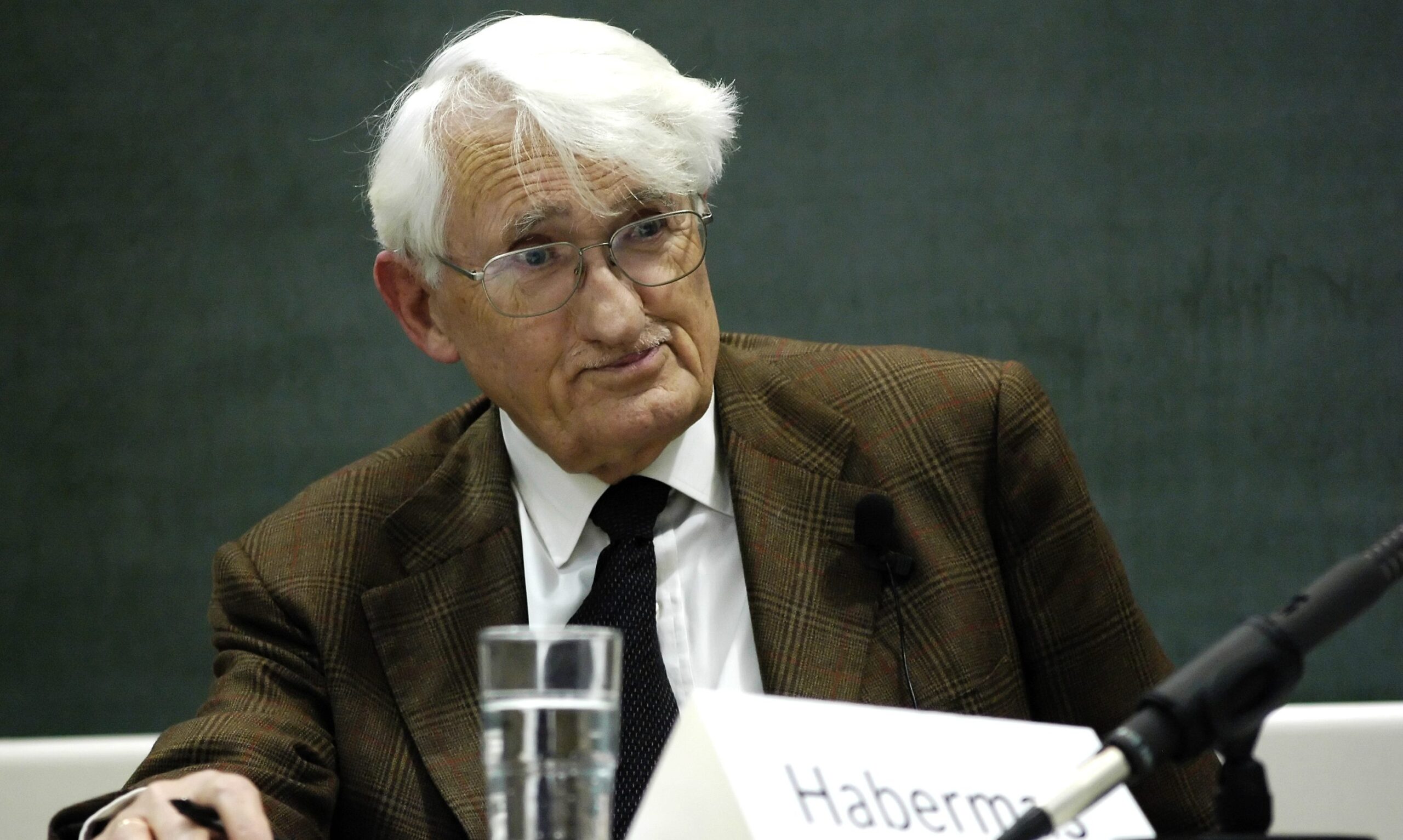
The death of Jürgen Habermas marks the end of an extraordinary intellectual life stretching across nearly a century and profoundly shaping modern social and political thought. Very few philosophers have so fully constructed and studied philosophy, sociology, political theory, and public life.
A sociologically inclined academic theorist, Habermas believed philosophy must always stay engaged with the moral and political emergencies of his time. At times, his writings can be seen as a defence of the possibility of rational argument and deliberation in an age that appears to be shaken by endless ideological fundamentalism, technocratic repression, and democratic decline.

Habermas was born in the rubble of Nazi Germany and its post-war moral reckoning. Like many of his generation’s intellectuals, he grappled with the harrowing question of how a modern, culturally advanced civilisation could slide into barbarism; those questions haunted and intellectually challenged him for decades. This concern also placed him in intellectual proximity to the critical theorists of the Frankfurt School, who were already shaping European philosophy with their reflections on Enlightenment reason gone wrong. Yet, Habermas did not simply inherit their reflective despair. Instead, he embarked on an ambitious project to rebuild the emancipatory promise of reason.
In The Structural Transformation of the Public Sphere (1962), Habermas traced the historical emergence of social spaces in which citizens could freely discuss issues that concerned them, uncoerced by the state. They were arenas of rational-critical debate, where public opinion was formed and transformed, as much in coffeehouses, salons, and the early press. But Habermas finally recognised the inequalities that shaped these historical spaces. Still, his essential point remained: Democracy needs not just institutional frameworks but also communicative processes that enable free citizen debate.
Deliberation was democracy’s lifeblood. For him, the life of democracy depended on the vigour with which we engage in public reasoning. Political legitimacy could, at best, be created by connecting citizens to permanent, open, and rational discourse — not through the means of power applied or administrative authority.
In the decades that ensued, Habermas’s intellectual ambitions expanded dramatically. His magisterial two-volume study, The Theory of Communicative Action (1981), sought to synthesise a comprehensive social theory capable of explaining, on the one hand, different modes of social integration and, on the other, crises of modern societies. Central to this project was a deep insight: Human actors are not just strategic agents with self-interest at heart but social beings who seek mutual understanding through language gradually learnt and negotiated.
Everyday communication, Habermas argues, has certain implicit norms concerning truthfulness, sincerity, and justification. When people communicate with each other, they assume that claims can be challenged and justified by reasons. This concept of bilateral comprehension is the foundation of social trust. Communicative rationality differs from the standard definition of rationality in that it is a form not defined by calculation or strategic speech, but rather by dialogue and mutual understanding (Habermas, 1984).
Such a diagnosis gives Habermas’s work a critical orientation. He cautioned that contemporary societies face the danger of being governed by unelected technocrats who issue executive orders, and believe that democratic discourse is not required. Unlike some other critical theorists, however, Habermas did not abandon the Enlightenment project. He sought, instead, to redeem it by rooting rationality in communication rather than instrumental control.
One of Habermas’ most impactful contributions to philosophy is discourse ethics, which emerged out of his social theory. Drawing from the strands of philosophy that deal with linguistics and moral theory, he argued that ethical norms can only legitimately bear authority if all participants in a putative discourse rationally agree to them. Consequently, a thorough and logical debate is required to justify its use as the basis for morality. Ethics shifted away from personal conviction or inherent traits.
Habermas argued that democratic legitimacy comes from processes that engage the citizenry in deliberation over laws. It is not enough to say that the law commands because it has authority. Public justification of laws is necessary, allowing all to participate as free and equal debaters. This framework enables him to offer a highly philosophically advanced argument for deliberative democracy.
His work was both collaborative and combative, in conversation with major thinkers of the 20th century. His intellectual back-and-forth with John Rawls would become one of the great exchanges in modern political philosophy. Whereas Rawls located justice in the reflective reasoning of individuals behind a “veil of ignorance,” Habermas insisted that public deliberation among citizens supplies grounded concepts of justice and preference, deeply embedded within already-existing democratic schemes. Nevertheless, both philosophers shared the goal of protecting liberal democracy through logical reasoning.
The critical theorist was also highly wary of the philosophical turn associated with Michel Foucault and other poststructuralist thinkers. But while he praised Foucault’s explorations of power and domination, Habermas worried that dismissing universal norms might risk undermining critique itself and working against the cause of rational progress. When all knowledge amounts to only a mere reflection of power, there’s scant possibility left to speak about justice or emancipation. Habermas unhesitatingly defended the possibility of rational critique grounded in communicative practices.
In his later work, Habermas also addressed the role of religion in modern societies. He argued that secular democracies should be open to moral ideas from faith groups, but at the same time regulate political discourse so it’s accessible to all and uses public language shared across the nation. The idea fit into his broader efforts to reconcile pluralism and democratic legitimacy.
In the European project, and in particular its normative significance internationally, he argued that constitutional values can transcend national paradigms without abolishing political pluralism. Globally, Habermas likewise defended the empowerment of intergovernmental law and institutions — like the EU and the UN — for here, too, legitimacy in global norms must increasingly rest not on a social contract among one-off states but rather on procedures resembling democratic deliberation between states and peoples. Knowing too well the cruel, often darkly ironic nature of power politics, he nevertheless argued that the potential for a more just world lay most in global legal structures and international civil society.
Amid a world of technological disruption, geopolitical competition, and democratic instability, Habermas’s questions are ever-pressing. How do societies maintain healthy public debate over the long term? How can the legitimacy of democratic institutions be found in ever more complex power structures? And how can reason endure in an epoch of post-truth? Habermas struggled with these questions throughout his life. A constant thread throughout his work is his belief that rational communication is among our most effective tools for collective understanding.
We have lost one of that wonderful intellectual landscape’s end voices. But the discussion Habermas launched about democracy, reason, and the ethical dimensions of communication will endure to enliven public discourse, and his legacy will always be an integral component of that living conversation.
The writer teaches at Jadavpur University, Kolkata, and was the Eugenio Lopez Visiting Chair at the Department of International Studies and Political Science at Virginia Military Institute, US

