



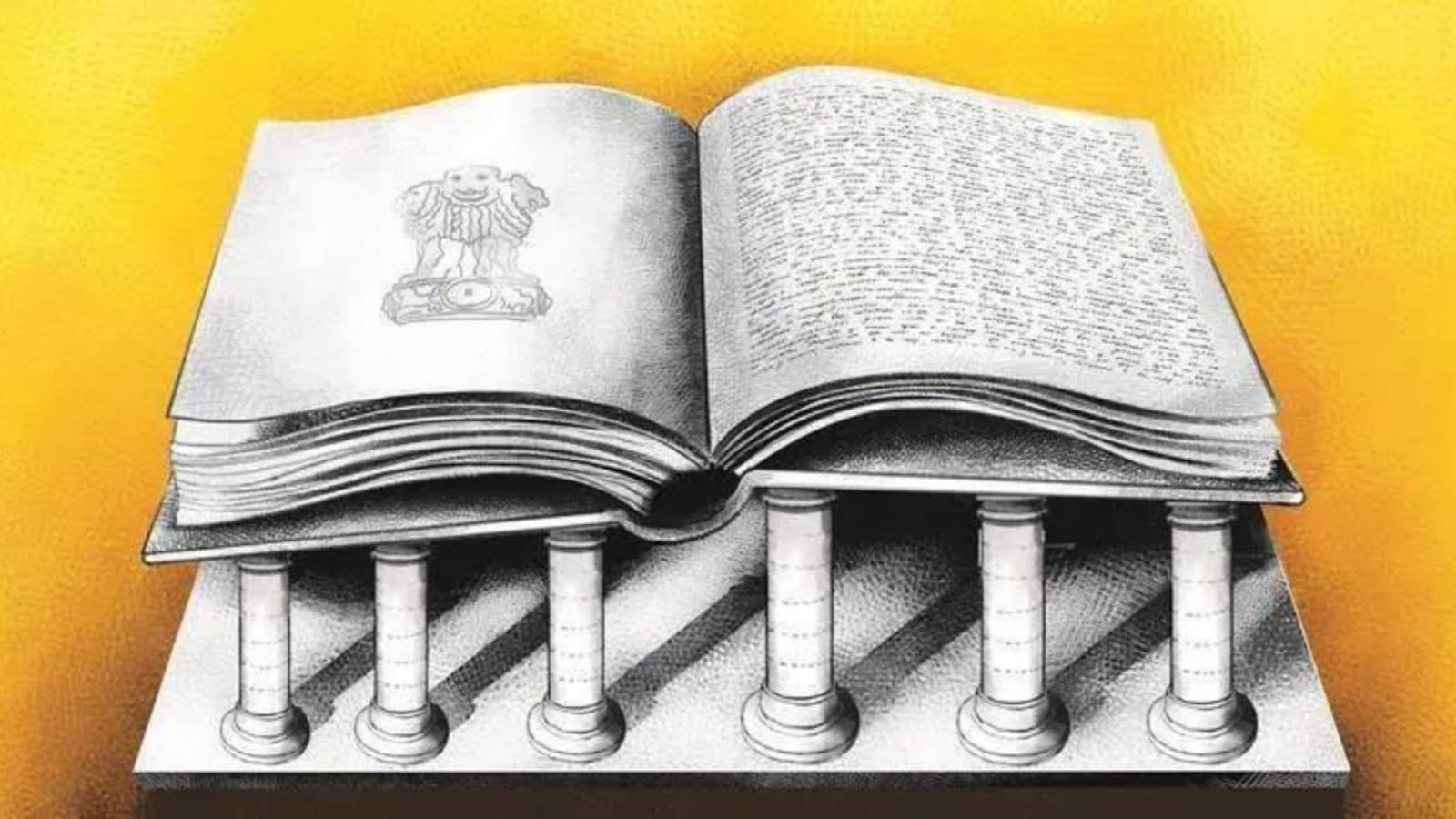
Almost two months ago, we celebrated the 77th anniversary of our republic. Although some interesting ideas were canvassed, the major issues raised by the republic were left unexplored. Why, for example, does India have two days of celebration? What is the difference between independence and republic? Why are the two celebrated so differently? We call ourselves a democratic republic. Why not the republic alone? What does democracy add to it?
Although India is a democracy, this does not fully describe what the authors of its Constitution had in mind. The Congress resolution on the objectives of the Constitution moved by Jawaharlal Nehru in the Constituent Assembly on November 20, 1946, included the word “republic” but not “democracy”. When asked why, he replied that the former “included” the latter. His reply implied that the term republic was wider than and did not mean the same as democracy, but he did not spell out the difference.

After some weeks, when the first draft of the Constitution was introduced, it included the word “democracy” but dropped the word “republic”. Its final draft had both and declared India a “democratic republic”. For its authors, the country was meant to be not just a democracy but also a republic, and it has since the 1950s celebrated Republic Day separately from Independence Day and given it a very different orientation. This raises the question of what they meant by the two terms and why they did not think either was enough. The two terms are also translated by different words with different histories and meanings in vernacular languages. (prajasatta or ganarajya is different from lokshahi).
Many leading Indians from the mid-19th century onwards were fascinated by and had written about the Indian and Western republics from different perspectives. The Republican idea was particularly popular among the spokesmen of the Scheduled Castes. Jyotirao Phule, one of their ablest and earliest spokesmen, had read and was influenced by the works of the Western republican writers including Rights of Man by Thomas Paine. He praised the republican spirit of equality, love of liberty, and commitment to public well-being. He attributed the success of post-Renaissance Europe to the rise of the republics, and the decline of India to the overthrow of the Buddhist republics by the Brahmanic monarchies. Ambedkar took a broadly similar view and was particularly interested in the French and American republics. He studied the latter closely during his years at Columbia University, wrote and lectured on the subject, and made a powerful case for making India a republic. He admired the French Revolution of 1789 and its “republican” and egalitarian spirit. His Independent Labour Party (founded in 1936) was later called the Republican Party of India. Although this happened after his death, he had already set the wheels in motion.
Several mainstream liberal and socialist leaders, too, were great admirers of the republican form of government. Jawaharlal Nehru wrote about the modern European republics in his Glimpses of World History, praising their great virtues such as civic courage, public spirit, egalitarian ethos, and love of freedom, and came close to equating republicanism with socialism. J P Narayan, Lohia, Narendra Dev, M N Roy, and others shared his view.
Although these and other advocates of the republic drew their inspiration from different sources and stressed its different features, they shared a broad consensus on what it meant and why it was important. For them, it overlapped with but was not the same as democracy and referred to a political and social order characterised by four important features. These were social and economic equality, the state as a public institution, an active and public-spirited citizenship, and separation of powers.
First, the republic was based on and energised by the principle of equality. Its citizens enjoyed equal dignity, respect, status, and opportunity; had no masters or superior class above them; and were the ultimate source of all political authority. Ambedkar defined republicanism in terms of extensive social and economic equality and even equated it with some form of socialism that was needed to create and sustain that equality. Following Machiavelli, Rousseau, Tocqueville, and other republican writers, he, Nehru, and others thought that the republican ethos of equality required that economic divisions in society should be considerably narrowed and the extremes at both ends abolished.
Second, the republic stood for the idea that the state was a “public” institution. As the drafting committee of which Ambedkar was the chairman put it, “Republic means res publica, literally public property”. The state was not the private property of its rulers but belonged to all its citizens. It subjected power to institutional constraints, dealt with matters of common concern, its affairs were conducted publicly and in a participatory spirit, and it aimed at the common good rather than the interest of a particular group including the majority.
Active public-spirited citizenship and the virtues associated with it were the third defining feature of the Republic. Its citizens regarded the state as theirs, identified with it, took ownership of it, made sacrifices for it and exhibited such qualities as a love of liberty, a sense of social justice, and patriotism. They saw themselves not as members of particular religious, regional, or ethnic communities but as citizens or public persons sharing a common identity and committed to the well-being of their community. In a democracy, citizens might use their political influence and power to promote their own or their group’s narrow interests. Such an attitude undermines the very spirit of the Republic.
The separation of powers and the related idea of checks and balances was the fourth constitutive feature of the republic, stressed by some but not all Indian republicans. In a monarchy, political power was centralised and not subject to constitutional constraints. Even in a democracy, the elected legislature could wield supreme power and treat the unelected judiciary as a subordinate organ of government. By contrast, a republic had the system of checks and balances built into its very structure.
Both Nehru and Ambedkar approvingly referred to Montesquieu’s doctrine of the separation of powers and laid particular stress on the independence of the judiciary — the only reliable guardian of the liberties of individuals. Article 50 of the Constitution explicitly enjoins the State to “take steps to separate the judiciary from the executive”. Historically, the idea of the Republic has been closely associated with those of revolution and new beginning. The language of the French Revolution, especially the Trinity of Liberty, Equality, and Fraternity, was the guiding principle of a republic. For the authors of the Indian Constitution, a republic was acceptable only if it was built on a democratic foundation and guaranteed adult universal franchise. This is why they wanted India to be a democratic republic and frequently invoked the French Revolution, as the first in history to marry democracy and republic.
Under the Constitution, India has a dual political identity: It is both a democracy and a republic, a democracy with a republican orientation and ethos, and a republic resting on a democratic foundation. Democracy defines its form of government; republic the guiding principles of its political and social order. Its democratic identity is evident in its electoral provisions, the chapter on fundamental rights, and so on; and the republican identity in the preamble, the emphasis on social equality and affirmative action, and the directive principles of state policy that are not merely aspirational but intended to guide governance.
To call India a democracy is to utter a half-truth; it largely stresses the elections and the basic individual rights, and obscures the country’s commitment to such goals as social and economic equality, fraternity, and integrity of the public realm that its republican identity connotes. It is both puzzling and unfortunate that the idea of the republic and all it stands for has virtually dropped out of view in independent India, and almost the entire political sphere is dominated by the discourse of democracy. Judged as a democracy, India’s score is high: As a republic it is woefully deficient. A judicious integration of the two is vital to form a balanced judgement on India. The qualities and commitments of the citizens of India also raise a few questions. Few of them display the republican virtues mentioned earlier, and obviously a democratic mansion cannot be built on such poorly prepared bricks.
The writer is political philosopher, academic, and author
