




The rupee hitting record lows has drawn renewed attention. From about 45.9 per US dollar in January 2010 to 95.04 in March 2026, it has depreciated at an average annual rate of roughly 4.6 per cent over the past 16 years. India runs a persistent goods trade deficit, relies heavily on imported energy, and depends on capital inflows to finance this gap. Over time, these structural features tend to get reflected in the exchange rate. It is a pattern seen across most economies with sustained trade deficits.

While the drivers of a currency’s movement are well understood, the manner in which this adjustment takes place warrants closer attention. In many economies, such adjustments tend to be more visible. In countries like Brazil or South Africa, periods of currency pressure have typically been accompanied by tighter monetary policy, with interest rates raised to stabilise the currency, often at the cost of domestic demand. In contrast, there are cases, particularly in parts of East Asia, where sustained export growth has helped reduce external imbalances over time, limiting the need for repeated currency adjustment.
India’s experience over the past few years has been somewhat different. The rupee has been allowed to adjust, but in a gradual manner. The central bank has intervened to contain volatility, without targeting any specific exchange rate level.
However, what this also makes clear is that the scale of external pressure on the rupee is simply too large to be offset through intervention alone. Since 2022, there have been several phases where the central bank has been a net seller of dollars in the foreign exchange market. Yet, over the same period, the rupee has continued to weaken (see chart below).
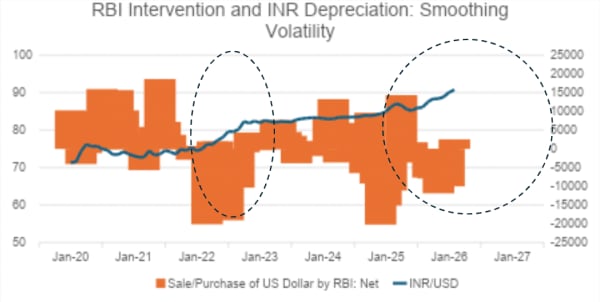 RBI internation and INR depreciation
The coexistence of sustained dollar sales and a depreciating exchange rate is telling. It underscores a basic constraint: Intervention can smooth volatility and influence the pace of adjustment, but it cannot offset persistent and large external imbalances. When pressures are continuous, the exchange rate absorbs them.
The role of sustained external pressures is not difficult to identify. Movements in the rupee track the combined behaviour of oil prices and capital flows (see chart below). For instance, the sharp increase in Brent crude from around $70 per barrel in early 2021 to over $116 by mid-2022 translated into a significantly higher import bill, widening the current account deficit.
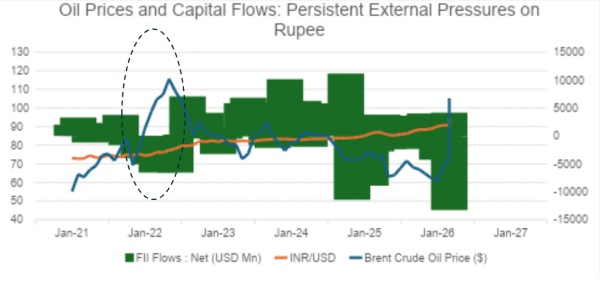 Oil prices and capital flows.
At the same time, FII flows turned volatile, with visible episodes of net outflows. The rupee began weakening during this period and has continued to depreciate since, even as these variables have fluctuated. This is visible even in the recent period, with tensions in West Asia leading to a sharp rise in oil prices.
Read together, the charts point to a consistent story. The pressure on the rupee has not been episodic or driven by isolated shocks; it has been persistent and multi-sided. On one side, elevated oil prices have structurally increased India’s external financing requirement. On the other side, the volatility of capital flows has made that requirement harder to meet on stable terms. In such a setting, the exchange rate inevitably becomes the primary margin of adjustment.
In India’s case, rather than adjustment occurring through shifts in trade competitiveness or production structures, a significant share of the burden is being carried by the exchange rate. This supports near-term stability but leaves the underlying sources of external imbalance largely unchanged. India’s merchandise trade deficit has widened sharply to $27.1 billion in February 2026, nearly double the $14.4 billion recorded in February 2025. Capital flows remain volatile, with net FDI turning negative in recent months due to high repatriation, while portfolio (FPI) outflows have dominated.
Energy dependence also remains elevated, with crude oil import reliance at 88.6 per cent from April 2025 to January 2026. Export concentration persists, with a limited set of products such as refined petroleum, pharmaceuticals, gems and jewellery, and electronics, and a narrow set of markets led by the US, accounting for a large share of exports.
The more relevant question, therefore, is whether the economy should continue to depend so heavily on it as the balancing variable. A more durable adjustment would come from gradual but sustained structural changes in the underlying structure of the economy. This would include boosting manufacturing, greater export diversification, a rebalancing of capital inflows toward more stable FDI, and a reduction in energy dependence through domestic production, renewables, and efficiency improvements.
These are slow-moving processes, but they determine whether adjustment takes place through structural change or through relative prices. In a world where external conditions are likely to remain volatile, durable adjustment will have to come from within. The absence of structural change simply ensures that it is the rupee that will have to continue to bear the weight.
The writer is Research Associate at Centre for Social and Economic Progress, New Delhi. Views are personal

