



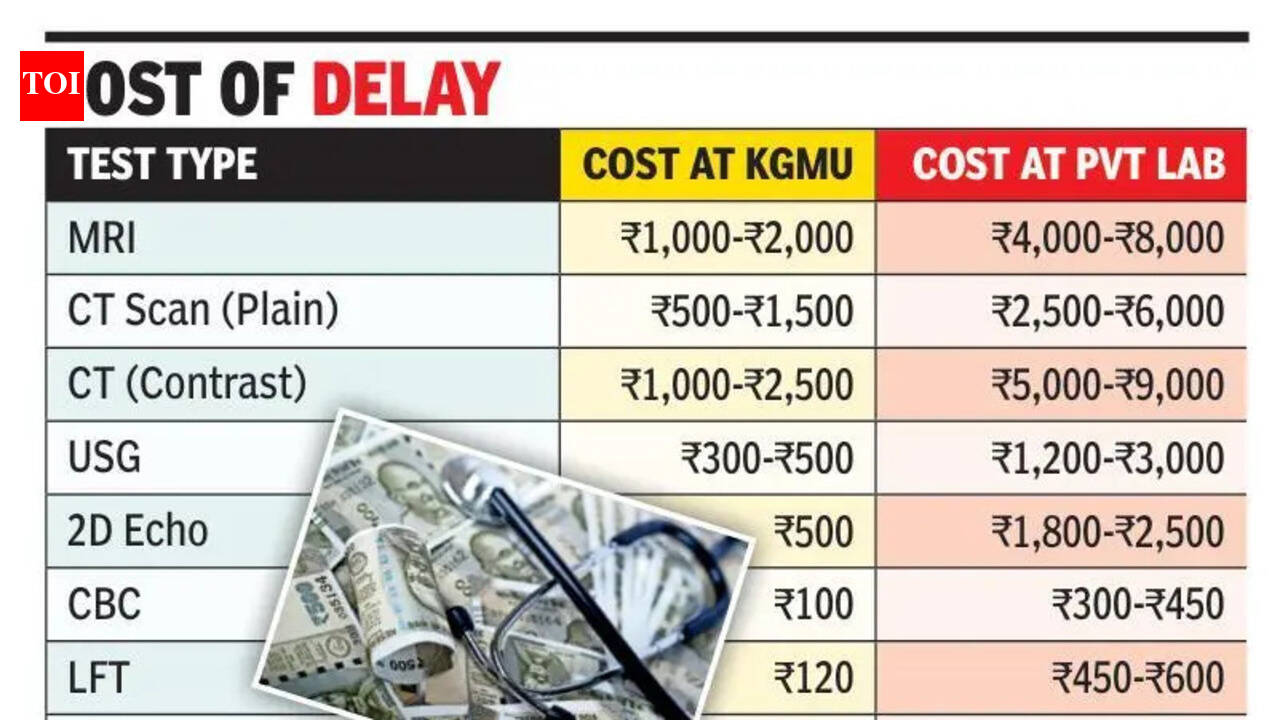
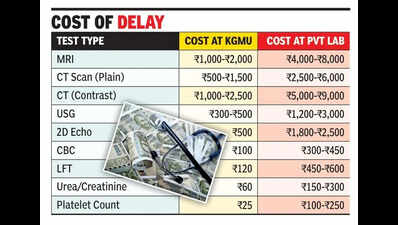
Lucknow: When 36-year-old Versha Singh, who is pregnant, was advised to have an urgent ultrasound at KGMU, her family expected the test to be done quickly. Doctors marked her case as urgent, but she was given Mar 14 as the date. With no other way, the family got the scan done at a private centre to avoid delay, paying 3 times higher than KGMU.Several other patients reported similar experiences, saying waiting periods ranging from 1 week to 2 months forced them to turn to private diagnostic centres and pay several times more. Patients and doctors said these long waiting periods were mainly faced by OPD patients, as admitted and emergency cases were usually prioritised. KGMU receives up to 11,000 OPD patients daily, and submitting blood samples alone can take about 1 hour, with only 3-4 pathology counters handling large volumes. Rakesh Singh, 43, from Chowk locality, was prescribed a USG whole abdomen but was given Feb 21 as the earliest date. Ali Raza, who also requires a USG whole abdomen, received the same date. Both families said they were considering private laboratories to avoid long waits. Raj Kumar, 55, with suspected heart disease, was advised a 2D echo but received a date more than 1 month later. His relatives said the delay pushed them towards private diagnostic centres. Patients said reports often take several days, and many imaging tests are scheduled weeks later because of limited machines and staff. Estimates suggest only about 15 to 20% of prescribed diagnostic tests are completed within the hospital. Diagnostic tests at KGMU remain far cheaper than in private laboratories, but delays are pushing many patients to spend more for faster results. An MRI costing about Rs 1,000 to 2,000 at KGMU may cost Rs 4,000 to 8,000 in private centres while a CT scan priced at Rs 500 to 1,500 can cost Rs 2,500 to 6,000 outside. An ultrasound costing Rs 300 to 500 at KGMU may cost Rs 1,200 to 3,000 privately, and basic blood tests such as CBC, LFT, or platelet count are often 2 to 4 times higher. KGMU officials said steps were taken to reduce waiting times, including extending testing hours, repairing and adding machines, and increasing ultrasound machines for OPD patients from 2 to 6. Spokesperson Prof KK Singh said urgent cases were being prioritised and registration and payment processes were being streamlined. “We are expanding the diagnostic services to reduce waiting time,” he said.

