



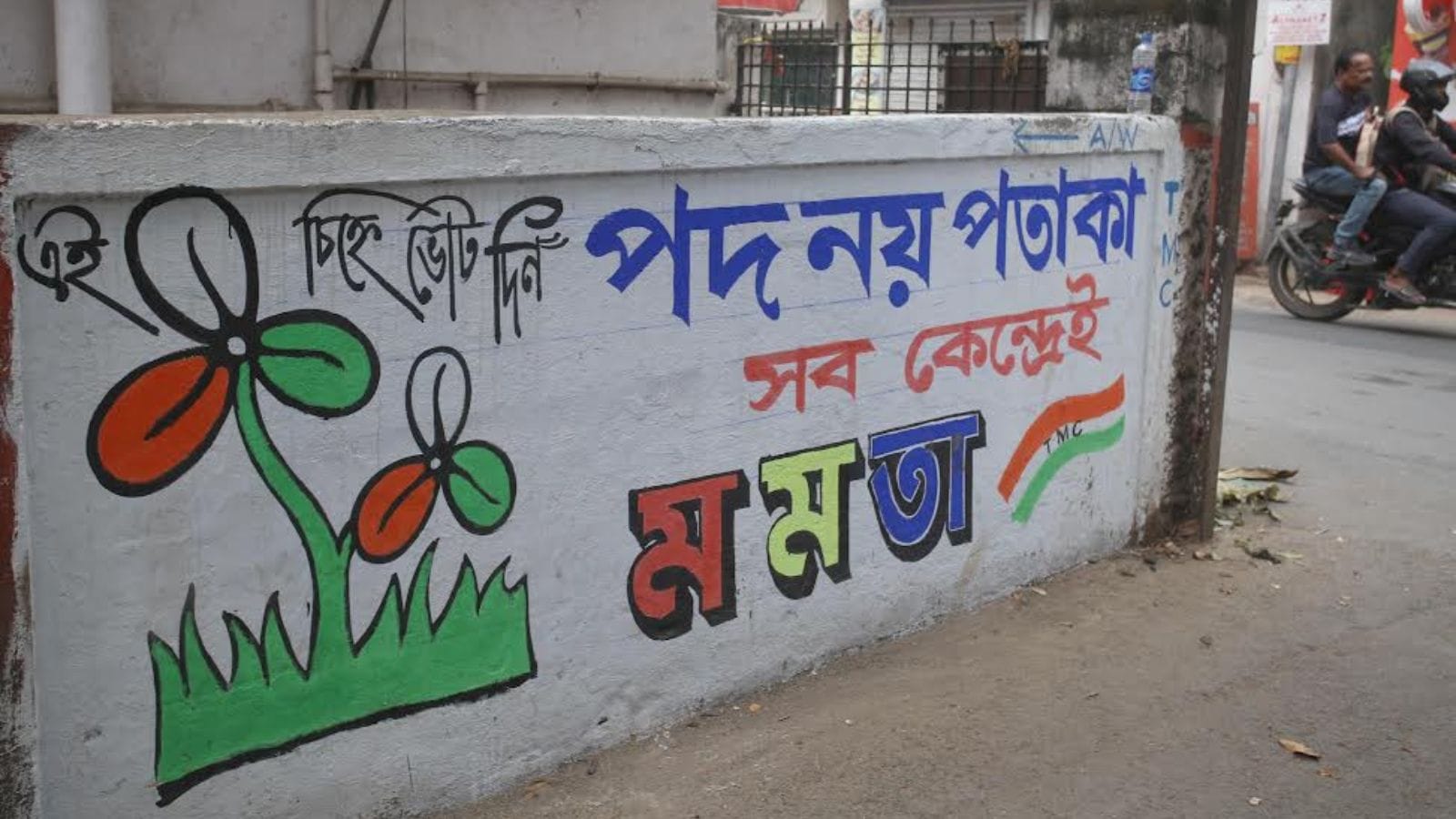
In the 2026 West Bengal assembly elections, the BJP and the TMC, the state’s two main contesting political parties, are investing heavily in media campaigns. However, their core campaign messages could not be more different. The BJP asserts the moral high ground, accusing the TMC of ethical failures. Meanwhile, the TMC portrays the BJP as the bullying invader.

Both their 2026 election campaigns provide a revealing insight into the changing dynamics of political messaging and media segmentation. The BJP and TMC are not merely competing for the same pool of voters; they are engaging with two distinct political mindsets, employing divergent messaging strategies to identify and profile their target voters, and advancing contrasting visions of Bengal’s future.
This distinction is crucial. Elections are not won solely by the loudest voices or the most visible campaigns, but by those who can accurately identify their audience, frame issues in ways that resonate, and align their messaging with the underlying perceptions and priorities of their voters.
The BJP’s current campaign approach is clearly confrontational. Its frequent use of “chargesheet” language and “cut-money” accusations seeks to stir moral outrage among voters, not just partisan support. This exemplifies a typical negative campaign technique: Reducing complex governance issues to a simple emotional spark and repeating it until it appears as common sense. Its strategy in West Bengal also seems more unified than before, utilising data-driven booth targeting, an earlier candidate rollout, and a conscious effort to tone down some rhetoric where needed. It shows that the BJP has learned, through hard experience, that West Bengal cannot be secured by rhetoric and religion alone.
However, the BJP’s campaign has a clear weakness in its messaging. It spends too much time criticising its opponent and too little time explaining what it would positively bring to the table for the people of the state. In political communication, anger can open the door, but it rarely keeps it so for long unless it is followed by hope. At present, the BJP’s messaging in Bengal often resembles a prosecution brief in a magisterial court. It is effective at making accusations but weaker at inspiring imagination and emotion. It highlights what is possibly broken, but not what the BJP itself would improve, make fairer, calmer, or more efficient.
The choice of media is equally revealing. The BJP’s advertising in some local English newspapers, nearly every other day, especially on the front page, indicates an effort to reach two overlapping yet distinct voter groups quickly and convincingly: Non-Bengali-speaking voters residing in Bengal and the affluent, English-reading Bengali upper- and upper-middle-income classes. In campaign science, this is known as audience segmentation. An advertiser does not just buy media space; they buy social positioning. An English newspaper front-page advertising, alongside vernacular dailies, is not merely about the sure delivery of information but also about signalling focus in terms of economic class, urbanity, and audience management. It also subtly conveys that this is a party aiming at voters who view politics through the lens of status, social belonging, and relative affluence. That may be an advantage within Kolkata’s upper and upper-middle-class milieu. However, it is unlikely to be effective in semi-urban and rural Bengal.
The TMC, by contrast, continues to root itself in the language of belonging. The “Bohiragato” campaign frame is very powerful because it turns the BJP into not just a rival, but a stranger, an invader. That is a deeply psychological positioning, and it has worked repeatedly because it transforms political competition into cultural defence. The TMC’s emphasis on welfare, grassroots presence, and Bengali identity aligns with a long-standing truth of the state’s politics: Many voters may distrust a certain political climate, but they still respond to a party that appears to “know” them. In that sense, the TMC’s campaign is less about spectacle than saturation. It wants to be felt everywhere, especially in the local “para”, in the tea-stalls at every street-corner, in the bazaar, and in the lived experience of protection and patronage of fellow-feeling, community.
In Bengal, politics has always been about more than policy and implementation. It is also about tone, timing, and rhetorical ease. A campaign that can laugh, tease, and needle the opponent subtly often travels farther than one that only lectures. The TMC’s messaging may not always be elegant, but it is rarely bloodless. The BJP’s communication, by comparison, often feels stoic and managerial, and often talks down from a pedestal, failing to generate affection. Mostly, they sound artificial.
Social media tells the same story in sharper form. Both parties, along with their social-media influencers and online messaging, focus on food habits, lifestyle cues, and cultural markers, and are less about policy debate and more about identity sorting. It tries to frame the contest as one between civilisational preferences and political correctness, between “modern” aspiration and “regional” sentiment. That is clever, but it is also risky. When a campaign leans too heavily into lifestyle coding, it can look less like outreach and more like social profiling. In a state as politically literate as Bengal, voters often notice when they are being categorised rather than addressed.
The last-minute induction of big names into the BJP ranks, such as the sports icon Leander Paes, is curious. In political communication, late celebrity or heavyweight induction without past political affiliation is usually a distress signal rather than a sign of confidence. It suggests either a shortage of local credibility or a need to quickly manufacture momentum. Parties do this when they believe the contest is still fluid, and also when internal assessments warn them that the campaign is not organically expanding.
This is where campaign science becomes useful. The most effective campaigns do three things: Define the enemy, offer a credible self-image, and create repeated contact with the voter. The BJP’s campaign in Bengal is strong at the first; the TMC is strong on all three. The BJP’s attack line around corruption and governance can mobilise resentment, to an extent, especially in urban and semi-urban areas. But resentment alone rarely sustains a state-level breakthrough unless it is paired with emotional familiarity and local legitimacy. That is why the BJP’s biggest challenge in Bengal is not messaging volume but relational depth.
The TMC, meanwhile, is not invincible. Its reliance on welfare and identity politics can look defensive if it fails to project administrative seriousness. But in the present campaign, it seems to understand that politics is not just about projecting strength and masculinity, but also about winning hearts. The party that appears to speak the voter’s language, inhabit the voter’s anxieties, and defend the voter’s cultural self-image starts with an enormous advantage.
And, as usual, the Congress, the Marxists, and a couple of specific minority-focused political parties in the state remain in a strange limbo, no longer central enough to define the campaign, but not entirely irrelevant either. Their presence is more atmospheric than decisive: A reminder of earlier political vocabularies, a reservoir of residual sentiment, and in some pockets a possible spoiler function.
Chattopadhyay is a narrative history writer and columnist

