



In 1953, a young lawyer drafted a defamation suit on behalf of a dynamic young politician against a local newspaper that had published a series of articles casting aspersions of financial corruption. The judge decreed that the publisher, Balakrushna Kar, had published these for sensationalism and imposed a fine. The young lawyer went on to become the Attorney General of India in the 1990s, while the young politician Bijoynanda Patnaik, soon to be affectionately called Biju Patnaik or Biju babu, became one of the nuclei around whom the story of modern Indian politics, and more so that of modern Odisha, would be scripted.
He was born on March 5, 1916, to Lakshmi Narayan Patnaik, a graduate of the Madras Christian College who later became a pioneering figure of Odisha’s renaissance, and Ashalata, who came from a revolutionary family of Chittagong, with one nephew being hanged and the other incarcerated for a long time for the famous Chittagong armory raid led by legendary Surya Sen. Biju babu himself emerged as one of the freedom fighters who did not carry his nationalism on his sleeve, but in his heart and in his courageous actions, which included confronting colonial authorities and standing by Indian revolutionaries.

Beaten by the local British Superintendent of Police twice, once for trying to push his way to have a darshan of Gandhi, and once for trying to touch, dreamy-eyed, the wings of the helicopter which had made an emergency landing for refuelling in their town, Biju babu was unstoppable. He wanted to be a leader and a pilot. He became both.
He trained to be an ace pilot in Delhi, and in the initial years of Indian aviation ferried British officers, including the later-day Viceroy Wavell, whom he legendarily threatened in mid-air for insulting him as a “bloody Indian”. Later, he flew Indian revolutionary leaders, including Jayaprakash Narayan, to their hiding places during the Quit India Movement and also distributed pamphlets. Not long after, it was his courage and daredevil mind that made him fly his Dakota aeroplane to Indonesia to bring the leaders of the Indonesian Freedom movement, Mohammad Hatta and Prince Sutan Sjahrir, to India for safety, when the Dutch were out to destroy them and their bases. His wife, Gyan, who was from Rawalpindi, met him in Delhi and partnered with him in this adventure.
He nurtured an absolute desire to see India become a modern industrial nation, and he became a pioneering industrialist when he founded Kalinga Airlines. He helped the Indian army defence forces in the NEFA during the 1962 war and worked closely with Jawaharlal Nehru, who sent him as his emissary to John F. Kennedy to discuss India’s defence and industrial needs. In 1964, he was also invited by the Russian leadership to discuss India’s industrial needs, and he spoke eloquently about how India required modern industrial technology, along with peace, for its development.
Busied soon in the politics of the province, Biju Patnaik, in more senses than one, was one of the spirits behind the growth of India’s steel and mining industries. With a skewed development of capitalism in India during and after the colonial rule, mining-rich areas like Odisha and modern-day Jharkhand or Chhattisgarh, with no local class or capital to take up and develop industrial and mining sectors, became the backyard of the capital from elsewhere. Odisha was fortunate to have in Biju Patnaik not only an entrepreneur with adventure written in all his enterprises but also a leader who could spell out the road to development. Attacked viciously by different business interests, his political persona and indomitable courage provided the emerging middle class and the small class of entrepreneurs in these areas with significant support. He led them by personal example. Biju Babu involved the state to let the benefits of the industry go to the people. The vision saw him start Orissa Textile Mills (OTM). He brought on a young Pratap Singh, scion of the DCM family of Delhi, and cutting-edge technology for OTM’s weaving and spinning sections from Germany and Switzerland, making OTM the first modern textile mill in Odisha that competed in quality with the Bombay Mills.
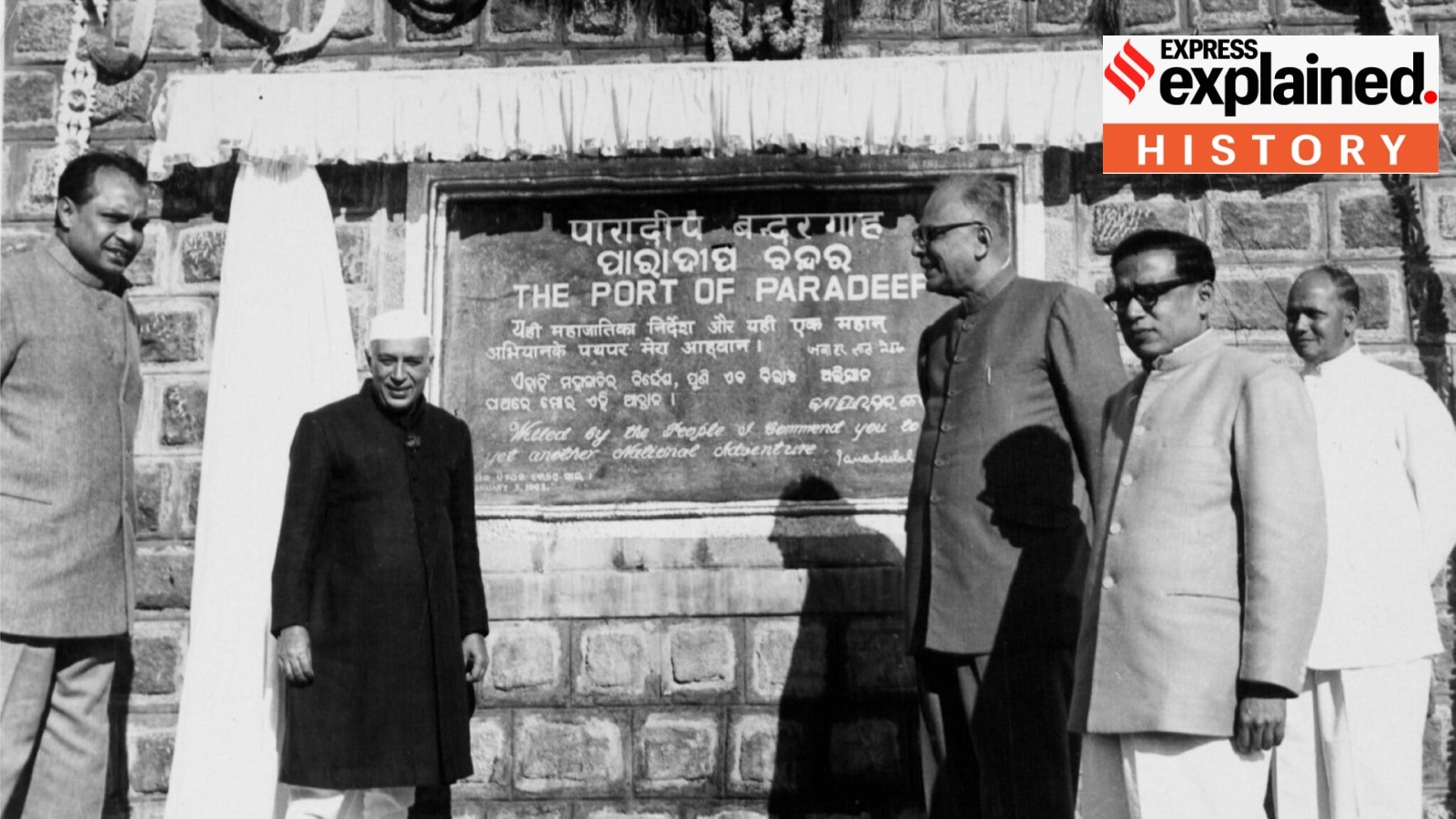
Odisha had abundant coal, bauxite, and iron reserves. Biju Babu wanted coal to be the centre of a modern industry. He got Talcher coal tested by the German Krupp’s group to ascertain whether it could be gasified. The positive results made him determined to develop Talcher as the centre of a futuristic project for energy security. The development of the Paradip port was his second big dream, along with that of starting the second steel plant in the state, for which he fought till his end in the 1990s, including trying to bring the most advanced CAPARO group to invest here. It didn’t fructify.
It was due to his leadership that eastern India and Andhra got the benefit of the mining and steel industries, not being captive to private interests. He was instrumental in getting NALCO started. The process began when he visited Russia in 1978 at the invitation of the Russians regarding the technical modernisation of the already existing aluminium project at BALCO at Korba, which had begun in the ’50s. Biju Babu realised the demand for aluminium in the defence industry was rising fast. While he got the NALCO to Odisha, he also helped Andhra to get its Vizag Steel plant, which many say was at the cost of his lifelong ambition to have a second steel plant in Odisha.
His intuitive understanding of industry made him advocate the idea of captive power plants; he got one for NALCO, and in fact, as the steel and mines minister in the Janata government, helped other projects get it. It was to Biju Babu that the Bhilai plant management turned in 1978-79, when they faced an acute crisis due to the shortage of low-ash coking coal for their blast furnace. Biju Babu allowed them to get the best coking coal from Australia: A departure from the conventional use of the local coal by the Public Sector steel plants, then. It not only fired the blast furnace of the Bhilai steel plant better, but it also opened up the steel industry to source its material globally.
When the Rourkela Steel plant was coming up, and the state and the country still lacked enough engineers, he quietly set up the Regional Engineering College (REC, now NIT Rourkela) using his Chief Ministerial authority long before the formal process took off. In those days, money was scarce, yet a letter to Biju Babu describing a student’s financial hardship would often mean that fees and other expenses were quietly met from his own pocket. Many of the latter-day industrial leaders of the country were beneficiaries of this quietly generous commitment to human capital.
In an era when smaller men and smaller events are inflated into a spectacle, remembering Biju Patnaik is to remember a nationalism that lived in action — a modernising spirit that refused to accept the underdevelopment of a region, and a political courage that doggedly turned adversity into the raw material of a new Odisha. Politics was not merely a career for him but the very pulse of creating a new India, and he had no second thought in selling his coveted Lutyens bungalow to fund his own elections. Those who besmirch his name clearly don’t have a sense of history, nor do they understand commitment to higher ideals. For men of Biju Babu’s rare cast, politics was never an ambition in the narrow sense; it was inseparable from the grand vision of the nation in independent India.
The writer is a historian of Modern India and teaches media studies at JNU

