



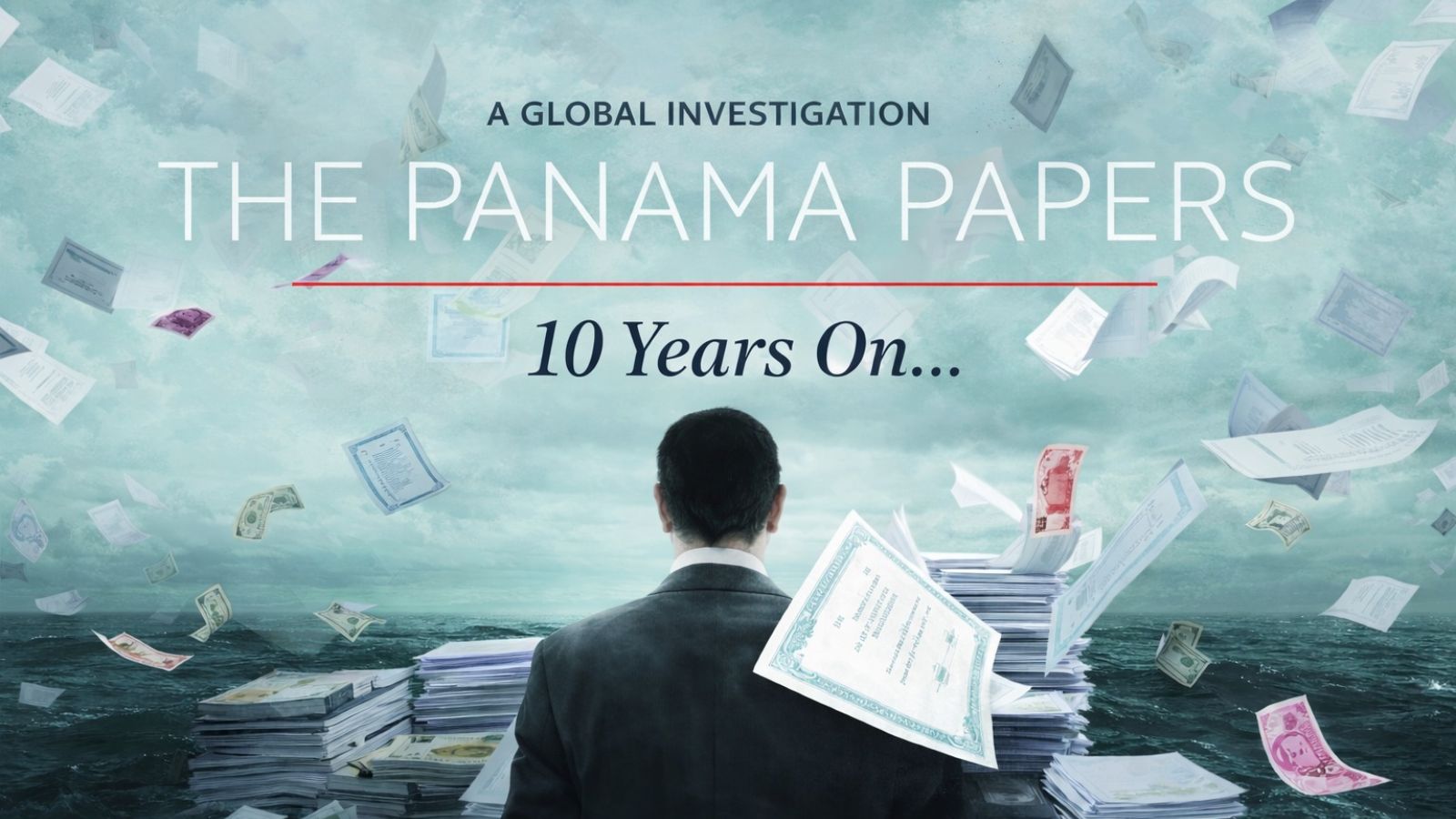
A cryptic eight-word message received by a German reporter 11 years ago would go on to change the face of collaborative journalism in the world.
“Hello. This is John Doe. Interested in data?”

The subsequent leak of 11.5 million internal records of Panamanian law firm Mossack Fonseca by an anonymous whistleblower brought together a coalition of 370 journalists from 109 media organisations in 80 countries on a single platform hosted by International Consortium of Investigative Journalists (ICIJ).
In July 2015, the Panama Papers investigation was launched to map the offshore footprints of the rich and powerful who went looking for financial secrecy. Ten months on, in April 2016, its findings would shake the world.
The long list of names found in the 2.6 terabytes of data included serving presidents (UAE and Ukraine), former presidents (Argentina and Sudan), serving prime ministers (Ireland), former prime ministers (Pakistan, Iraq, Ukraine, Jordan and Moldova), a former emir (Qatar) and a king (Saudi Arabia).
The investigation also exposed offshore dealings of Russian President Putin’s close aides, the brother-in-law of China’s Xi Jinping, children of former Pakistan PM Nawaz Sharif, former British PM Margaret Thatcher, and members of the Spanish royal family.
A second tranche of Mossack Fonseca data leaked in 2017 showed how the edifice they had set up in 1977 collapsed rapidly in the aftermath of the Panama Papers investigation.
The India chapter
A three-member team of The Indian Express, along with another 22 reporters, conducted the Panama Papers investigation in India. To identify those named in the data, The Indian Express team visited nearly 300 addresses across the country.
The Indian government set up a special multi-agency group to investigate the Panama Papers findings. Until now, 426 cases have been investigated, 84 searches conducted and prosecution moved in 46 instances. So far, the probe has identified undeclared assets worth Rs 20,078 crore — of this, Rs 13,800 crore have been brought to tax.
Modus Operandi
Secrecy and low- or zero-taxation make offshore tax havens — such as the Cayman Islands, British Virgin Islands, Seychelles and Panama — attractive. It costs a few hundred dollars to set up an offshore entity — available off-the-shelf or can be registered in just 48 hours through a registered agent, such as Mossack Fonseca.
An offshore entity does not need natural persons as directors or shareholders. Often corporate service providers, or their staff, fill in as dummy office bearers. The real beneficiary or owner remains unnamed.
Some of Mossack Fonseca’s Indian clients floated offshore entities at a time when this was illegal; some bunched their annual quota of remittances to buy shares in an offshore entity acquired at an earlier date. Some of these clients opened foreign bank accounts to park pay-offs in government contracts or illegal trade — at times to buy property through trusts or foundations.
There are instances when offshore funds for investing in India were sourced from India, or assets of Indian companies were used to guarantee loans raised by offshore companies without informing the Indian regulators. Changing ownership of offshore companies to actually transfer shares held by them in Indian companies without paying taxes in India was also common.
What it meant
A thin line — or “the thickness of a prison wall”— separates tax evasion, which is outright illegal, and tax avoidance, which may not be.
Companies are free to structure finances in whichever way they wish to reduce tax liability and tax avoidance is a legitimate offshore advantage. A company is also protected by what is known as ‘corporate veil’ and the regulator is not supposed to fish for evidence of suspected wrongdoing.
Only if a fraud is established can the regulator pierce the corporate veil, since fraud unravels everything— even a law, if it comes in the way—because no legislature intends to guard fraud.
That is where the Panama Papers investigation proved to be a game changer. In their sheer size and scope, the revelations enabled the regulators in India and across the world to step in and lift the veil of secrecy.
The writer is Associate Editor, The Indian Express

