



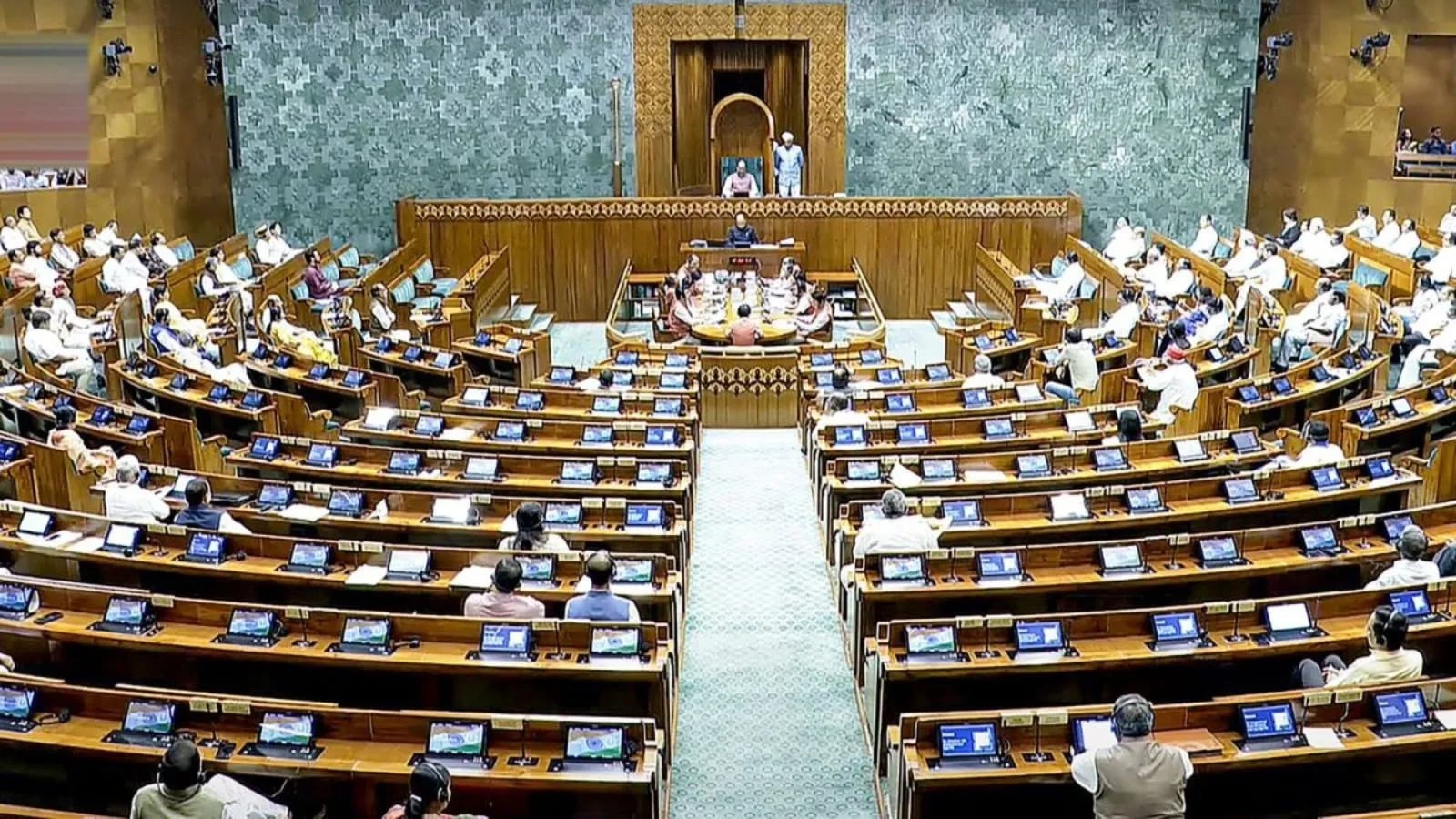
India’s population is projected to peak in the early 2060s at about slightly more than 1.6 billion before beginning a long decline. Yet, proposals to raise the Lok Sabha ceiling from 543 to 850 seats, tied to a new Delimitation Commission using the 2011 Census, are being discussed as if limitless expansion were the only future. This combination of near-term demographic peaking alongside a potentially permanent institutional expansion forces a harder question than “More People, More MPs.” But this is exactly where public debate is getting trapped.

We are treating “people per MP” as the sole measure of representation and assuming that the only way to achieve a higher ratio is to add seats. As a demographer, I want to pose a simpler question without resorting to formulas and state-wise shares: Do we actually need more MPs to better represent Indians?
The case for expanding the Lok Sabha is often framed as a simple representation problem: Average population per constituency is large and unequal across states. But acknowledging the strain of disproportionate representation is not the same as accepting an across-the-board expansion to 850 seats as the inevitable or best solution.
Start with what has changed since 1971. Representation is not only a matter of headcounts; it is a matter of access. In the early decades after Independence, access depended heavily on physical distance and slow communication. A constituency office was harder to reach. Roads and rail connectivity were patchy. Telephones were rare, and there was no internet. An MP’s ability to hear grievances, follow up with administrators, and be visible in the constituency was constrained by the infrastructure of the time.
That world no longer exists. Travel is easier and faster for many citizens and representatives. Communication has been transformed by mobile phones, messaging apps, and video calls. Constituents can reach leaders directly and publicly, often in real time. By saying this, I am not romanticising digital politics or denying inequality in online access. But it does mean that the 1971 “service capacity” of an MP cannot be assumed to be the right benchmark for 2026.
More importantly, a key question, then, is not whether representation should be equitable, but whether a large, irreversible increase in seats is being justified primarily on a demographic arithmetic that is already approaching its crest. India is not heading into limitless population expansion; it is approaching a peak-and-decline trajectory within this century’s first half. Even our recent population projections indicate an earlier population peak than what the UN suggest.
Representation Needs Capacity, Not Just More Seats
Even if India’s average constituency size is large, over 2.2 million persons per constituency in 2011, the policy question is what mix of institutions should carry representation and service delivery burdens. India already has a vast democratic architecture closer to citizens than Parliament: Over 250,000 Panchayats, about 3,700 urban local bodies, and more than 3 million elected representatives at the local level.
The representation challenge is not a lack of elected offices in absolute terms but the distribution of authority, finances, and problem-solving capacity across tiers of government. If we are worried about citizen access and responsiveness, the evidence points as much to the depth and effectiveness of local institutions as to the size of the national legislature.
Women’s Representation Needs Party Reform, Not a Larger House
A second justification sometimes offered for increasing seats is the hope of improving women’s representation. Yet after the 2024 Lok Sabha elections, 74 women were elected, 13.6 per cent of MPs, a decrease from the previous House. Comparative figures underline the gap: Women are 46 per cent of MPs in South Africa, 35 per cent in the UK, and 29 per cent in the US. India’s problem is not population arithmetic capacity but empowerment and political choices about nominations and winnability.
The women’s reservation bill to reserve one-third of seats has been passed, but has yet to come into effect. If one-third reservation is the stated goal, then the bottleneck is implementation and political will, not the number of seats in the House. Expansion risks becoming a distraction, an argument that the system should “grow” before it can become fair, when the evidence from the current House shows that even within 543 seats, women’s representation can stagnate or fall depending on party decisions.
It is also worth noting that women’s political participation is already extensive at the grassroots: Reservation has brought over 1 million women into formal political leadership roles in Panchayats. The pipeline challenge is not merely “finding women leaders” but ensuring that higher tiers reflect this leadership pool and empower them in decision making roles.
Strengthen the Tiers That Already Exist
A practical alternative to seat expansion is to deepen democratic effectiveness where the numbers are already large: In local bodies that handle everyday public goods. The scale is unmistakable: over 3 million elected local representatives, a density of elected accountability that Parliament cannot replicate even if expanded to 850 seats.
If the concern motivating delimitation is representation and responsiveness, then strengthening the tier with 3.2 million elected representatives, including 1.5 million women, should be part of the solution set, rather than an afterthought. Before we build a larger Parliament, it may be worth asking what citizens would actually gain, and whether the same resources and political attention could deliver more if spent on stronger institutions of service and accountability.
A Reform That May Outlive Its Rationale
The demographic argument for urgency is weaker than it first appears because the demographic “problem” is time-bound. That makes it reasonable to ask why the institutional response is being framed as a one-directional expansion rather than a calibrated package combining targeted boundary rationalisation, institutional strengthening, and a deeper role for local government using technology. The proposals on the table are not mere administrative tweaks; they are rules that will shape India’s federal balance and the weight of individual votes for decades, including well beyond the point when India’s population growth is expected to have peaked and begun to reverse.
Expanding the Lok Sabha is, in effect, a one-way door. Seats, once created, become entrenched. Even if future demographics change, few parties will have incentives to support reducing representation for any region. That does not make expansion wrong, but it raises the burden of proof: if the principal rationale is a temporary peak in population size, are we confident that the long-run institutional trade-offs are worth it? Finally, as the country rapidly approaches a demographic turning point, proposals to expand the Lok Sabha, driven by arithmetic temptation and demographic rationale, risk locking in a permanent fiscal and federal redesign for what may ultimately be a temporary population moment.
The writer is a demographer at the International Institute for Population Sciences (IIPS), Mumbai. Views are personal.
