



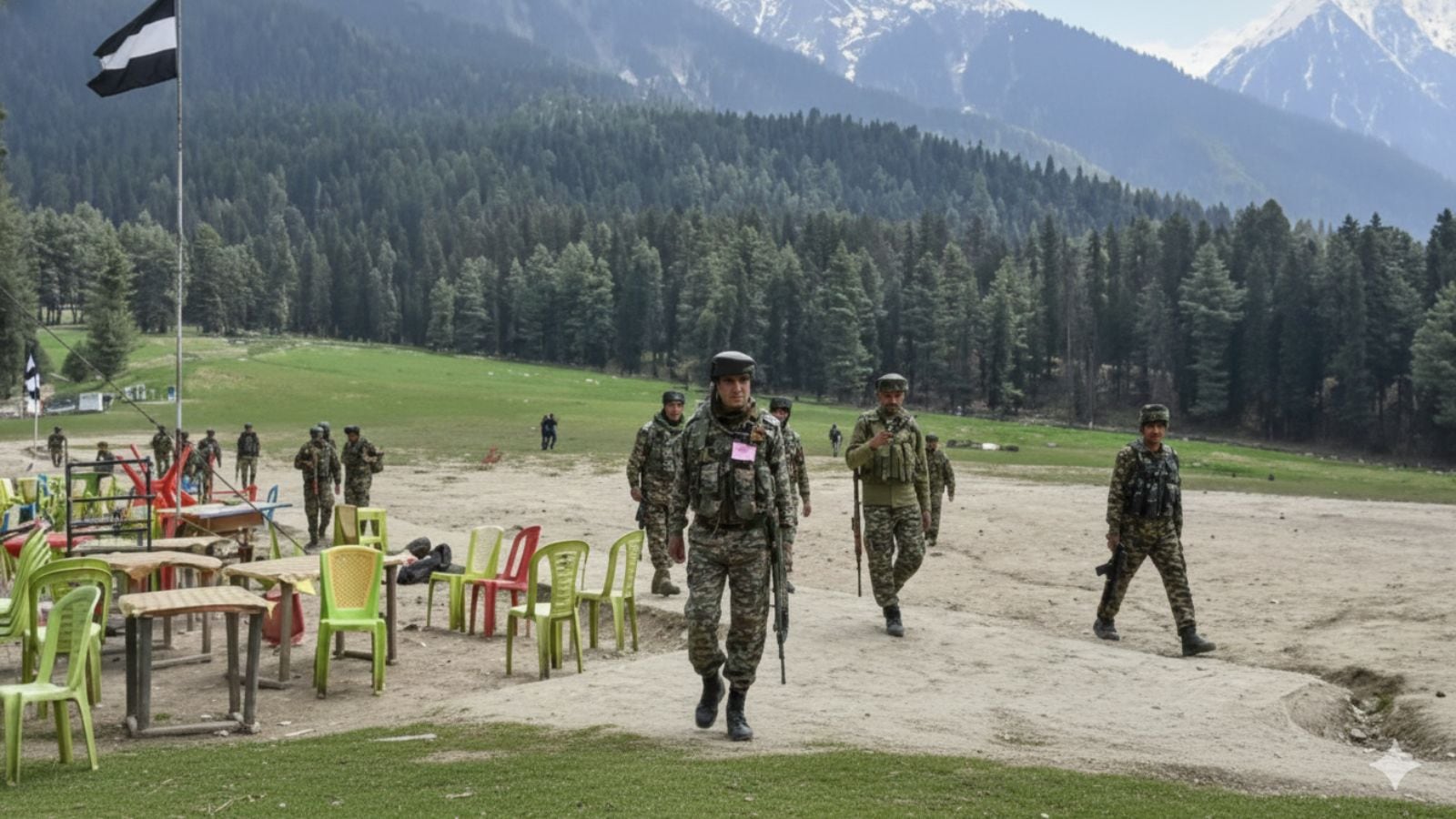
In Kashmir, time does not pass in straight lines; it circles back through memory, disruption, and uneasy calm. One year after Pahalgam, the Valley appears composed once again — tourists have returned, roads are busy, the rhythms of life restored. But if the state’s response since then has been to project normalcy, the time has come to ask a harder question: Was that normalcy real, or merely held in place? A year on, what is required is not commemoration, but clear-eyed scrutiny.
The Pahalgam attack revealed what may be described as a “terror triangle strategy” — a synchronised architecture involving local logistical support, foreign-trained commandos, and carefully chosen global timing. The use of M4 carbines and body-mounted cameras underscored a dual objective: Tactical lethality on the ground and propaganda amplification in the digital domain. The aim was not merely to inflict casualties, but to maximise economic disruption and diplomatic fallout.

The response, however, has not been static. From urban checkpoints and visible deterrence, the security grid’s focus has shifted to high-altitude forest domination. Following Operation Sindoor, there has been a push to flush out foreign militants embedded in the dense terrains of the Pir Panjal and Kupwara ranges. This marks a doctrinal recalibration — taking the fight to the adversary’s sanctuaries rather than waiting for infiltration to translate into urban strikes. Simultaneously, vulnerable yet economically critical zones — such as the high-altitude meadows of Baisaran — are being brought under layered surveillance.
Yet, terror’s deeper effect lies in its ability to disrupt narratives. Undoing carefully constructed perceptions of peace, it unsettles tourism and dampens investor confidence. It is therefore significant that the response has emphasised recovery and rebranding, with tourism at its centre. The Udhampur-Srinagar-Baramulla rail link project is expected to be transformative, and is being complemented by international outreach.
On the diplomatic front, the approach to Pakistan requires clarity and composure. The cross-border ecosystem of support for terror remains intact. At the same time, the geopolitical context is shifting. The Iran war has elevated Pakistan’s diplomatic profile in West Asia. Iran, given its long border with Pakistan, cannot afford sustained hostility or instability in that corridor. And Pakistan’s relationship with the US will remain important.
For India, the lesson is one of maturity as a rising power. To react and complain loudly at global forums after every provocation risks signalling weakness. Sporadic attacks have occurred across governments and across doctrinal approaches — muscular and conciliatory alike. The answer lies in consistency: A posture that is firm, silent, and measured. It may be time to review and call off Operation Sindoor, which has served its immediate purpose, and transition to a more sustainable posture.
Looking ahead, certain priorities are clear. The Comprehensive Integrated Border Management System, or smart fencing, must be accelerated and fully integrated into border management. Technology must become the backbone of surveillance and response. Intelligence systems must evolve from accumulation to anticipation, combining data analytics with grounded human intelligence.
Equally important is the internal dimension. Restoring an elected government in J&K and granting statehood would strengthen legitimacy and accountability. CM Omar Abdullah must have a defined role in the security grid; friction between administrative and political authority, LG vs CM, risks weakening coherence. Public sentiment, too, has shifted. The shock that once defined responses has given way to a more vigilant, and at times dissatisfied, public mood. Today’s frustrations are more administrative — from smart metering issues to perceptions of bureaucratic high-handedness. These concerns, if unaddressed, can erode the stability that security measures seek to protect.
Ultimately, one year after Pahalgam, the lesson lies not in alarmism or assertion, but in balance. The gains in security must be consolidated with equal attention to polity and economy. Kashmir today is neither a story of resolution nor one of relapse; it is a continuum that must be managed with care. It remains a work in progress — one that demands patience, precision, and quiet resolve.
The writer has served as special director, Intelligence Bureau; secretary (security), Government of India; and Central Information Commissioner
