



NEW DELHI: NEW DELHI: Zero hunger, quality education, affordable and clean energy—sounds like a dream state? Not quite. Kerala, a consistent topper in most Sustainable Development Goal rankings, is set to deliver its verdict on May 4, even as its celebrated development model comes under closer scrutiny.The Left Democratic Front (LDF) government is banking on this performance to secure a third consecutive term in office. If the political winds swing left again, it would mark a first in Kerala’s recent history, where anti-incumbency has typically dictated a change in government every cycle.Even CM Pinarayi Vijayan has expressed confidence in his tenure’s welfare gains, saying: “Our confidence is rooted in our vision and our unwavering commitment to it. We have successfully merged world-class social welfare with massive infrastructure development. Kerala consistently ranks first in Niti Aayog’s Sustainable Development Goals index and health indices. People trust us because we have proven that we deliver on our promises.“Yet exit polls suggest a far tighter race, with the Congress-led UDF projected at around 72 seats, just ahead of the LDF at 63 in a 140-member House, signalling a contest that may be decided at the margins rather than mandates.
Why SDG rankings show an incomplete picture?
However, a closer reading of the Centre for Science and Environment (CSE) assessment suggests that this leadership tells only part of the story. Despite its overall high ranking, Kerala has not crossed the halfway mark in 20 out of 107 indicators, with gaps spread across 13 of the 16 SDGs. Weaknesses are particularly visible in areas central to long-term social and economic resilience — gender equality (SDG 5), health (SDG 3), education (SDG 4), and decent work and economic growth (SDG 8).The shortfall is most striking in gender equality, where Kerala’s reputation contrasts with measurable outcomes. The state lags on key indicators such as female labour force participation, representation of women in managerial roles, ownership of operational land, and wage parity. However, Sivadasan Mankada, history professor at Calicut University, contests that a “wide range of welfare measures introduced by the Pinarayi Vijayan government has created a strong shield against anti-incumbency, with even opponents acknowledging that such sentiment is absent in the current state legislative elections.”Mentioning the LIFE mission, a housing welfare project which was also appreciated by the NITI Aayog, the professor said: “This is evident in the successful implementation of the highly acclaimed Life Mission housing project for the poor, the uninterrupted and enhanced pensions for the elderly and economically disadvantaged, and the robust support extended to healthcare and school education.”
Migration, wage gaps and demographic shifts: Undercurrents that would shape verdict
As Kerala heads towards the May 4 results, a set of structural challenges—rather than headline political narratives—are emerging as potential factors that could weigh on the ruling Left Democratic Front (LDF) led by Pinarayi Vijayan.Foremost among them is migration, which has moved from being a background economic trend to a central electoral issue. Estimates suggest that between 23 and 25 lakh Keralites are working abroad, with another 10–15 lakh employed in other Indian states, PTI cited S Irudaya Rajan, chairman of the International Institute of Migration and Development (IIMD) saying. This large-scale outward movement continues despite relatively high literacy levels and social development indicators within the state.The driver is not a lack of jobs per se, but a persistent wage disparity. Daily wage labourers in Kerala can earn over Rs 1,000, yet entry-level salaries for educated youth often range between Rs 12,000 and Rs 15,000 per month.“A labourer earns over Rs 1,000 a day, around Rs 25,000 a month. In contrast, an educated worker may earn Rs 12,000-Rs 15,000 as a starting salary. This pushes many to study abroad, where they can earn better soon after completing their education,” PTI quoted Benoy Peter, executive director, Centre for Migration and Inclusive Development (CMID) saying. This mismatch has created a paradox where manual labour is better compensated than white-collar entry jobs, pushing students to pursue education and careers abroad where returns are quicker and significantly higher.“I want the LDF to continue in power. A change to the UDF doesn’t seem likely to alter the current situation. Many people are going abroad not out of hardship, but by choice,” said Sooraj Sudheer who works at a media company in Kottayam.At the same time, Kerala’s labour market is increasingly dependent on migrant workers from other states, who now account for a substantial share of the workforce in sectors like construction and manufacturing. This dual dynamic, outmigration of local youth and inflow of external labour, has sharpened concerns over the state’s economic structure and long-term sustainability.timesofDemographic changes are adding another layer of complexity. In many parts of central and southern Kerala, homes remain locked or are occupied only by elderly parents, reflecting the social cost of migration. The trend is particularly pronounced among those moving to Europe, the US and Australia, where permanent settlement is more common than in traditional Gulf migration patterns.Beyond economics, social factors are also at play. Exposure to global lifestyles and aspirations has widened the gap between local opportunities and expectations, further accelerating outward mobility.Together, these trends have fed into a broader perception challenge for the LDF government—whether it has done enough to align Kerala’s economy with the aspirations of its youth, a question that could influence voting patterns as the state awaits its verdict.
UDF’s ‘not a charity’ welfare push
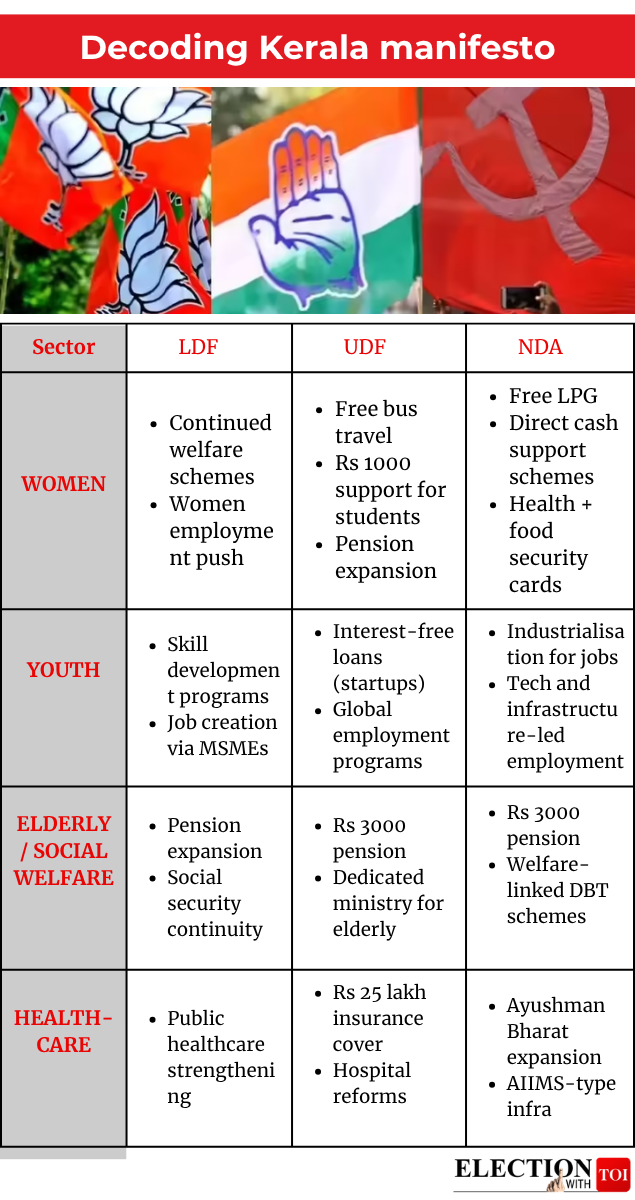
United Democratic Front has crafted its manifesto as a direct counter to the Left Democratic Front’s long-standing social security narrative. By declaring pensions a legal entitlement, not a dole, the UDF is attempting to reframe the welfare debate and challenge the incumbency advantage enjoyed by chief minister Pinarayi Vijayan.At the heart of this push are the “Indira Guarantees” unveiled by Rahul Gandhi, which significantly broaden the scope of welfare. Free bus travel for women, monthly stipends for college students, a Rs 3,000 social pension, and expansive health insurance coverage signal an effort to outpace the LDF on both scale and inclusivity. The promise of interest-free loans for young entrepreneurs also adds a forward-looking economic dimension, targeting Kerala’s educated but employment-seeking youth.The UDF’s approach blends welfare with structural reforms. Proposals such as a dedicated department for senior citizens, a Job Watch Tower to track employment trends, and a Tribal University in Wayanad suggest an attempt to institutionalise support systems rather than rely on periodic schemes. At the same time, initiatives like “Nava Ashraya” for housing, Indira Canteens for food security, and targeted assistance for marginalised communities aim to consolidate traditional welfare constituencies.Crucially, the manifesto goes beyond social spending to address economic growth, an area where the opposition has consistently attacked the LDF. Projects like Mission Samudra, expansion of aviation, and the creation of 10,000 enterprises are pitched as engines of job creation, countering criticism of Kerala’s limited industrial growth. By combining expansive welfare promises with economic and governance reforms, the UDF is attempting to turn the election into a referendum on delivery versus fatigue. Whether this rights-based welfare plank resonates against the LDF’s record will be clear when votes are counted, but the opposition has unmistakably raised the stakes in Kerala’s political contest.
BJP eyes Kerala through calibrated welfare push
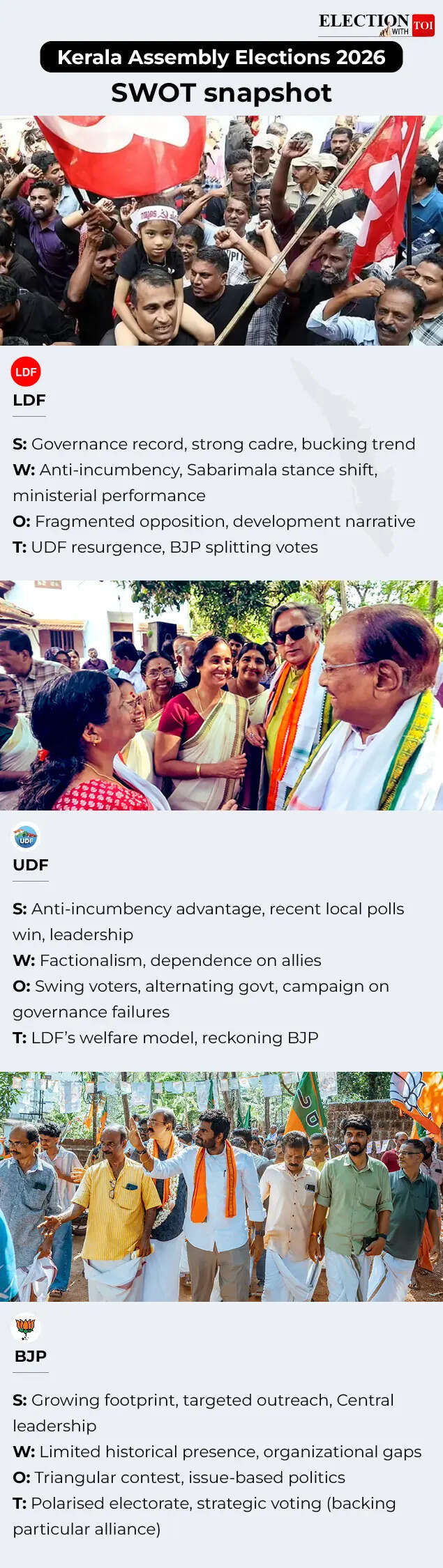
High on confidence after recent electoral gains, the Bharatiya Janata Party (BJP) is sharpening its Kerala strategy with a strong welfare pitch aimed at expanding its social base. The party’s breakthrough in the 2024 Lok Sabha elections, winning its first-ever parliamentary seat in the state, along with its emergence as the single-largest front in the Thiruvananthapuram corporation, has reinforced the sense of momentum within the organisation. These gains have encouraged the BJP to move beyond its traditional focus areas and position itself as a viable third force against both the LDF and the UDF.The welfare plank is central to this recalibration. The party’s manifesto, unveiled under the leadership of Rajeev Chandrasekhar, combines social assistance with development promises to appeal to a broader cross-section of voters. Proposals such as a Rs 3,000 monthly pension for vulnerable women, widows and the elderly, free water supply up to 20,000 litres per household, and two free LPG cylinders annually are designed to directly compete with the welfare-heavy narratives of both the LDF and UDF. The proposed “Bhakshya Arogya Suraksha” card, offering Rs 2,500 monthly support for essential expenses, further signals an attempt to build a sustained welfare connect with economically weaker sections.At the same time, the BJP has paired these measures with infrastructure and growth-oriented promises, such as an AIIMS, a high-speed rail corridor, and investments in governance reforms, to project itself as both a welfare provider and a development driver. This dual approach reflects a strategic shift: rather than relying solely on ideological or identity-based mobilisation, the party is seeking to embed itself in Kerala’s competitive welfare politics. With both rivals historically strong on social schemes, the BJP’s expanding welfare pitch indicates an effort to erode their dominance and convert recent electoral inroads into a more durable political presence.
Why anti-incumbency is making the Left nervous
Anti-incumbency is not an abstract risk in Kerala, it is a recurring electoral pattern that has repeatedly upended ruling fronts. For the LDF led by Vijayan, the historical record offers little comfort ahead of the 2026 verdict. Past assembly results show a clear tendency among Kerala voters to rotate power, often sharply. In 2001, the LDF’s tally dropped to 41 seats against the UDF’s 100 after a stint in office, only to rebound to 102 in 2006 when it returned from the opposition. The cycle repeated in 2011, when the Left’s strength fell to 70 from 102, despite having governed the previous term. These fluctuations underline a consistent pattern: the electorate has shown a willingness to curtail governments after a term, and even more so when they seek continuity.What makes the current moment more precarious is the duration of the LDF’s rule. In power since 2016 and reinforced with a commanding 94 seats in 2021, the Left is attempting something relatively rare in Kerala politics — a third consecutive term. Historically, even strong mandates have not insulated incumbents from erosion in support over time.
