



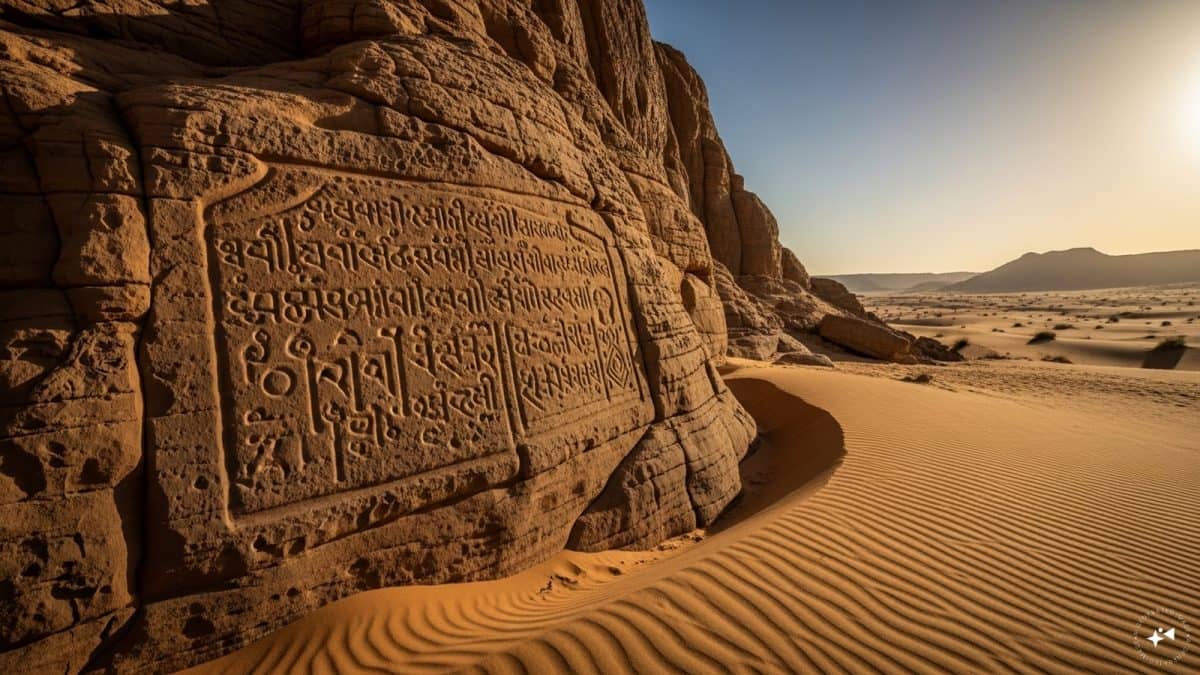
“Bunty loves Pinky. Pierced heart.” “Vikram + Poonam = heart.” Or just plain “ILU (I love you).” Anyone who has visited a heritage site in India would have seen these messages scribbled on the walls. These random graffiti are the most ubiquitous modern imprint on our history and the most wince-inducing as well. But these modern-day vandals are not a species indigenous to India alone. Nor are they a peculiarly 21st-century phenomenon.
In fact, the astonishing discovery of 2000-year-old graffiti left behind by ancient Indian travellers and merchants on the tombs of Egyptian pharaohs has hit headlines earlier this week, causing excitement not just among historians and archaeologists but the general public as well. Scribbled onto a number of pharaonic tombs in the Valley of Kings, these 30 inscriptions – of which a majority are in Tamil Brahmi – document not just ancient India’s deep mercantile and maritime relations with Egypt but also the very human need to imprint one’s presence on history.
The inscriptions themselves are straightforward enough – one reads “Cikai Korran vara kantan”, or “Cikai Korran was here”. A fellow traveller dittoes the sentiment: “Kopran vara kantan” or Kopran was here. These intrepid Indian seafaring merchants – the same tribe who carried fine Indian goods like the Berenike Buddha or the Pompeii Yakshi/Lakshmi to Egypt and Rome – perhaps felt compelled to leave behind some sign of their presence on a monument which would have been ancient even 2000 years ago.
And thank god for that. Because in doing so, they have helped expand the history of ancient India’s connections with the world around it. In fact, Korran and Kopran are not the only ancient Indians who left behind some fingerprints on pharaonic Egypt. Three inscriptions from the Red Sea port of Quseir-al-Qadim, or Leucos Limen, offer tell-tale signs of intrepid seafaring Indians not only trading with Egypt and Rome but also living in transit trade hubs like Alexandria, Berenike or Leucos Limen. The three inscriptions – two in Tamil Brahmi and one in Prakrit – mention some of these merchants by name. Halaka, Vinhudata or Vishnudatta and Nakada or Nagadatta are selling oil, wine or honey and meat.
Another pottery inscription mentions yet another Tamil trader called Cattan or Kannan who left his signature on his goods in Tamil Brahmi. Just as interesting is the inscription in Greek found at the Temple of Seti I at Kanayis, located somewhere between Berenike on the Red Sea and Apollinopolis on the Nile. The inscription is an offering to the Greek god Pan (which many historians have surmised was an offering to Lord Krishna but made in a Greek temple) from an Indian called Subhanu.
Some of these scribblings are symbols like the Buddhist wheel and Hindu trishula symbols that popped up in a Ptolemy-era tomb in Dendera, confounding historians about who left those imprints and why. That’s not to say that Indian merchants have only found mention in these assorted graffiti – several contemporary sources like the Oxyrhynchus papyrus, which contains a fragment of a Greek farce, Ptolemy’s Geography and Periplus of the Erythraean Sea, and the Sanskrit inscription at the Isis temple at Berenike by a trader called Vasula all attest to their presence.
While ancient Indian graffiti in Egypt may be in the news right now, historical graffiti are not rare either in India or elsewhere in the world. On my first ever trip to the Ajanta complex, the local guide pointed out a name scribbled on a pillar in Cave 10: John Smith. This British official had accidentally discovered the caves in 1819 while chasing a particularly elusive tiger and had felt impelled to leave his signature behind as well, giving the sacred art of ancient India a taste of some good old-fashioned colonial impertinence.
Just as deliberate were the Viking/Norse runic scribbles inside the Hagia Sophia in Istanbul. One particularly clear-cut one simply states, “Halfdan was here”. Inscribed in the 9th century, this elite member of the Byzantine Varangian guards was, in effect, vandalising a 300-year-old building when he left his name on its walls.
Sometimes, the scribblings are marks of protest too, like the charcoal graffiti left in the cell blocks of Richmond Castle in the UK. These were by men who were refusing to fight in WWI and had been imprisoned as a result. Just as interesting are the many doodles and texts left behind by unfortunate prisoners on the walls of the Tower of London. There is, for example, an entire prayer scribbled in Latin by Philip Howard, Earl of Arundel. Dated 1587, it says, “The more our pain in this world, the more our glory in the hereafter.”
Of course, not all graffiti is quite so pure-minded in tone and tenor. Some of the most titillating scribbles can be found on the walls of Pompeii, which included everything from nudge-nudge wink-wink references to the rich and famous, political sloganeering and even salacious gossip about rivals and competitors, all preserved by the lava-spewing fury of Mount Vesuvius. But perhaps the most blush-worthy are those left behind by drunk customers after a visit to the city’s famed red-light quarters.
The most famous graffiti in India, though, includes the imprint of three emperors, separated by a millennium each. This is the Prayag Prashasti Pillar in Prayagraj, which bears the names of three emperors.
Originally an Ashokan pillar, it carries some of Ashoka’s edicts in Prakrit, written in Brahmi script. Later, it was used to carve the most detailed record of Gupta emperor Samudragupta’s reign by his minister and scribe Harisena. The Prashasti includes details of the emperor’s conquests across both North and South India.
Finally, Mughal emperor Jahangir uprooted the pillar and planted it in Allahabad Fort, adding an inscription in Persian. The three sets of inscriptions, spanning 2,000 years, have turned the pillar into a time capsule connecting different parts of India’s past.
Sometimes, graffiti can be history too — though not the love-sick variety we now see defacing the walls of heritage sites.
(The author is a senior journalist and an author. Views expressed are personal and solely those of the author. They do not necessarily reflect Firstpost’s views.)
End of Article
