



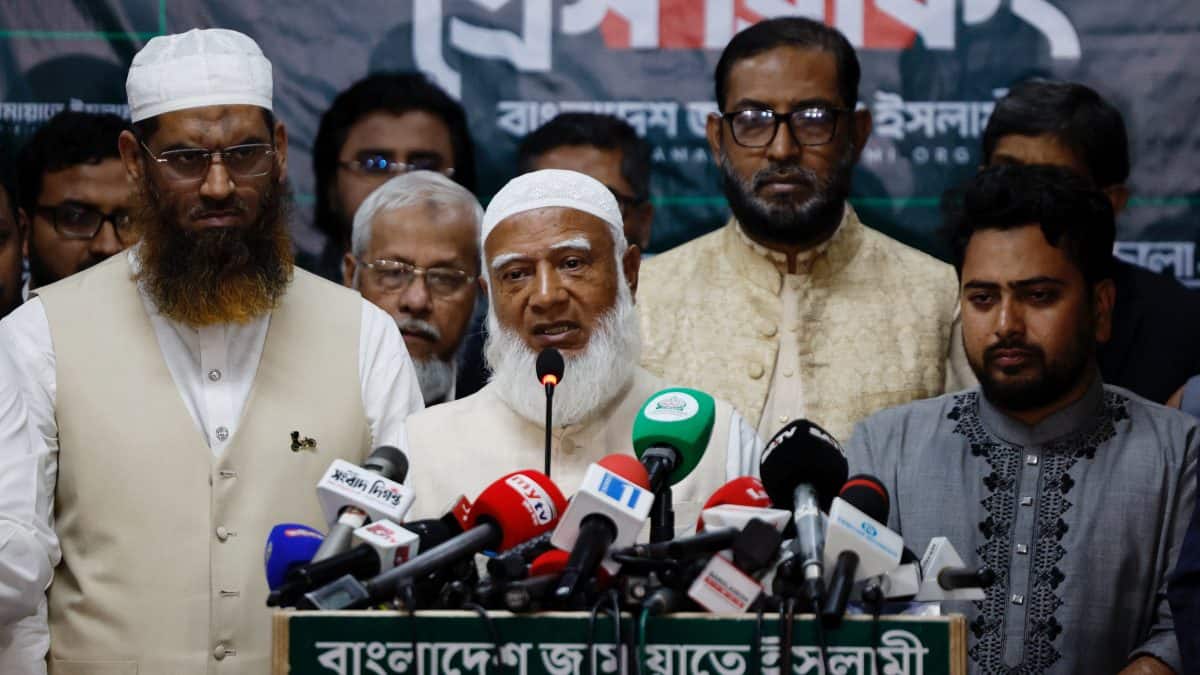
The Bangladesh Nationalist Party (BNP) has won the elections in Bangladesh, but the real winners are the Islamists of Bangladesh.
Even as Tarique Rahman, the leader of the BNP, steps up to become prime minister, he will know that unquestionably this is Jamaat-e-Islami’s moment, as the Islamists, long a fringe and street power in the riverine state, are now the most powerful opposition force, with more political and deep structural support than ever before.
The Jamaat, who opposed Bangladesh’s independence movement in 1971 and committed serious war crimes to prevent the country from breaking away from Pakistan, has regained legality, political centrality and international engagement in a way that would have been unthinkable a decade ago. Its rise is taking place within an Islamist ecosystem in which its principal street rival is the even more hardline Hefazat‑e‑Islam, whose growth was indirectly midwifed by Sheikh Hasina’s own tactical bargains with Qawmi madrasa networks and clerical leaders.
The 2026 general election is the first major national vote since the student‑led uprising of 2024 toppled Sheikh Hasina (her Awami League party was barred from participating in the polls) and ushered in an interim administration that lifted the ban on Jamaat‑e‑Islami and allied organisations. Once treated as a pariah for its Razakar legacy and war‑crimes convictions, Jamaat is the principal opposition with a historic vindication of its politics.
This institutional rehabilitation gives Jamaat three forms of legitimacy it had lacked after years of proscription and repression. First, legal‑constitutional legitimacy: the ban has been removed, its candidates are on ballots, and its participation is overseen by the Election Commission and courts. Second, political legitimacy: other parties will treat it as a normal negotiating partner in coalitions, seat‑sharing and post‑poll arrangements. Third, social legitimacy: large numbers of voters, especially in conservative districts, now see Jamaat not as a hunted underground but as a mainstream vehicle for an Islamic politics that claims to work within a parliamentary framework.
Jamaat’s gains are not limited to domestic structures; they mark a visible shift in the way regional and global actors approach Bangladesh’s Islamist spectrum. Foreign diplomats, business figures and international NGOs that once kept the party at arm’s length, wary of its war‑crimes stain and its ties to transnational Islamist currents, are now meeting its Ameer, Shafiqur Rahman, and senior leaders as inevitable interlocutors in Dhaka. Coverage of the 2026 election in international media repeatedly frames Jamaat as a pivotal actor that could emerge either as the main opposition or even as the senior partner in a ruling alliance, embedding it in the vocabulary of ‘normal’ democratic competition rather than extremism management.
Women voters in Bangladesh, a powerful constituency, may have overwhelmingly voted against the Jamaat, whose head said even before the 2026 elections that a woman could never be accepted as the head of the organisation, but the results show that Jamaat’s support base has never been stronger. This creates a feedback loop that enhances Jamaat’s international profile and, through that, its domestic standing. As external stakeholders accept it as part of the post‑Hasina order, Jamaat gains access to diplomatic channels, development debates, and rights discourses, which it can then instrumentalise to polish its image as a responsible, welfare‑oriented Islamic party. Critical voices such as Taslima Nasreen warn that this normalisation – especially as the Jamaat becomes the main opposition due to the continued banning of the Awami League – threatens Bangladesh’s fragile secular compact by making a religion‑based party the principal counterweight in a formally secular republic.
If Jamaat is the institutional winner of 2026, its principal challenger on the Islamist flank is Hefazat‑e‑Islam Bangladesh, an umbrella of Qawmi madrassa teachers and students headquartered around Chittagong. Hefazat built its reputation through massive street mobilisations, notably the 2013 Dhaka rally against the Shahbagh movement and war‑crimes tribunals, where it demanded blasphemy laws and a harsher Islamic public order. Its network of thousands of loosely regulated madrassas has given it an unparalleled capacity to mobilise young men in large numbers, to police moral boundaries in public life, and to intimidate both secular activists and religious minorities.
Ideologically and tactically, Hefazat has often positioned itself to the right of Jamaat – though in the past it has struck deals with Hasina. Where Jamaat has tried, especially in the 2026 campaign, to reassure observers that it will operate within the secular constitution and respect pluralism, Hefazat’s factions openly advocate for explicit sharia implementation, including death penalties for blasphemy and tighter controls on women’s visibility in public space. This diverging posture means that Jamaat’s ‘moderation’ appears relative, not absolute: it is framed as the more disciplined, parliament‑friendly Islamist actor against a backdrop of a more populist, doctrinaire and madrassa‑rooted rival.
The irony is that the relative empowerment of Hefazat – and thus the sharpening of an Islamist pole more radical than Jamaat – owes much to Sheikh Hasina’s own tactical manoeuvres in the 2010s. After Hefazat demonstrated its street power, Hasina’s government made a series of concessions: recognising degrees from thousands of Qaumi madrassas, amending school textbooks to remove content labelled ‘un‑Islamic’ or authored by non‑Muslims, and symbolically embracing the group by accepting honorifics such as ‘Mother of the Qaum’. These steps effectively upgraded Hefazat from an unruly pressure group to a semi‑partner in the management of Islamic education and public morality, while the state simultaneously squeezed Jamaat through deregistration and war‑crimes trials.
It cannot be forgotten that in the past, the BNP has been amenable to building coalitions with Islamists with ease, namely with Jamaat. How much of that would happen now under Tarique Rahman, who has returned from exile in London as prime minister, remains to be seen.
The 2026 election is thus less a decisive closure than an opening act in a longer competition between Jamaat and Hefazat over the soul of Bangladesh’s Islamist politics. Before the elections Hefazat had declared that voting for the Jamaat was ‘haram’. Jamaat emerges from the election clothed in legality, parliamentary presence and international recognition, which it can convert into patronage networks, welfare outreach and youth recruitment through student and professional fronts. Hefazat, by contrast, retains a diffuse but potent street power anchored in madrassas, mosque pulpits and moral policing campaigns, giving it leverage to veto policies it deems un‑Islamic and to pressure any government – including one involving Jamaat – from the right.
In such a landscape, two dynamics are likely. First, secular and centrist forces may fragment or be pushed into tactical alliances with one or the other Islamist pole, further normalising their presence in the core of the state. Second, Jamaat’s very quest to appear ‘responsible’ in parliament could generate space for Hefazat-e-Islam and others (even more Islamist than the Jamaat) to claim the mantle of uncompromising guardians of faith, radicalising parts of the public sphere even if formal legislation moves more cautiously.
(Hindol Sengupta is a professor of international relations and director of the India Institute at the OP Jindal Global University. Views expressed are personal and solely those of the author. They do not necessarily reflect Firstpost’s views.)
End of Article

