



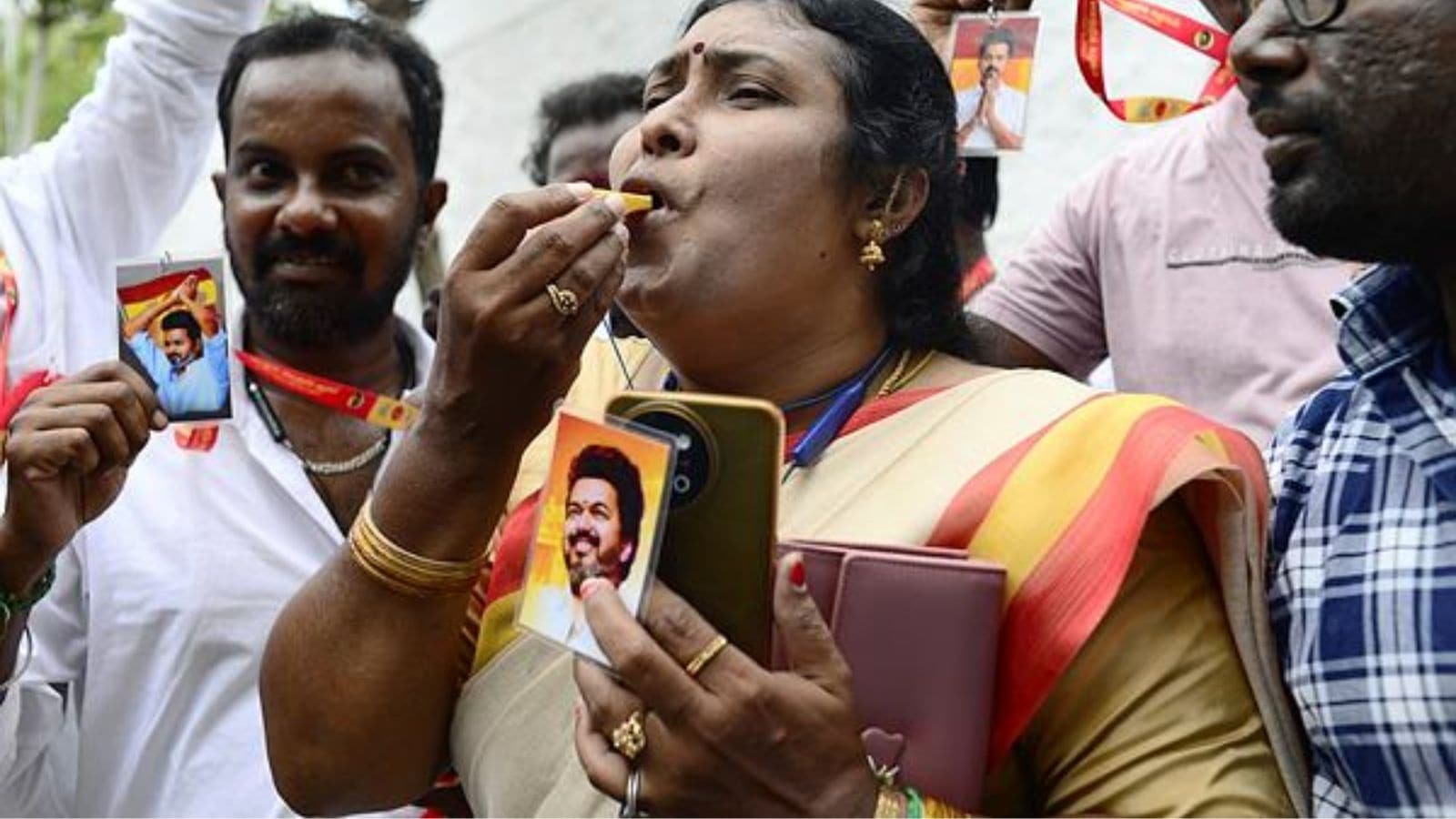
The Dravida Munnetra Kazhagam (DMK), which, according to many pollsters, was set to win comfortably, if not by itself, but at least with the support of its admittedly grumpy alliance partners, has barely pipped AIADMK (All India Anna Dravida Munnetra Kazhagam) for the second position. Stunningly, Chief Minister Muthuvel Karunanidhi Stalin has lost his pocket borough of Kolathur by a convincing margin, even as many of his party veterans have fallen. A lone exit poll pundit who predicted a Tamilaga Vetri Kazhagam (TVK) victory was mocked by all-knowing political analysts. Even though technically it is a hung assembly, it is nothing but a tsunami in favour of C Joseph Vijay and his fledgling party. What explains this shocker, and how did political analysts and academics miss this phenomenon?
Riding on a slew of welfare measures and the momentum of three consecutive electoral victories (2019 and 2024 Parliament and 2021 state assembly elections), the DMK clearly misread the depth of the anti-incumbency sentiment. In developing a cosiness with intellectuals and supposed opinion-makers, it was smug in its echo chamber. The unseemly hurry to anoint Udhayanidhi Stalin as heir apparent fuelled the charge of dynastic politics. The resentment of government employees, extensive use of outsourcing to constrict tenured employment, the ham-handed handling of unionisation efforts (for example, in the Samsung factory), and the continuing unsustainable exploitation of natural resources such as river sand may all have come to a boil now. More proximate causes would include the less-than-smooth negotiations with alliance partners resentful of the DMK’s big-brother attitude. Yet, the DMK’s vote share sits almost level with TVK. This is less a rejection than a finely balanced contest where a slender shift in votes has produced a dramatic electoral outcome.

If this was the state of the ruling alliance, AIADMK hardly covered itself with glory. For most of the five years in Opposition, Edappadi K Palaniswami exhausted his energies to gain control of his party and keep an ever-ambitious BJP in check rather than call out the ruling party. No single campaign or protest can be recalled, nor was a worthwhile exchange recorded in the legislature.
Vijay had nursed a long-term ambition to win political power. Unlike his predecessor Rajinikanth, who harboured similar dreams, age and time are on Vijay’s side. With the demise of tall leaders such as M Karunanidhi and J Jayalalithaa, the arena had few gladiators. It could be argued that the DMK shielded Udhayanidhi in this election campaign, fearing a walkover. Pushing 50, but still sprightly and agile, Vijay has an enviable charisma that has captured the imagination of a cross-section of people, cutting across caste, class and religion. From what we know, the crowds that turned up to see Vijay were spontaneous. Evidently, he had capitalised on an amorphous desire for change in the electorate who for the first time in many decades saw an alternative to the Dravidian parties. Systematic data crunching will have to wait, but TVK seems to have undermined all vote banks, inflicting severe damage on DMK, though the final margins seem to be not more than a few percentage points. Even the citadel of Chennai, which has weathered many an anti-DMK storm, has fallen to Vijay’s battering ram.
Could 2026 be the inflexion point in the history of the Dravidian movement? After nearly 60 years, a Dravidian party will not be forming a government in Tamil Nadu. What will be the future of “the Dravidian model” that explains the staggering growth of the state on all development parameters? If the DMK claimed all the credit for this model, curiously, the AIADMK, which helmed the state for more years than its rival, disowned it. Vijay’s development programme or ideological proclivities are unknown; at best, all one can hope for is a benign populism. Will the model continue, or will it be a decent burial? What of the future of the Dravidian movement? Will the DMK revive itself? Given that age and health are not on Stalin’s side, does Udhayanidhi Stalin have it in him to lead the charge? Will there be a churning within the DMK? Will AIADMK return to its roots, or will it let BJP capitalise on the fall of the Dravidian Babylon? But these larger questions will have to wait.
For now, what will be the shape of the new government? Even though TVK is shy of a majority, the vox populi is resounding. Intellectuals had better heed it rather than turn up their nose as they did in the run-up to the elections, using demeaning epithets to put down its support base. Untainted by Hindutva, Vijay remains nominally secular, making it easy for the Congress (which, in any case, played footsie with TVK during seat negotiations) and other DMK alliance parties, such as the communist parties, and the DMDK (with the possible exception of the Dalit party, Viduthalai Chiruthaigal Katchi) to lend support.
A rank outsider to the polity, Vijay has a tough job on hand. Will he measure up to it? At least a hundred greenhorn legislators are set to enter the august assembly hall. Apart from his trusted but untested lieutenants, he would necessarily have to rely on experienced administrative and police hands. The shooting floor is chaotic. But the director has blown the whistle. The clapperboard has clacked. The shooting has commenced. Let the show begin.
The writer is the co-editor of The Cambridge Companion to Periyar
