



The Congress’s decision to back Vijay’s Tamilaga Vettri Kazhagam after the DMK’s defeat is being read in Delhi as betrayal, in Chennai as opportunism, and in television studios as the eleventh-hour pivot of a party with no choices left. None of these readings is wrong, but each is incomplete. The pivot is the visible end of a longer argument the Congress has been having with itself for the better part of a year, and the alliance now being stitched together is less interesting for the seat-share it produces than for what it could mean if the party draws the right lessons from how it got here.
This decision, moreover, arrives against a backdrop of unsettled choreography. The Governor is yet to be persuaded of TVK’s numbers, the swearing-in remains unscheduled, and the NDA’s interest in pulling Vijay into its fold is not being concealed. The Congress’s public commitment, then, is doing more than securing cabinet berths. It is closing off an option the BJP would prefer to keep open.

That argument was, at heart, factional. A pro-DMK faction anchored by Mallikarjun Kharge and P Chidambaram, drawing on the old guard’s instinctive preference for the familiar ally, prevailed in the run-up to the polls. A pro-TVK faction associated with Rahul Gandhi, in which Manickam Tagore and Praveen Chakravarty did the legwork, argued for the harder calculation: That a charismatic insurgent two years into existence might be the better partner. The old guard won the pre-election debate. The results — a TVK sweep in seats and vote share, the DMK ousted — handed the next round to the other side, and Rahul Gandhi conveyed his support to Vijay almost as soon as the trend was clear.
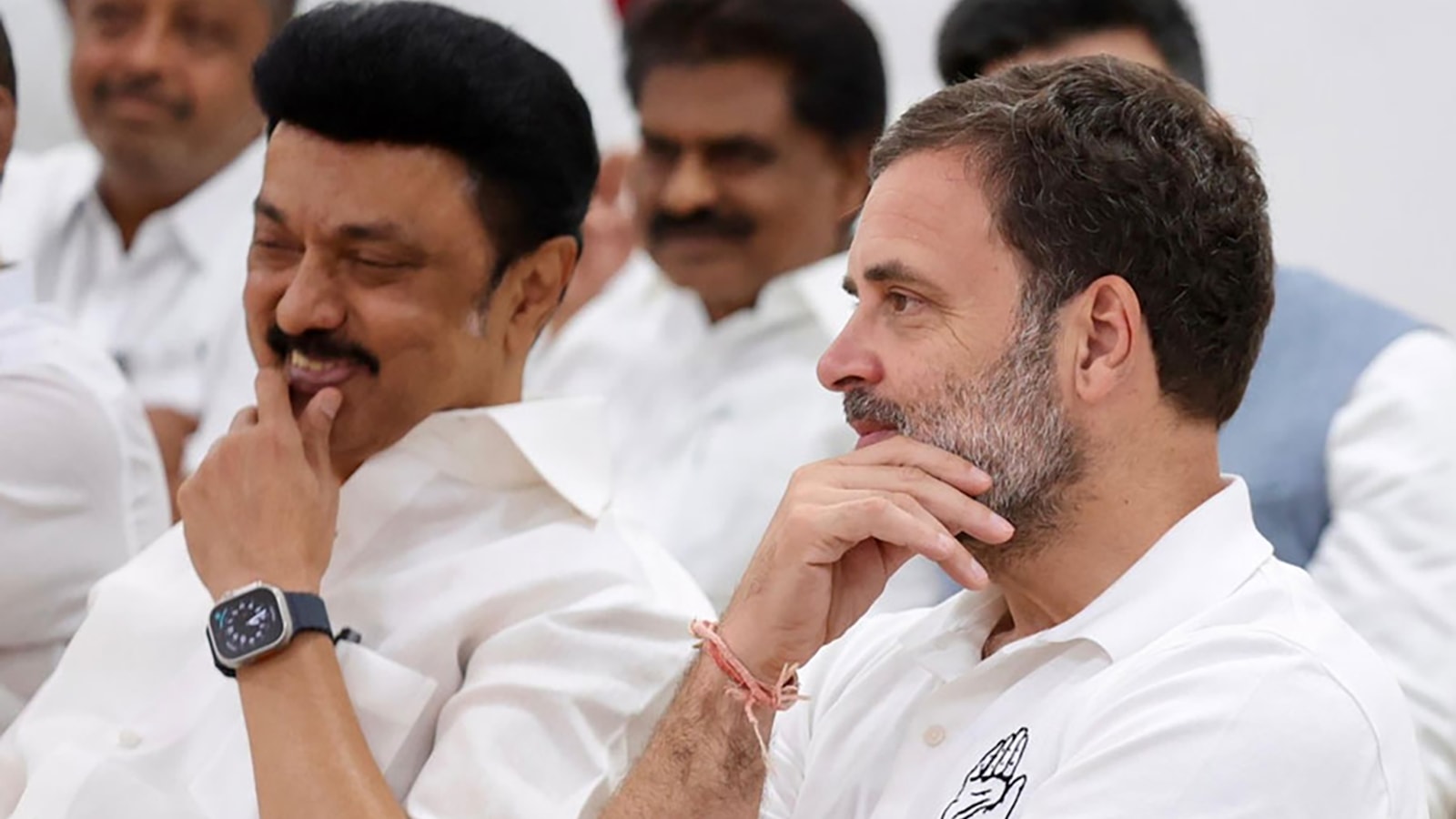
Even within the alliance that fought the election, the optics were poor. The Congress did not appear as a unified force, and Rahul Gandhi avoided sharing the stage with M K Stalin throughout the campaign. In Tamil Nadu, where political grammar is unusually attentive to gesture, that visible distance mattered. After years of declarations of brotherhood, it read as something worse than disagreement. It read as embarrassment.
It is worth saying plainly that a faction within the Tamil Nadu Congress has long preferred the AIADMK to the DMK, and the post-result swing toward TVK draws on the same impulse: A search for a partner that does not subordinate Congress candidates the way the Dravidian majors have. To see why, the alliance arithmetic has to be examined honestly.
With the DMK, Congress relies on the ally’s cadre and resources to fight elections, and the strike rate has been remarkable. But that dependency narrows the post-victory horizon: The DMK is a stratified, programmatic party, and a Congress MLA elected on its strength has very little room to operate independently in the constituency. With the AIADMK, the equation would not be fundamentally different — perhaps worse, because the AIADMK is a bottom-heavy organisation built around a centralising leadership at the top, and is, electorally, an anti-Congress party in much of its base. In either case, the Congress wins seats but hollows out its own ground game.
The TVK presents a different configuration. It has a charismatic leader who has demonstrated that he can convert personal appeal into votes for those he endorses, and it does not yet have a party structure dense enough to dictate to its alliance partners. For Congress representatives, that means more independent room in the constituency, and at the state level, cabinet berths after roughly six decades. Some dependency is inevitable; far less than under either Dravidian major.
The rationale, in other words, is sound. But the longevity question is harder, and three things follow from it. First, the Congress should target the seats currently held by the AIADMK, especially the dominant-caste bastions in the western and southern belts. These are precisely the constituencies where a TVK alliance could open up new possibilities. Separately, this would also help the DMK incentivise and energise its regional cadres, many of whom have long worked for allies rather than contesting themselves. Second, the dependency problem is ultimately a money problem. The Congress could alter the alliance equation decisively if it finds a way to fund its own candidates more effectively. This could be done either through a party-wide asset monetisation programme drawing on properties accumulated by senior leaders from the 1960s onward, or by fielding a select group of resource-rich candidates capable of supporting others, a category Tamil Nadu Congress still has in significant numbers. Without one of these, every alliance arithmetic will tilt against it. Third, the facade of fraternal love can now be retired. Between TVK and DMK, Congress need not be anyone’s brother. Issue-based, situational partnerships, visible when they help, dropped when they hurt, are healthier than mood-based embraces that the electorate has learned to discount.
The wider lesson is clear. The INDIA bloc has no consensus-builder of the old school, and pretending otherwise has produced precisely the optics that hurt the DMK-Congress front. What the bloc needs is a secretariat-style functioning: Rules of engagement, a standing mechanism for seat-sharing and messaging, partners who coordinate without performing affection. Paul Brass was writing about Congress’s unending factionalism as far back as the 1960s, and a coalition that absorbs that factionalism into a procedural architecture will outlast one that depends on personal warmth between principals. The party the bloc is up against is, after all, formidable on all three fronts that matter: Discourse-making, resource mobilisation, and personnel management.
The Congress has, for once, made the calculation it should have made earlier. Whether it builds on the calculation — or simply enjoys the cabinet berths until the next reckoning — is the question that matters now.
The writer is a postdoctoral researcher in Indian and Indonesian politics at the Royal Netherlands Institute of Southeast Asian and Caribbean Studies, Leiden, and a research affiliate at King’s India Institute, King’s College London
