



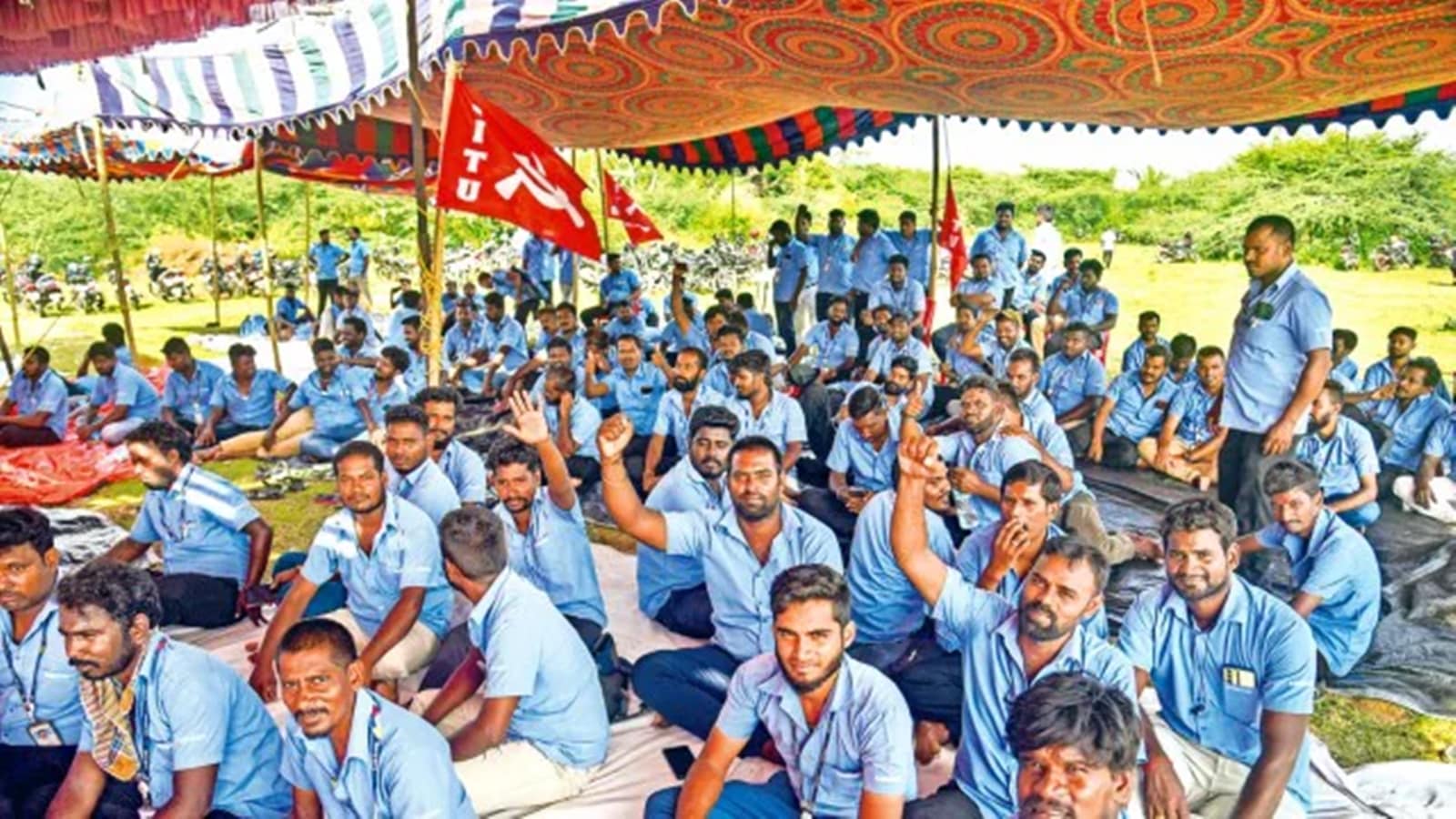
I was in Noida recently to meet striking workers. I wanted to listen to them, understand their anxieties, and express solidarity with their struggle. What stayed with me after the visit was not merely the suffering of the workers, but, in fact, the silence of our mainstream politicians. I did not find the BJP leaders there. I did not see the leaders of Congress there either. For parties obsessed with appearing “industry-friendly”, workers often seem to exist only as statistical abstractions, those invisible hands powering economic growth, but undeserving of political attention.
This is the tragedy of contemporary India: Unseeable poverty amidst celebrated plenty.

As the country celebrates stock market highs, unicorns, and the arrival of global capital, millions who actually keep the economy running continue to survive on fragile wages, informal contracts, and so on. The vast silent workforce of India, including factory workers, delivery agents, sanitation workers, and gig labourers, rarely appears in triumphant speeches about development.
That is where ideological conviction matters.
My political sensibility as a Leftist compels me to stand with workers, not because it is electorally fashionable, but because politics without the concerns of labour becomes little more than corporate management. Many parties today pay ritualistic lip service to workers while amplifying the voices and interests of corporations. The Left alone continues to ask uncomfortable questions about exploitation, inequality, and the dignity of labour.
The same political instinct recently took me to Kotdwar to meet a young fitness entrepreneur who had dared to raise his voice against majoritarian communalism and discrimination based on religion. Speaking against hate now requires courage. Once again, I did not find the political mainstream there.
Many politicians woke up only after my visit became news. I welcome their eventual attention, but it also demonstrates an old truth about Indian politics: The Left often leads morally before others discover the issue politically.
For the Left, politics is not confined to seminar rooms, literary festivals, or cocktail conversations about secularism. We have stood consistently with people in moments of fear and abandonment. During the farmers’ protests five years ago, Left cadre and leaders were among those present from the beginning. Many mainstream leaders arrived much later. Rahul Gandhi himself never visited the main protest site at the Singhu border. After the 2020 Delhi riots, Left activists stayed with survivors, documented testimonies, and exposed state complicity when many others had already moved on to the next news cycle.
That is the real Left, not performative radicalism but sustained solidarity.
It is, therefore, curious when some Congress leaders now speak as though the Left is somehow politically outdated or that mainstream politicians step into their shoes. Shashi Tharoor, whose principal strength admittedly lies in vocabulary and articulation, would do well to remember that the constituency he represented since 2009 — Thiruvananthapuram — became receptive to a cosmopolitan global citizen because of decades of social reform and Left politics in Kerala. Before him, the people of Kerala had elected VK Krishna Menon, another global intellectual figure.
Kerala’s political culture did not emerge accidentally. Reformers and communists transformed society by dismantling feudal hierarchies, expanding public education and creating democratic social consciousness. The progressive culture that allowed an outsider intellectual to thrive politically in Kerala was itself produced by Left influence.
When the Left had nearly 60 MPs in Parliament, we extended support to the Congress-led UPA government without bargaining for ministries or privileges. In Malayalam, there is a phrase: “We did not ask even for a mug of kaali chaya. We supported the alliance because we believed keeping communal forces away from power was historically necessary.” That is ideological consistency, something tough to imitate through mere political messaging.
And let us remember another truth often conveniently forgotten: Many welfare measures later showcased proudly by the UPA bore the imprint of Left pressure and intervention.
The so-called Kerala model, or what Amartya Sen famously described as the “Kerala experience”, emerged from precisely these political priorities. Economists around the world have studied Kerala because it achieved remarkable human development through investments in public health, education, and social welfare despite limited industrial wealth. We eradicated extreme poverty while many richer states continue to struggle with deep social inequalities.
Can any other state lacking a substantial Left tradition claim something remotely comparable?
Even the Congress in Kerala had to internalise aspects of Left politics simply to remain relevant in the state’s political culture. That itself is testimony to the ideological depth of Left influence.
Kerala today still prides itself on social harmony. So did West Bengal during decades of Left governance before political deterioration set in after the Left’s decline. In Kerala, no party dares openly dictate dietary practices because Left influence helped create a society resistant to communal policing of food and identity.
Elsewhere in India, we increasingly see states attempting to enforce cultural conformity while human beings are lynched in the name of food habits.
We built societies that resisted hatred. And we continue resisting it. During these elections too, in several states including Kerala, the Congress often functioned as the BJP’s indirect facilitator through political fragmentation that ultimately aided the saffron camp. Ironically, the Congress today increasingly resembles a training ground for future BJP leaders, much as the RSS once did.
Yet every electoral setback for the Left is immediately described as the death of ideology. Why? When parties like the DMK or TMC suffer reverses, analysts call it cyclical politics. But when the Left loses seats, they declare the sunset of an entire worldview. This is intellectually dishonest.
The conditions that produced Left politics remain painfully alive. Inequality is rising sharply. Gig workers face exploitation without protection. Informal labour continues expanding. Millions remain trapped in economic insecurity even amid claims of national prosperity.
The India I encountered in Noida and Kotdwar is the real India.
The Left remains committed to the grammar of resistance — against communal fascism and economic exploitation alike. True, we do not possess the three Ms that dominate politics today: media, money, and managers. We are not the favourites of television studios or corporate newsrooms. But our politics remains rooted in justice and dignity for those excluded from elite comfort zones.
This election setback is painful. But it is also an invitation to work harder and return more deeply to our roots.
In the movie Anbe Sivam, Kamal Haasan says love does not disappear even if the Taj Mahal is demolished. The same applies to the Left. Electoral defeats cannot erase the necessity of fighting inequality, hatred, and exploitation. Because we speak for the poor and the marginalised, we may never naturally appeal to prime-time anchors or elite influencers. But we continue to speak for the people India too often refuses to see. Now, the claim that the Left can be easily emulated in its electoral absence is a tall one, far easier articulated than practised.
The writer is a CPI(M) Member of Parliament (Rajya Sabha)

