



4 min readMay 12, 2026 03:55 PM IST
First published on: May 12, 2026 at 03:55 PM IST
The bleak grey of the outer wall gave away the socialist pedigree of the flats well before the camera rose further up to capture the hammer and sickle that once dominated more than just this forsaken building. There was nothing visible through the broken windows. The plaster on the walls inside was scaling, as untouched school books fluttered in the breeze.
A hesitant shadow walked through this urban desolation. The screen then showed the sad face of a 94-year-old David Attenborough bringing yet another riveting story to viewers, except this time he was on Netflix. It was yet another documentary, A Life on Our Planet (2020), a genre of reportage over which he has reigned across the world, in any language. But this location was different.

“Pripyat in the Ukraine is a place unlike anywhere else I have been. It is a place of utter despair. On the face of it, it seems a pleasant town… It has all the amenities we humans have brought into existence to give us a content and comfortable life — all the elements of our homemade habitat.”
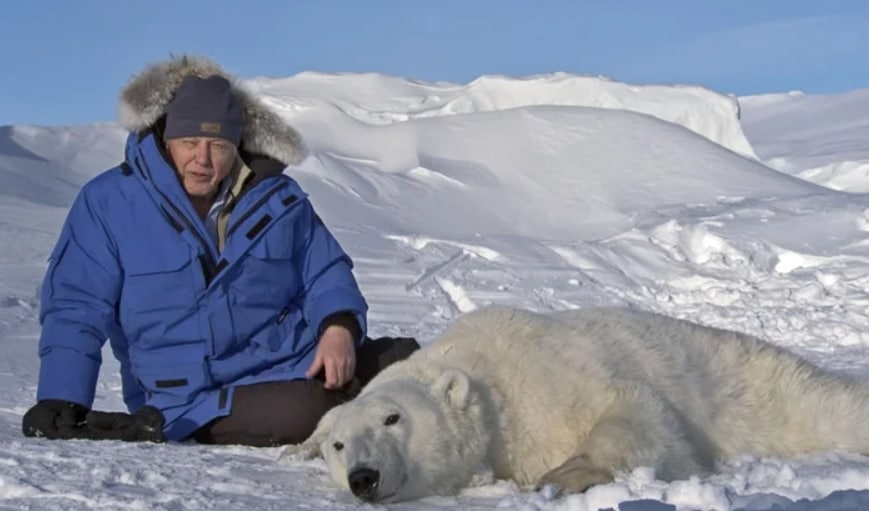
Unlike the jungles he covered (Seven Worlds One Planet), the oceans he brought into the living room (Blue Planet I, II & III), and polar life (Frozen Planet I & II), here he faced the camera from the grimness of a post-nuclear Ukrainian city. “Many people regarded it as the most costly disaster in the history of mankind. But Chernobyl was a single event. The true tragedy of our time is still unfolding across the globe… I’m talking about the loss of our planet…It’s biodiversity…It’s happening in my lifetime. I’ve seen it with my own eyes.”
Attenborough has seen more of this planet than any living being. From the middle of the 20th century to well into the 21st, he has travelled to the remotest parts of Earth to bring the natural world to viewers everywhere. He has witnessed the destruction of our natural world. Pripyat is a microcosm for a deeper global contagion.
Attenborough likely sees that contagion as part of a larger issue since he describes himself as a “standard boring left-wing liberal”. And in an era where science is being challenged by political authority across the world, he will see it as “misery really, the market economy”.
Soon after national service in the Royal Navy, Attenborough found himself with a job at the BBC, and he remained there for most of his employed life. He was not in front of the camera in the early years, working as a producer for various projects. It was Zoo Quest that launched him as a presenter, albeit with a voiceover from the studio. That was the show which made him a household name in Britain, khaki attire vivid despite the black and white footage, whether in West Africa or Indonesia, his Britishness conspicuous.
His most striking feature was his accent, of course — BBC posh, but not pompous. And it has remained that way, almost as a statement of his political philosophy. Even as he turned to greater climate advocacy in later years, Attenborough’s contribution to television broadcasting was not limited to the natural wonders of the world. In fact, as Director of Programming at the BBC, Attenborough introduced, as a 1998 interview in The New Statesman noted, “along with one-day cricket, Pot Black, floodlit rugby league and Match of the Day — a package designed as sport for the masses and now reinvented as fodder for Murdoch.”
Over the years, as he made his way to the front of the camera, Attenborough’s self-identification also altered, and he clearly selected the messenger role rather than that of the authority. “Because I appear on TV, people think I’m one of the great naturalists. That’s rubbish. Really, I’m a journalist, ” he once said.
In an era of climate denial and the pursuit of rampant profit over natural resources, Attenborough’s message resonates globally.
The writer is a former MP from Rajasthan
