



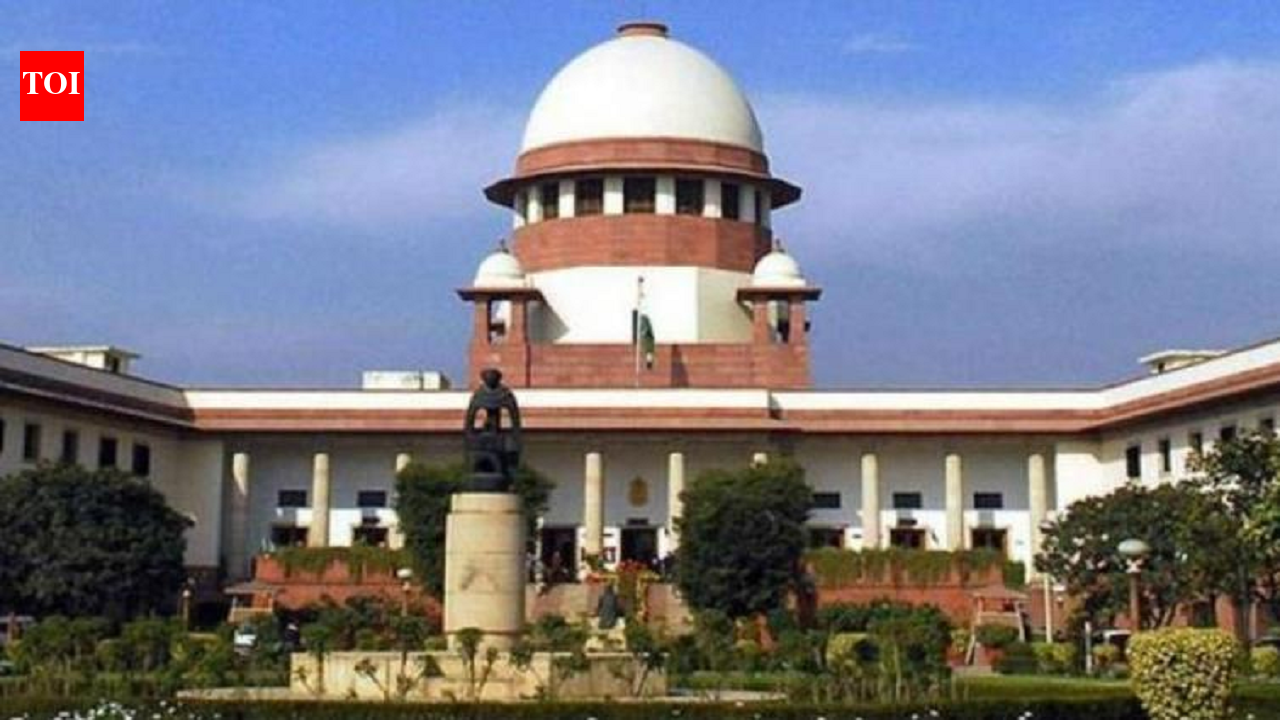
NEW DELHI: In a pro-religious practice stand, the Centre told a nine-judge SC bench that the constitutional mandate under Article 25(1) entitling all persons equal “freedom of conscience and the right freely to profess, practice and propagate religion” did not provide for gender equality.In his rejoinder, SG Tushar Mehta told a bench of CJI Surya Kant and Justices B V Nagarathna, M M Sundresh, Ahsanuddin Amanullah, Aravind Kumar, A G Masih, P B Varale, R Mahadevan and J Bagchi, “Article 25(1) does not provide for gender equality for the simple reason that Articles 15 and 16 already prohibit discrimination on the grounds, inter alia, of ‘sex’.”He said the expression ‘equally entitled’ conveyed non-discrimination on grounds of belief, faith, worship, religion or denomination. Every denomination was entitled to prescribe different modes of worship, beliefs and rituals for men and women.Advocating a hands-off approach for courts in religious issues, Mehta said only the legislature could bring about social reform through wide deliberations and discussions by representatives of people in Parliament or assemblies.“If courts may reform religion in the absence of legislation, whenever they determine that a practice offends the Constitution, there is, in practice, no limit on the judicial reformation of religious traditions. Every denomination’s internal discipline, every temple’s mode of worship, every faith’s institutional arrangements become permanently available for constitutional challenge. This consequence is not hypothetical, it has occurred in the Sabarimala case,” Mehta added.He added that the Constitution did not envisage constitutional courts as the “reformatory overlord of religious traditions of 1.4 billion citizens”. The bench reserved its verdict after a 16-day hearing spread over five weeks.Senior advocates Gopal Subramanium, C S Vaidyanathan, Rakesh Dwivedi and Rajeev Dhavan agreed with the SG’s stand. Subramanium said Articles 25 and 26, which confer individual and group religious rights, operated on separate spheres and hence there could not be any conflict between them to warrant judicial interference for a harmonious interpretation.Like individuals, every denomination had the right to practice, profess and propagate its religion, he said, adding, “Denominations survive because of its spiritual leaders and its own inner strength.”Dhavan, who appeared as a party in person, said Article 26 was most important as without denomination, there was no follower and no individual right to profess a religion. “Without property and institution (like temple, mosque or church), no denomination can survive. To manage the property and propagate its faith, the denomination needs autonomy,” he said.For Nair Service Society, Vaidyanathan said it would be wrong to presume that without an individual’s right to freedom of religion, there would be no denominational rights. “A denomination’s right to manage its religious affairs is not an aggregation of its individual members’ personal rights to practise religion. It is a distinct right, vested in the denomination as a body, and it protects something qualitatively different: the community’s authority over its own faith, doctrine, ritual and governance,” he said.
