



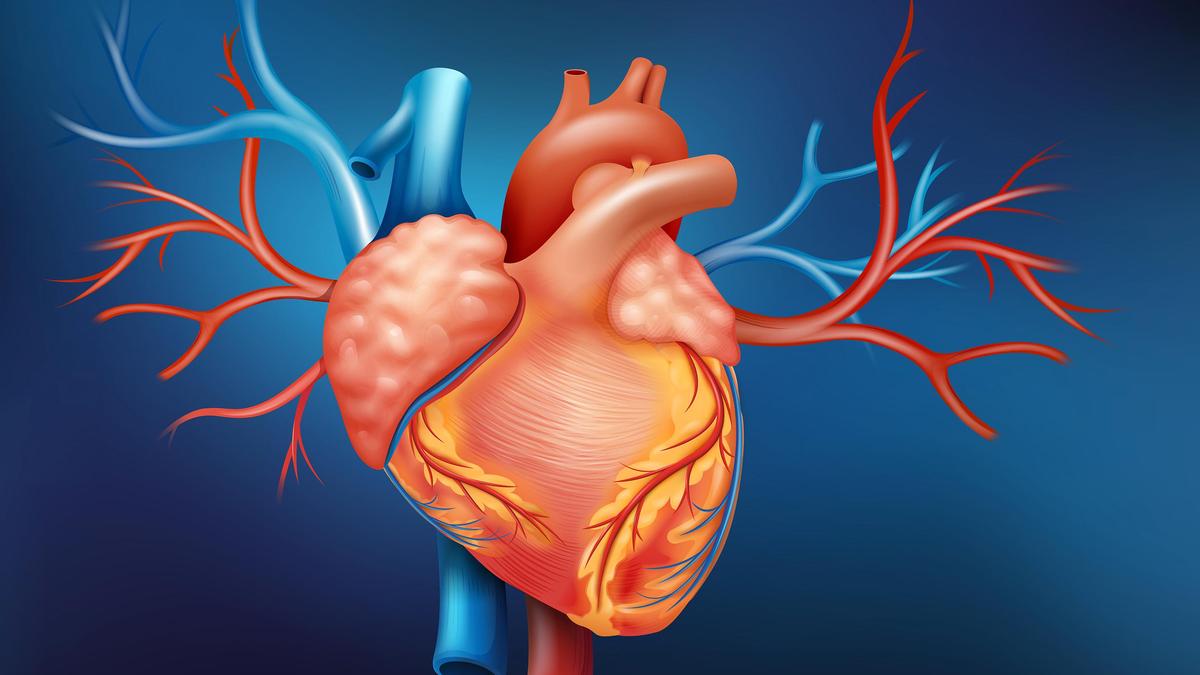
The human heart beats more than 1 lakh times a day, pushing blood through the body under constant physical strain. Every second, it encounters circulating cells, including cancer cells that travel through the bloodstream. Yet tumours of the heart are strikingly rare.
For decades, scientists have tried to explain this puzzle using genetics, immune surveillance, and the unique biology of heart cells. But these explanations have not resolved the paradox. Now, new research published in Science has pointed in a different direction — suggesting that the force of each heartbeat may itself limit the growth of cancer cells in the organ.
Clinical clue
The idea did not begin with cancer but with an unexpected observation in patients with severe heart failure, said Giulio Ciucci, a postdoctoral researcher at the International Centre for Genetic Engineering and Biotechnology, Trieste, Italy, and co-author of the study.
“Patients on heart-assist devices showed signs that their heart cells could start dividing again,” he added.
In adults, these cells are largely locked in place and rarely regenerate. Devices that support failing hearts reduce the mechanical load they normally endure.
This observation led to a broader question. If reducing this load allows heart cells to grow again, could the constant forces of a beating heart do the opposite by keeping cell growth in check, including that of cancer cells that reach the heart?
Role of physical forces
The researchers tested this idea in mice. They introduced cancer-causing mutations across multiple organs, expecting tumours throughout the body. Tumours formed in several tissues but not in the heart.
The team then altered the physical environment of the heart itself. In mice, they surgically implanted a second heart into another part of the body and connected it to blood vessels so it remained alive and beating, but no longer pumped blood through its left ventricle under normal mechanical load. This allowed it to receive blood without experiencing the forces generated by each heartbeat. In these “unloaded” hearts, cancer cells that had struggled to grow began to expand rapidly, in some cases occupying large portions of the tissue.
Even then, the researchers remained cautious. “We could see that mechanical forces were playing a role, but we needed clearer evidence,” Dr. Ciucci said.
To isolate the effect, they used lab-grown heart tissues made from living cells arranged into small, beating strips. These could be constrained to either contract or remain relaxed. Again, reducing mechanical activity allowed cancer cells to proliferate more easily, reinforcing the pattern.
Motion as a barrier
Taken together, these experiments point to a seemingly straightforward conclusion: the physical forces generated by a beating heart can directly suppress cancer growth.
With every contraction, heart muscles generate compressive forces that cells must withstand. For cancer cells, this creates a hostile environment that limits their ability to multiply. When this mechanical activity is reduced, the restraint lifts, allowing cancer cells to multiply more freely.
This suggests a different way of thinking about the heart. Its constant motion of circulating blood incidentally also creates physical conditions that are unfavourable for cancer to grow.
What makes this effect striking is that it extends into the cell’s nucleus, to the genes.
“Forces as macroscopic as those generated by a beating heart can directly and precisely reshape chromatin structure,” Dr. Ciucci said.
Chromatin is the name for DNA inside the cell, in its ‘packaged’ form. Some parts are tightly packed while others are more open, making the genes in those regions easier to activate. The researchers found that mechanical stress changed which parts of the DNA became easier for the cell to access. In beating heart tissue, regions linked to slowing or restraining cell division became more accessible, while signs of active proliferation declined. Together, these changes suggested that mechanical force shifted cancer cells away from a rapidly growing state.
To understand how this happens, the researchers investigated how mechanical forces might propagate within the cell. Their experiments pointed to a pathway involving the cytoskeleton — the cell’s internal support structure — and connecting proteins such as nesprin-2, which link the cytoskeleton to the nucleus. The findings suggested that stress from the beating heart may reach the nucleus through these physical connections and influence how DNA is organised and used.
Findings in context
The idea that physical forces can influence how DNA is organised is not new. But how cells sense and process these forces remains unclear, said Jan Lammerding, professor of biomedical engineering at Cornell University, U.S.
“Several previous studies have shown that the mechanical environment can lead to changes in chromatin organisation inside the nucleus, which then influence gene expression and cell fate,” he said.
What remains less clear is how these forces reach the nucleus. “It’s still uncertain whether the nucleus detects mechanical stress directly, or whether signals are first picked up elsewhere in the cell and then relayed inward,” he said.
Against this backdrop, the new study provides evidence that forces generated by a beating organ can indeed alter chromatin organisation and gene activity in cancer cells through physical connections inside the cell.
Implications and caveats
For Dr. Ciucci, the work has broadened how he thinks about cancer itself. If mechanical forces can influence gene activity in heart tissue, similar effects could be at play in other organs where cells are constantly stretched, compressed or exposed to physical strain, such as the lungs, blood vessels, and muscles.
That idea fits within a broader understanding of how the body responds to force. Mechanical signals generated by blood flow are already known to guide how heart and blood vessel cells grow and function, C.C. Kartha, ex-professor of eminence at the Rajiv Gandhi Centre for Biotechnology, Thiruvananthapuram, said. These signals are known to travel through molecular pathways that connect the cell surface to the nucleus, where they can influence gene activity.
What the “significant and stimulating” observations from this study show, he said, is that some of these same pathways may also act to suppress cancer cell growth in the heart, helping explain why tumours rarely take hold there.
But he cautioned that the picture is not straightforward. In other settings, mechanical cues from the tumour environment can promote cancer progression and metastasis.
“It would be important to identify which specific physical signals lead to these different outcomes,” he said.
Understanding that distinction could help researchers develop drugs that interrupt growth-promoting mechanical signals in tumours, while potentially enhancing the growth of healthy heart cells during regeneration, Dr. Kartha suggested.
Anirban Mukhopadhyay is a geneticist by training and science communicator from New Delhi.

