



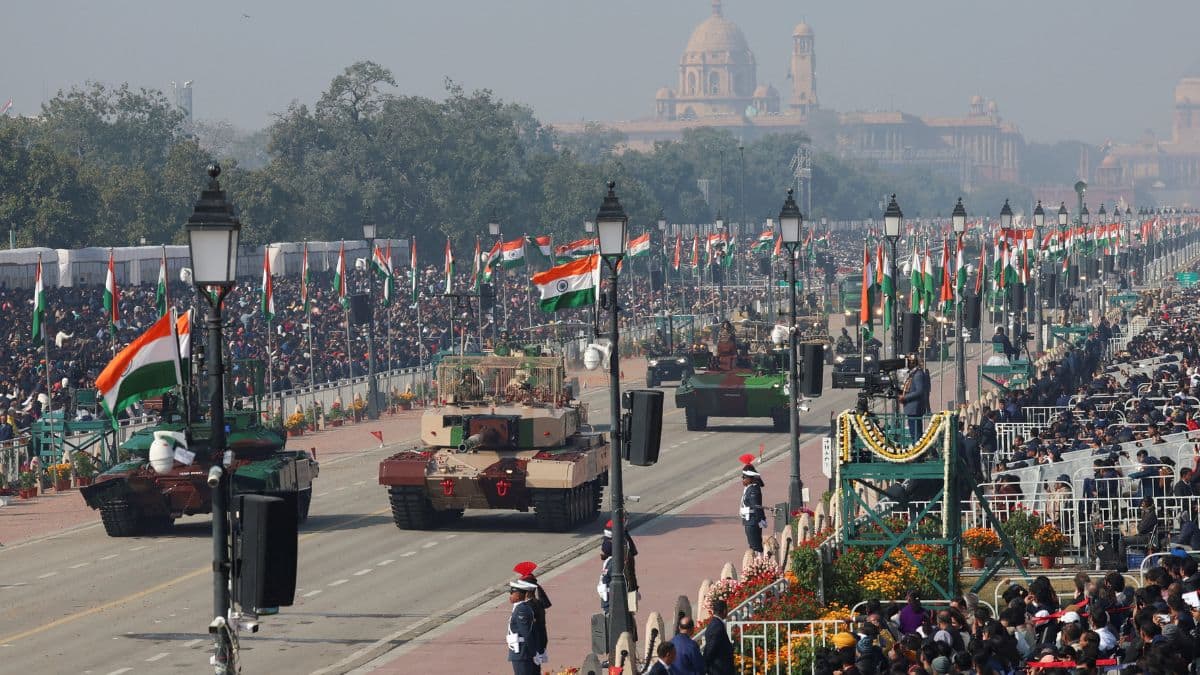
The Government of India released the Economic Survey 2025–26 last week. Growth this fiscal is expected to touch 7.4 per cent, against the initial projection of 6.3–6.8 per cent. The economy is clearly pushing the growth frontier. Trading is harder in the current geopolitical climate. The world remains mired in conflicts. Strong armed forces and a robust security establishment are imperative for the economy to prosper. Europe has just realised that overdependence on the US for its security will not work. Technologies are not easily shared, and therefore “Atmanirbharta” is the only way forward. All this requires funding, and therefore defence budgets are analysed with a fine-tooth comb.
Nirmala Sitharaman, Finance Minister of India, presented the Union Budget 2026 on February 1, 2026, the first budget after “Operation Sindoor”. The budget estimates real GDP at Rs 38,339,569 crore ($4.18 trillion). The total annual national budget was Rs 53.5 lakh crore ($580 billion), up 5.62 per cent. Capital expenditure is Rs 12.2 lakh crore, up by 9 per cent.
She allocated Rs 7.85 lakh crore ($85.6 billion) to the Ministry of Defence, up 15.2 per cent from Rs 6.81 lakh crore ($78.57 billion) last year. This constituted nearly 14.67 per cent of the total budget and 2.04 per cent of GDP.
Defence allocations are generally made under four heads: Ministry of Defence (MoD) (civil), defence services (revenue), capital outlay for defence services, and defence pensions. The total defence budget for 2026–27 (excluding pensions) is Rs 6,13,340 crore ($66.9 billion). India’s military was given Rs 2.19 lakh crore ($23.8 billion)—an increase of 21.84 per cent—for modernisation (capital outlay). Revenue expenditure for day-to-day operations and training of the armed forces has been set at Rs 382,330 crore ($41.69 billion), a 15.7 per cent increase. Rs 171,338 crore has been allocated for pensions. The defence budget (civil) has been reduced by 0.45 per cent compared to last year’s Rs 28,554.61 crore.
Out of the total allocation made to the MoD, 27.95 per cent is for capital expenditure, 20.17 per cent for revenue expenditure on sustenance and operational preparedness, 26.40 per cent for revenue expenditure on pay and allowances, 21.84 per cent for defence pensions, and 3.64 per cent for civil organisations.
Year of Reforms
The Ministry will observe 2025–26 as the ‘Year of Reforms’ to further strengthen the government’s resolve for modernisation of the armed forces and to aim for simplification of the Defence Procurement Procedure to ensure optimum utilisation of allocations. There is a strong focus on jointness and integration initiatives among the armed forces, evolving integrated theatre commands, and an emphasis on new domains such as cyber and space, artificial intelligence, hypersonics, and robotics.
The Defence Budget 2026–27 supports scaling up manufacturing in several strategic and frontier sectors, rejuvenating legacy industrial sectors, creating champion MSMEs, delivering a powerful push for infrastructure, ensuring long-term security and stability, and developing city economic regions. A central pillar of the growth strategy is scaling up manufacturing across strategic and frontier sectors. Semiconductors form another core element of the manufacturing agenda. The budget also signals support for critical minerals and materials.
Capital Budget: A Closer Look
In the current geopolitical scenario, where the world is witnessing a changing paradigm of modern warfare, the Indian Armed Forces need to be equipped with state-of-the-art weapons and transformed into a technologically advanced, combat-ready force. The Ministry of Defence has major projects in the pipeline, such as contracts for fighter jets, submarines, and unmanned aerial vehicles. Additional funding is also required for the LCA and AMCA programmes, among others.
Keeping this in view, Rs 2.19 lakh crore has been allocated for capital outlay of the defence forces. This allocation is 21.84 per cent higher than the budget estimate (BE) of FY 2025–26. It includes Rs 63,733 crore for aircraft and aero engines and Rs 25,023 crore for the naval fleet.
Out of this, Rs 1.85 lakh crore is earmarked for capital acquisition, approximately 24 per cent higher than the capital acquisition budget for FY 2025–26. During FY 2025–26, up to the third quarter (till December 2025), the MoD concluded contracts worth Rs 2.10 lakh crore and has, so far, accorded Acceptance of Necessity approval for more than Rs 3.50 lakh crore. Upcoming projects under capital acquisition will equip the armed forces with next-generation fighter aircraft, smart and lethal weapons, ships and submarines, unmanned aerial vehicles, drones, specialist vehicles, etc.
Interruptions in global supply chains and prioritisation of domestic requirements over foreign suppliers have re-emphasised the need for import substitution and indigenisation, not only for sustenance but also for future modernisation. In line with this, the MoD’s policy of earmarking funds to boost domestic industries through budgetary measures has been further strengthened by earmarking 75 per cent (Rs 1.38 lakh crore) of the capital acquisition budget for procurement through domestic industries during FY 2026–27. This reassures domestic players regarding investments and their expanding role in capability development of the armed forces. Enhanced allocation for capital acquisition, especially for domestic industries, will have a long-term positive impact on the national economy and lead to the development of many ancillary industries, creating employment opportunities. A significant part of this procurement will be from the private sector. The share of the private sector in total defence production rose from 21 per cent in FY 2023–24 to 22.56 per cent in FY 2024–25, marking three consecutive years of increase.
Key drivers of private sector participation include the new Defence Acquisition Procedure (DAP), prioritising ‘Buy (Indian-IDDM)’, ‘Buy (Indian)’, and ‘Buy and Make (Indian)’ categories. Positive Indigenisation Lists covering over 5,500 items restrict imports, forcing sourcing from domestic—including private—players. Up to 74 per cent foreign direct investment is allowed through the automatic route, encouraging joint ventures. The iDEX scheme received Rs 449.62 crore for FY 2025–26 to boost innovation among start-ups and MSMEs.
Major procurement subheads include aircraft and aero engines (Rs 63,733.94 crore), other equipment (modernisation) (Rs 82,217.82 crore), naval fleet (Rs 25,023.63 crore), and research and development (DRDO) (Rs 17,250.25 crore). The Joint Staff has received a capital budget increase of 85.82 per cent.
This allocation will cater to major acquisitions planned in the ensuing financial year and facilitate the MoD’s plans to venture into new domains such as cyber and space and emerging technologies like artificial intelligence, machine learning, and robotics. Major acquisitions planned for next year—such as long-endurance remotely piloted aircraft, stage payments for deck-based aircraft, and next-generation submarines, ships, and platforms—will be funded from this allocation. Capital investment in the defence manufacturing sector has a cascading multiplier effect on the national economy, boosting GDP and generating employment opportunities for the youth.
Operational and Sustenance Budget (Revenue)
The defence budget provides Rs 365,478.98 crore ($39.85 billion) for revenue expenditure, a 17.24 per cent increase over BE 2025–26. Of this, Rs 158,296.98 crore ($17.26 billion) is allocated for operations and sustenance, with the remainder for salaries and allowances. This will facilitate procurement of operationally critical stores and spare parts and ensure maintenance of vital platforms. Rs 207,183 crore has been allocated for pay and allowances of the three services, with any additional requirements to be addressed during the mid-year review.
The government has continuously increased allocations for sustenance and operational preparedness to meet requirements arising from additional border deployments, vessel hiring, longer naval deployments, and increased flying hours. Owing to its size, the Indian Army dominates the revenue allocation. Allocation for the Agnipath Scheme has seen a sharp rise, with Rs 17,396.18 crore allocated across the three services.
Boost for DRDO Allocation
The allocation to the Defence Research and Development Organisation (DRDO) has increased to Rs 29,100.25 crore in FY 2026–27 from Rs 26,816.82 crore in FY 2025–26. Of this, Rs 17,250.25 crore is for capital expenditure, marking a 15.59 per cent increase. This will support prototype development and strengthen indigenous R&D. The increased capital allocation will fund collaborative projects with private entities through flagship schemes such as the Technology Development Fund and aid the development of deep technologies in defence.
Strengthening Border Infrastructure
The government has reiterated its commitment to improving border infrastructure through enhanced allocations to the Border Roads Organisation (BRO). Capital allocation for BRO has been increased to Rs 7,394 crore for BE 2026–27 from Rs 7,146.50 crore in FY 2025–26. This will facilitate construction of tunnels, bridges, and roads in strategic regions and promote socio-economic development, employment, and tourism. BRO employs around 70,000 local youths, contributing significantly to local economies.
Continuous Support for Ex-Servicemen Welfare
The government has maintained higher allocations for veterans’ healthcare under the Ex-Servicemen Contributory Health Scheme (ECHS). For FY 2026–27, ECHS has been allocated Rs 12,100 crore, a 45.49 per cent increase over FY 2025–26.
There are approximately 34 lakh defence pensioners whose pensions are met from the defence pension budget. One Rank One Pension (OROP), implemented from July 2014, is revised every five years. The third revision, effective from July 2024, has been implemented in a timely manner. Defence pensions have been allocated Rs 171,338 crore, up 6.2 per cent from FY 2025–26, to address inflationary pressures.
Defence Exports
India’s defence exports reached a record Rs 23,622 crore in 2025, over 12 per cent higher than the previous year and nearly 34 times the level a decade ago. Exports are expected to cross Rs 25,000 crore ($2.88 billion) by the end of the fiscal year. Defence production hit record highs in FY 2024–25 at approximately Rs 1.54 lakh crore ($17.57 billion), driven by self-reliance initiatives, rising private sector participation, and export growth.
To Summarise
Describing the 2026–27 budget as “historic”, Prime Minister Narendra Modi praised its vision for a Viksit Bharat and emphasised increased defence allocation as central to national security. Defence Minister Rajnath Singh highlighted the budget’s support for defence manufacturing and recognition of critical minerals as strategic enablers.
Industry leaders welcomed the emphasis on MSMEs, rare earth corridors, research zones, and domestic manufacturing. The allocation signals prioritisation of the domestic industrial complex, with major contracts expected across aircraft, helicopters, submarines, artillery, and armour.
While challenges remain in accelerating acquisitions and reducing dependence on imports, India has emerged among the top 25 arms exporters. Capital allocations continue to rise, and long-term reforms are underway. As India remains a highly threatened nation, capability-based defence budgeting is essential. The budget signals the government’s intent to steadily build national defence capabilities through gradual, sustained reforms.
(The writer is former Director General, Centre for Air Power Studies. Views expressed in the above piece are personal and solely those of the author. They do not necessarily reflect Firstpost’s views.)
End of Article
