



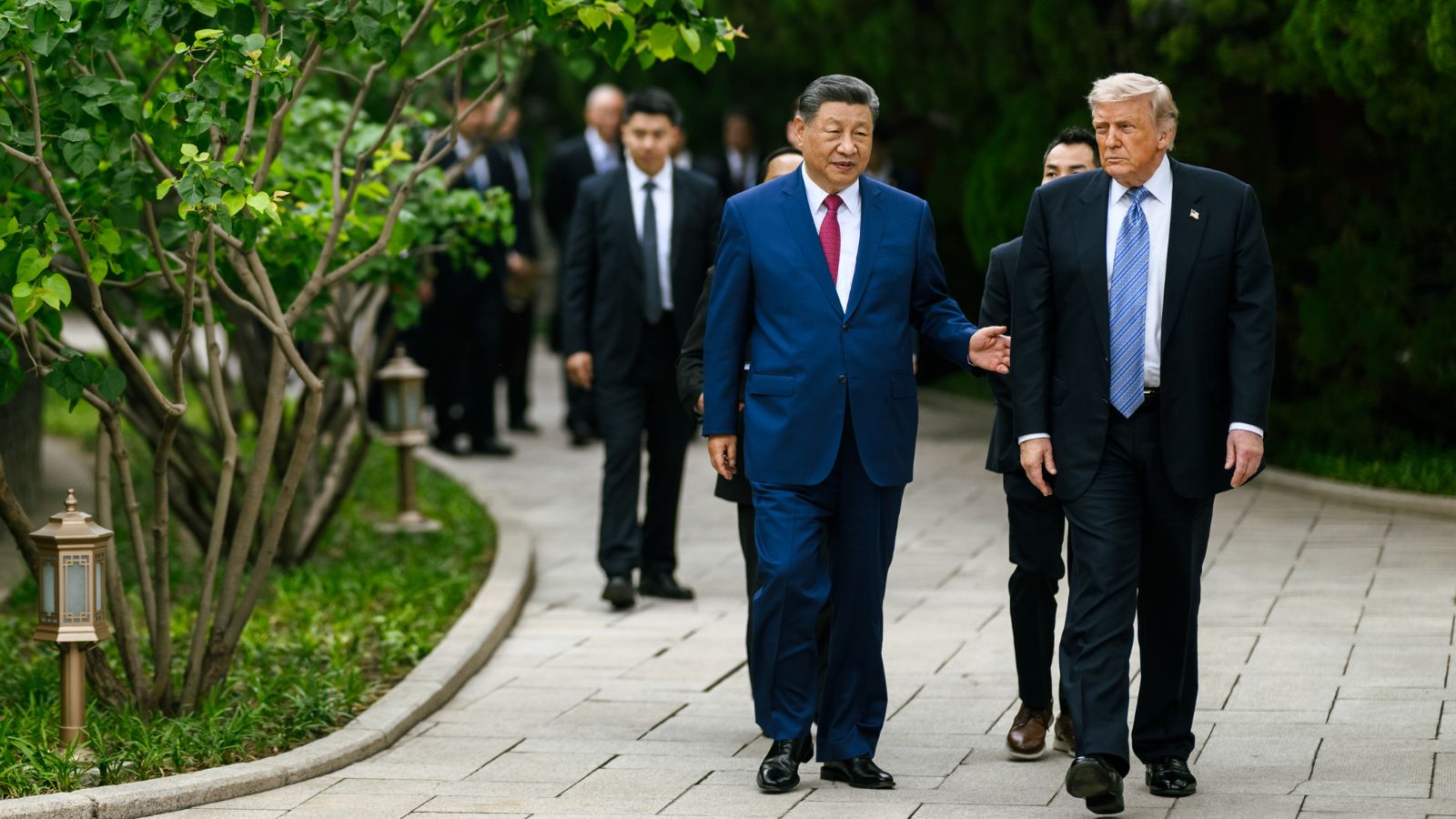
Donald Trump’s state visit to China was a performance of diplomacy: Carefully choreographed, heavy on optics, and light on binding detail. Both sides were eager to show progress: Trump called the visit “very successful”; Xi Jinping declared it “historic”. The Chinese catered to Trump’s weakness for spectacle with the state banquet, the parting tea, and Xi accompanying Trump to the Temple of Heaven – but the substance, as expected, was meagre. Significantly, Beijing, not Washington, controlled the narrative throughout.
Trump needed a foreign-policy “win” to serve as a distraction from the political headwinds of the Iran war, and to impress markets and domestic constituencies. Xi needed validation: That China had weathered the tariff storm, emerged from geopolitical friction with its strategic position intact, and was now being courted as a peer by the US, something Chinese leaders have long sought. Both got what they came for. But Xi got a little more.

The new formulation — “constructive strategic stability” — for the bilateral relationship, described by Foreign Minister Wang Yi as “the most important political consensus” of the summit, is Beijing’s handiwork. It is a deliberate conceptual move to displace the American vocabulary of “strategic competition” with a Chinese-preferred notion of long-term coexistence with guardrails. Beijing acknowledges the relationship as competitive but talks about keeping it within acceptable limits. Xi’s four-part elaboration — “positive stability with cooperation as the mainstay, healthy stability with competition within proper limits, constant stability with manageable differences, and lasting stability with expectable peace” — is designed to lock in the post-Busan détente.
Trump, characteristically, reached for a simpler frame: “It’s the two great countries… I call it the G-2.” The image of two great powers on equal footing was exactly what Xi had engineered. Both sides signalled a willingness to manage the relationship through summitry and bilateral validation rather than the harder work of resolving underlying disputes.
The tale of two readouts illuminates how much remains unresolved. The White House summary emphasised commercial commitments — Boeing aircraft orders, agricultural purchases, market access, Chinese investments — and agreement that the Strait of Hormuz must remain open and not be militarised. The Chinese readout was cautious and silent on most US specifics. Neither readout mentioned China’s state-nurtured industrial overcapacity and other systemic differences. Most structural problems were kept off the table, allowing China to preserve its policy space.
But Taiwan was an exception. The most striking moment was Xi’s Taiwan warning, delivered in a highly staged, public setting carried immediately by state media. If the Taiwan question is handled “poorly”, Xi said, the two countries risk “clashes and even conflicts”. Taiwan was absent from the US readout entirely. On Air Force One, Trump said he made “no commitment either way” on the pending $14 billion arms package and called it “a very good negotiating chip”. When a reporter invoked Ronald Reagan’s assurance to Taiwan that no president would consult Chinese leaders on arms sales, Trump dismissed the premise. Decades of US commitment on “Six Assurances” to Taiwan were waved aside.
On Iran and maritime security, the summit produced a measure of concrete, if still qualified, convergence. Both leaders agreed that the Strait of Hormuz must remain open. According to the US readout, Xi expressed interest in purchasing more American oil, agreed that Iran cannot acquire a nuclear weapon and committed not to sell weapons to Iran. The Chinese readout was circumspect, and the gap between Washington’s public optimism and Beijing’s operational delivery has a long history. The continued closure of the Strait is hurting China, but it is disinclined to deploy its leverage with Iran beyond a point.
On technology and AI — perhaps the most consequential long-term dimension of the rivalry — the summit was studded with ambiguity. Trump confirmed that chip exports came up, and that Xi told him China wants to make its own: A candid declaration of an indigenisation agenda. Licences for 750,000 H200 Nvidia chips remain stalled on the Chinese side, even as the US has cleared sales. Both sides have frozen new technology controls since the October 2025 truce, a freeze that disproportionately benefits Beijing. An AI dialogue was agreed in principle; its content remains undefined.
Conspicuously absent from both readouts were rare earths and export controls, despite their centrality to the current détente. China’s weaponisation of critical mineral supply chains — shutting off rare-earth exports last year and forcing Washington to stand down from tariff escalation — is the background condition for the Busan truce, reaffirmed in Beijing. That leverage is carefully maintained, and a China-resilient rare-earth supply chain remains years away.
The larger truth is structural and enduring. China has gained relative to the US and grown more confident despite its economic headwinds. It has the tools, patience and the strategic discipline to manage escalation dynamics. China is ready for long-term, indefinite competition. As Da Wei of Tsinghua University observed: “The US side looked a little passive. The Chinese side prepared very well.” Trump’s instinct for spectacle suits Beijing well; it allows Xi to accumulate the symbolic validation of peer-to-peer summitry without meaningful concessions. The summit was, in that sense, a tactical triumph for China.
For India, the summit is a sobering signal. The immediate effect — reduced risk of sudden great-power crises, some easing of energy market pressures — is modestly positive. But the structural implications are more uncomfortable. The G2 “overlay” — not a formal duopoly, but the atmospheric effect of two great powers coordinating — narrows the manoeuvring space available to other major powers, India included. A Beijing that reads India’s interest in improving bilateral relations as a result of India’s declining importance in the US strategic calculus has less incentive to offer meaningful concessions on unresolved issues.
The visit is a continuation of a tactical détente, not a strategic reconciliation. By agreeing to a rhetorical framework of “strategic stability”, the US and China are buying time even as they know that strategic rivalry is baked in the system. Yet, it is advantage Beijing.
The writer is former ambassador to China and holds the Subhas Chandra Bose Chair of International Relations, Chanakya University, Bengaluru
