



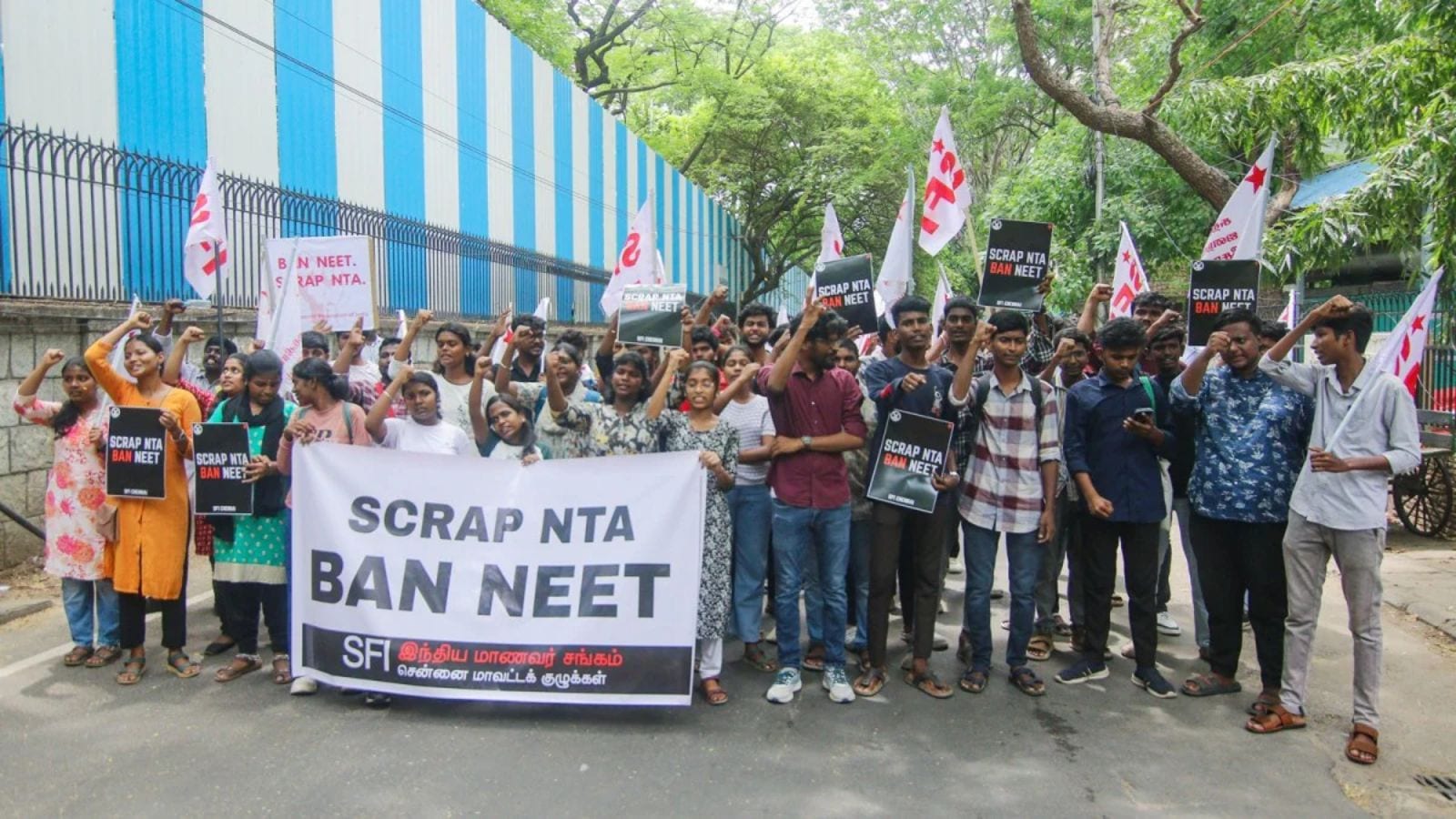
For the third time in recent years, the NEET examination has been marred by a paper leak — a phrase that has become, with grim predictability, a seasonal feature of India’s medical admissions calendar. The hopes of 22 lakh students are once again temporarily dashed. They go home, not relieved of a burden but still high-strung, facing a repeat examination and all the uncertainty that lies beyond it. Young men and women who have spent years in relentless preparation — after-school coaching, sleepless nights, the full weight of family expectation — have met their first roadblock before their journey even began. The frustration on their faces, visible in images circulating on social media, is not the frustration of a single bad morning. It is the accumulated anguish of years.

The paper leak raises questions that ought to disturb us deeply. In an era of digital encryption, blockchain-secured communication, and multi-layered cybersecurity protocols, how does a national examination of this magnitude remain so porous? The answer points, regrettably, toward structural corruption. Well-organised networks — often traceable to the commercial interests of large coaching institutions anxious to demonstrate the success rates of their students — appear to have cultivated contacts within the examination ecosystem itself: Those involved in question setting, collation, or distribution. It must also be said that NEET has provided an unintended but powerful impetus to the mushrooming of coaching centres across the country, several of them operating in conditions of overcrowding, unrelenting stress, and performance pressure that exceed reasonable human limits, driving a distressing number of aspirants toward depression, and some to suicide.
It is worth returning to first principles. NEET was introduced in 2013 to ensure uniformity in assessing eligibility for medical education, to uproot the menace of capitation fees, to end corruption in seat allocation, and to establish merit as the sole criterion for selection. These were not small ambitions. A decade later, each of these objectives deserves honest appraisal, not institutional self-congratulation.
Capitation fees have not been uprooted. Several private medical colleges continue to collect substantial sums above prescribed limits from candidates who possess the grades but not the means. More troublingly, the structure of NEET cut-offs has produced a perverse outcome: Low qualifying percentiles now favour the less meritorious but financially resourceful candidate over the more meritorious but economically constrained one. The student, compelled to borrow in order to capitalise on a hard-earned rank, enters medicine carrying a debt that reshapes every professional decision thereafter. The ethic of service that might have taken root at the threshold of a career is not lost through moral failure — it is foreclosed by financial obligation. Such graduates are driven, almost by design, into early private practice and commercially induced clinical behaviour. Ahead of them lie not one but two further examinations — NEET Postgraduate and NEET Superspeciality — with the same rigmarole. This repetitive cycle leaves doctors burnt out and diminished in their zeal to serve.
The consequences extend further. The middle-class graduate is pushed toward revenue-generating practice. Many of the most talented, merit-driven graduates — drawn by better professional environments and more enabling systems abroad — leave at the first opportunity. Both outcomes represent a loss the country can ill afford. India’s doctor-to-population ratio in several states remains dangerously below acceptable benchmarks. Community health centres across Tier 2 and Tier 3 districts report chronic vacancies. This is not a future concern — it is a present emergency. An admissions system that consistently diverts talent away from public service is not a neutral administrative arrangement; it is a structural problem with direct health consequences.
None of this is to say that NEET has produced nothing of value. The creation of a common national platform, the reduction in the multiplicity of competing entrance examinations, and some improvement in transparency within government college admissions are real, if partial, achievements that deserve acknowledgement. But partial success does not excuse systematic failure, and the failures are now too numerous and too consequential to be addressed by incremental adjustment.
The time has come for a rigorous, multi-pronged retrospective appraisal. Have the objectives set at conception in 2013 been met? Has NEET produced better medical graduates for the nation? Has it meaningfully curbed capitation, quantitatively and qualitatively? Has it increased the supply of doctors available to serve in health-impoverished geographies? Has it brought greater equity in the allocation of medical seats for economically disadvantaged and tribal communities? Has it, in any measurable sense, produced a generation of doctors who place the patient above self-interest? These are not rhetorical questions. They are the terms on which this examination was originally justified, and the country is owed honest answers.
The government’s immediate obligations are clear: Conduct the rescheduled examination with security measures commensurate with the stakes involved; provide verifiable redress to affected students through fee refunds and adequate notice; and institute an independent forensic investigation into this and previous leaks — one that names, charges, and prosecutes those responsible. The leadership of the National Testing Agency must account publicly for a pattern of failure that has become indefensible.
Beyond the immediate, a larger act of institutional honesty is required. The reform needed is not cosmetic. It must address examination security, fee regulation in private medical colleges, incentive structures that make rural and public service genuinely viable, welfare standards for aspirants caught in the coaching ecosystem, and accountability mechanisms for the institutions that have profited most from the current disorder.
Incompetence, lack of integrity, and unacceptable examination conduct have brought the standing of this national examination to its lowest imaginable point. That is not a political statement. It is a description of what is.
India has produced, across generations, physicians of extraordinary skill and dedication who have served this country and the world well. The question before those who govern this system today is not a complicated one: Does the process we have built honour the students we are putting through it, and does it serve the people those students are meant to heal?
The writer is former director, CMC Vellore

