



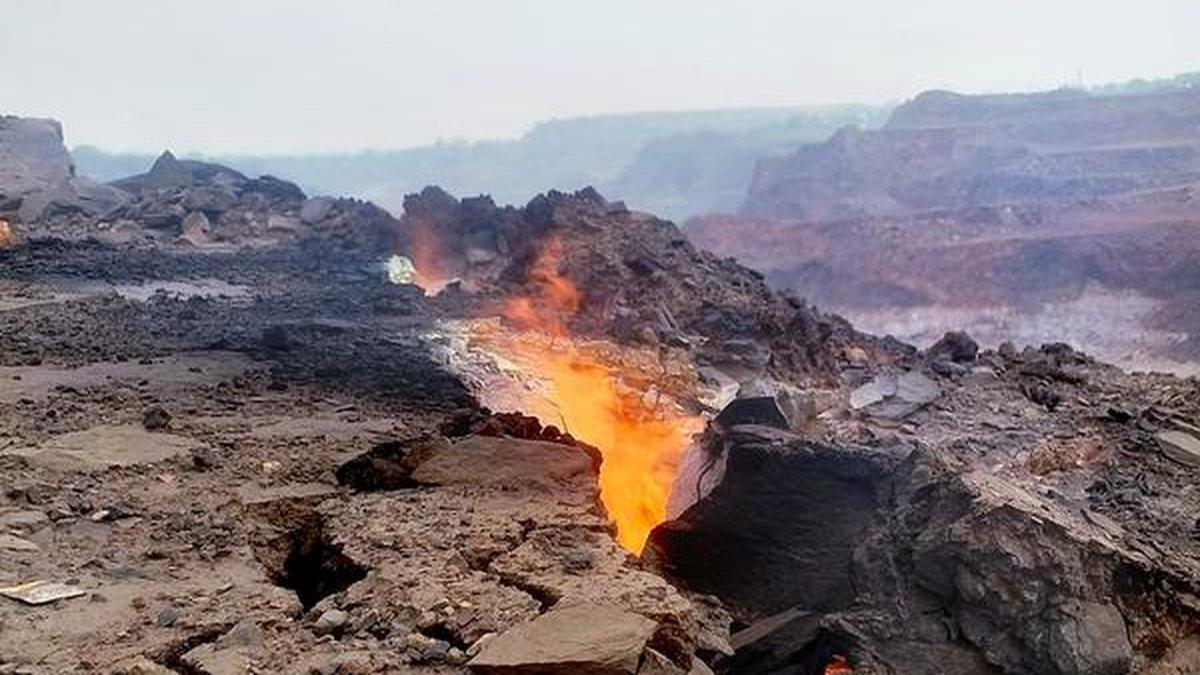
An underground fire burning in Jharia, Jharkhand, August 2024.
| Photo Credit: Amit Bhelari/The Hindu
Fires have burnt beneath the Jharia coal fields in Jharkhand for decades now, releasing smoke and gases through cracks in the ground. And according to a new study, parts of this underground fire system may burn hotter and release more greenhouse gases than previously estimated.
Researchers from the U.K. and India, including the CSIR-Central Institute of Mining and Fuel Research (CIMFR), reported in a May 18 paper in Communications Earth & Environment that the collapse structures created when underground fires consume coal seams and destabilise the rock above them can stretch vertically for more than 100 m through the earth, venting hot gases into the air.
When mining exposes coal to oxygen, natural oxidation reactions can trigger underground fires that smoulder for decades. Previous estimates suggested fires in the region already emitted copious greenhouse gases, but scientists have struggled to track them accurately because the fires spread irregularly.
The new study focused on the Ena, Bastacolla, and Tisera collieries. In 2018-2023, the researchers used numerical modelling and mineralogical analysis to document collapsed structures up to 10 m wide, collected samples of melted rock and glass-like materials, and analysed their composition.
The researchers found that larger cavities often had paralava: rock melted and re-solidified by the heat of coal fires. At Ena and Tisera, they found a kind of fused, glass-enveloped rock they nicknamed “birianiite”, reflecting the rock’s mix of geological ingredients and its resemblance to the popular rice dish.
Global fire outbreaks hit record high as ‘unprecedented’ heat extremes loom, scientists say
Since it was hard to directly measure the temperature inside active collapse structures, the researchers combined field observations with computer modelling. Their simulations suggested that large, isolated collapse structures could, on paper, approach 4,000 C in some conditions, much higher than estimates commonly associated with underground coal fires.
Using modelling based on the amount of coal likely burned in the structures, the team also estimated the global warming potential of Jharia’s fires at up to 748.72 MT of CO2-equivalent per year — nearly twice the U.K.’s reported territorial emissions in 2023.
While industrial emissions are subject to rigorous monitoring, fugitive emissions from uncontrolled coal fires like in Jharia are seldom part of global greenhouse gas audits. However, the authors acknowledged their model excluded some real-world processes, including chemical reactions and mechanical deformation, that could alter the temperature estimate. Likewise, the emissions estimate depends strongly on assumptions about the extent of burning, among other factors.
mukunth.v@thehindu.co.in
Published – May 20, 2026 07:45 am IST

