



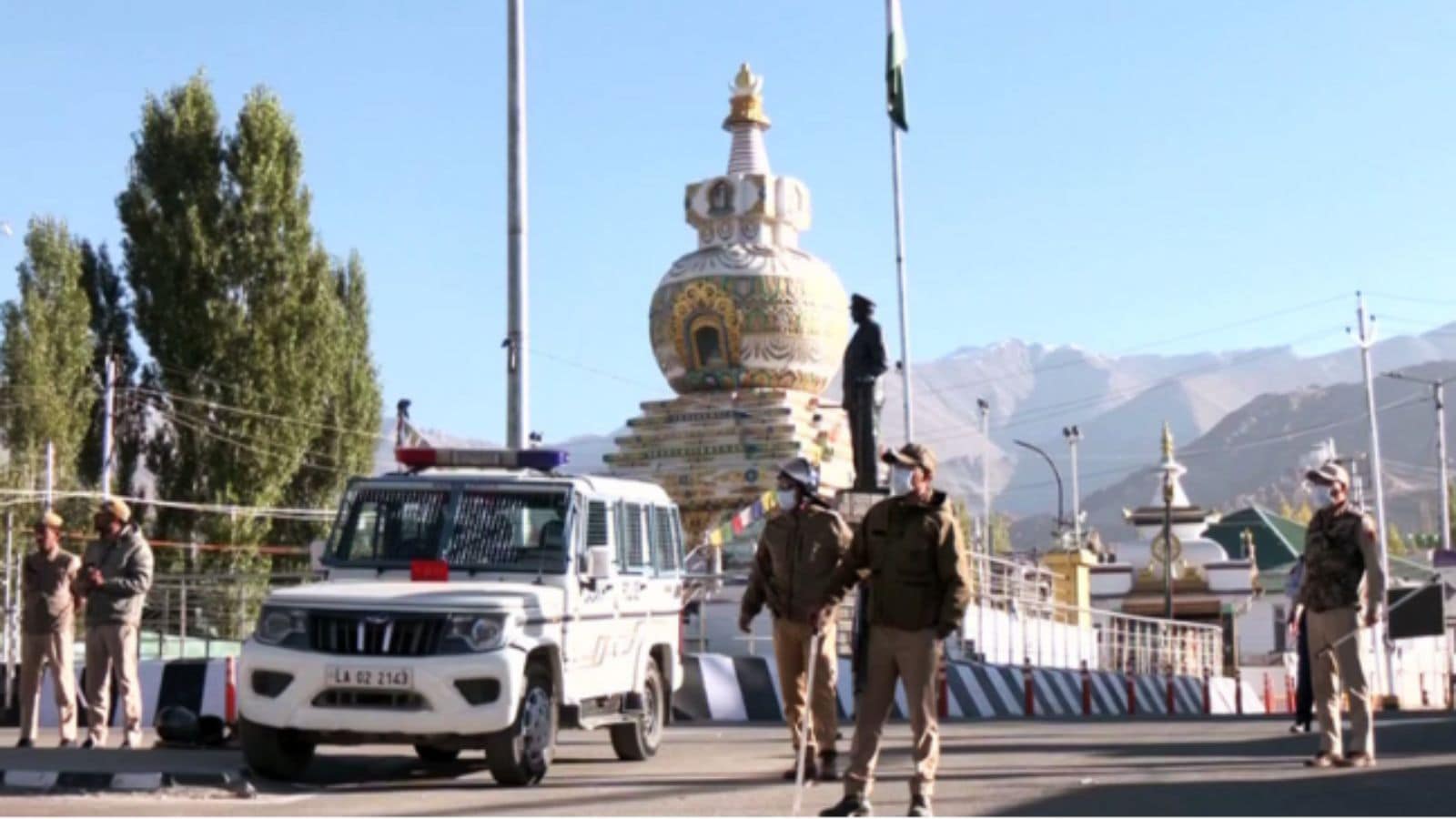
How sad and ironic that the Ministry of Home Affairs, Government of India, argues that Ladakh needs more districts rather than a legislature or stronger constitutional safeguards under the Sixth Schedule. It contends that Ladakh’s sparse population, strategic sensitivity and financial dependence on the Centre make a legislature unnecessary. Instead, it offers administrative decentralisation through additional districts.
This argument is fundamentally flawed and reveals an impoverished understanding of democracy. Let’s break this down. The British Empire argued not too long ago that Indians lacked the maturity and institutional capacity for self-rule. It was against such paternalism that Sri Aurobindo pioneered the ideal of Purna Swaraj — absolute self-governance — rooted in dignity and national selfhood. The British were on the wrong side of history. And yet, after 80 years of Independence, the same argument revives the old colonial logic. Must Ladakhis prove once again that they are sufficiently populous, profitable and capable to deserve a voice in the body politic? Does being geographically vast, sparsely populated and strategically located go against deserving a legislature?

The recent announcement of five additional districts — Nubra, Changthang, Sham, Zanskar and Drass — has been celebrated as a major governance reform. Certainly, administrative accessibility matters in a region spread across nearly 59,000 sq km of high-altitude terrain. But districts cannot legislate on land protection, demographic safeguards, ecological preservation, employment priorities, cultural autonomy, renewable-energy negotiations, education policy or the long-term developmental vision of the region. Districts are instruments of administration. Legislatures are instruments of representation. No amount of administrative decentralisation and convenience can substitute for political agency.
The most troubling aspect of the present discourse is that the Centre itself repeatedly promised constitutional safeguards to Ladakh. After the abrogation of Article 370 and the creation of the Union Territory in 2019, the BJP, in its manifestos for the MP and Hill Council elections in 2019 and 2020 respectively, articulated assurances regarding the Sixth Schedule. Yet once it won on these very manifestos, it went back on its commitments. Can promises made to frontier populations become expendable after elections?
What of the objections themselves? Take the first one — that Ladakh is too strategic a border to be trusted with self-government. Arunachal Pradesh shares one of India’s most sensitive borders with China. It is geographically vast, sparsely populated, strategically critical and financially dependent on the Centre. Yet when it was granted full statehood in 1987, India understood that people who feel politically enfranchised and constitutionally respected defend a nation more fiercely. If strategic sensitivity was an argument for empowerment in one Himalayan frontier, by what logic does it become an argument against it in another?
The same applies to much of the Northeast. When Nagaland was granted statehood in 1963, its population was barely 3.5 lakh. Mizoram became a state in 1987 with a population of roughly 5 lakh. Sikkim entered the Indian Union as a state in 1975 with a population of barely 2 lakh. Arunachal Pradesh had roughly 6 lakh people at the time of statehood. None of these states was financially self-sufficient. Many remain substantially dependent on central transfers even today. India did not tell them they were too small, or too poor, or too remote for a legislature. It understood that you integrate through belonging.
Which brings us to the fiscal objection — the weakest of the three. Ladakh, we are told, cannot generate enough revenue to sustain itself. But since when has fiscal solvency become the price of admission to Indian democracy? India’s federal structure is built on redistribution. Even large states depend heavily on central devolution. Uttar Pradesh, the most populous state in the country, draws enormous sums from the Centre through tax devolution, central schemes and grants-in-aid. Bihar, Assam and many other states similarly rely on fiscal transfers to bridge developmental disparities. Several Northeastern states derive between 70 per cent and 90 per cent of their expenditure from central assistance.
The same establishment that calls Ladakh economically negligible is, at this very moment, planning to build some of the country’s largest energy infrastructure on its land. The renewable project slated for the Pang region of Changthang totals roughly 13 gigawatts of combined capacity, spread across tens of thousands of acres of high-altitude pastureland. At an investment of approximately Rs 50,000 crore and a potential of Rs 7,000 crore of annual income, it is the arithmetic of a region central to India’s energy future. Increasingly, Ladakhis are witnessing decisions regarding solar parks, transmission corridors, mining possibilities, tourism expansion and land use. So the real question sharpens: Who negotiates the terms of that transformation? Who decides the land rights, the grazing rights, the ecological limits, the royalty owed to the people whose ground it is, and inter-generational sustainability? That is the work of a legislature — of representatives who answer to the people.
India’s greatness was the constitutional imagination to hold staggering difference inside one Union without flattening it — the same imagination that produced the Sixth Schedule in the first place, on the understanding that fragile, distinct frontier places need protections the plains do not. Ladakh is not asking to belong to India less. It is asking to belong more completely.
Sri Aurobindo wrote that freedom is the necessary atmosphere for a nation’s soul to grow. The soul of this nation has always been largest at its edges, in the places that chose Bharat and then defended it through cold, hardship and sacrifice. The voice rising from the mountains of Ladakh today is not a demand for privilege. It is an appeal to be trusted with itself.
The writer is founder of Himalayan Institute of Alternatives, Ladakh. She moved the Supreme Court against the detention of her husband, Sonam Wangchuk
