



The year 2018 was monumental in American foreign policy. The US dealt with two Asian nations that are militarily and financially weak compared to its military might and economic power.
However, there was a stark difference in Donald Trump’s approach—impractical and brash with one nation, practical and cordial with the other.
Iran and North Korea.
How Trump Dealt With Iran
In May 2018, Trump pulled out of the Joint Comprehensive Plan of Action (JCPOA), or the Iran nuclear deal despite Tehran complying with the agreement.
Terming the deal “a giant fiction”, Trump said that it was “a horrible one-sided deal that should have never, ever been made. It didn’t bring calm”. He cited Iran’s ballistic missile programme as the reason for the pullout though it wasn’t a part of the deal.
Iran had agreed to reduce its uranium stockpile by 98 per cent, restrict enrichment to 3.67 per cent, decrease the number of centrifuges at Natanz to 6,104 for the next 10 years, stop enrichment at Fordow for 15 years, fill the Arak reactor with concrete and provide unfettered IAEA access to its nuclear facilities and potentially to undeclared sites.
In exchange, the EU, the UN and the US committed to lifting nuclear-related sanctions.
Trump, who has limited knowledge of international affairs, was influenced by war hawks.
A little more than a week before the US withdrawal, Benjamin Netanyahu, who staunchly opposed the JCPOA, presented 55,000 pages of documents and CDs in Tel Aviv explaining Iran’s Project AMAD, a clandestine plan to build five nuclear weapons by 2004.
The Israeli PM was right—but Iran had halted the project way back in 2003 after a secretive dual-use uranium enrichment facility at Natanz and a heavy-water production facility (for plutonium) at Arak were revealed, alarming the IAEA.
Similarly, Trump’s NSA John Bolton, a prominent anti-Iran hawk who advocated bombing Iran’s nuclear facilities and had lied about Saddam Hussein hiding WMDs and the dictator seeking “yellowcake” uranium from Niger in 2002, also persuaded Trump to pull out of the JCPOA.
In his second term, Trump exerted maximum pressure on Iran to give up uranium enrichment and sign a new nuclear deal. Despite Iranian foreign minister Abbas Aragchi meeting Trump’s Middle East envoy Steve Witkoff five times, the US president, again under Netanyahu’s influence, backed the Israeli attack on Iran and bombed the nuclear facilities in Natanz, Fordow and Isfahan last June.
Now, Trump might attack Iran again—on the pretext of democracy and supporting the recent anti-regime protests.
After holding back, claiming that Iran had halted the execution of arrested protesters, he has threatened to “wipe out” Iran and said that an American “armada” is headed to West Asia (the USS Abraham Lincoln Carrier Strike Group left the South China Sea last week for the region).
If Iran were a nuclear power, neither Trump would have bombed its N-plants nor Israel would have attacked in June 2025. That’s precisely the reason Israel, the only nuclear power in West Asia, opposes a nuclear Iran.
How Trump Dealt With North Korea
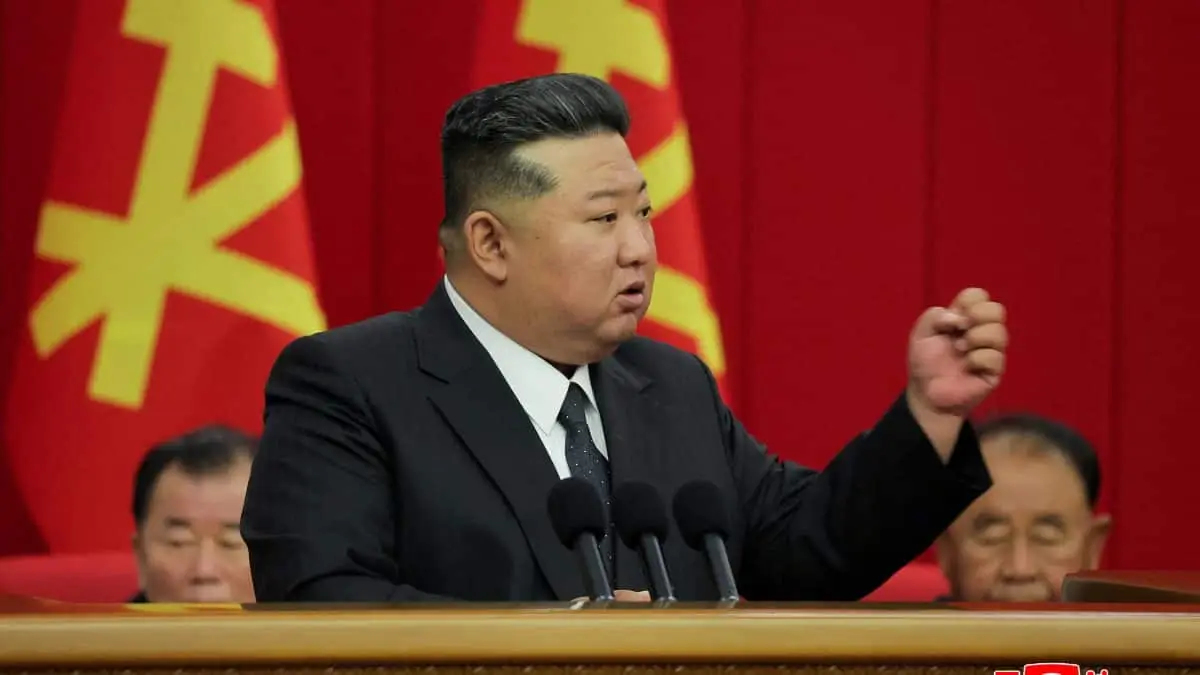
Around June 2018, Trump, without his typical coercion or brashness, cordially met North Korea’s Supreme Leader Kim Jong-un in Singapore.
The US president met the North Korean dictator two more times. The second time in Hanoi in February 2019. The third time was historical as Trump crossed the border at the Demilitarised Zone (DMZ) to shake hands with Kim in June that year, becoming the first sitting American president to set foot on North Korean soil.
Strangely, Trump met Kim thrice after a series of insults back and forth between them with the president threatening “fire and fury”, mocking him repeatedly as the “Little Rocket Man”, and threatening North Korea with his “much bigger and more powerful nuclear button” after the dictator’s nuclear threat.
Trump’s different ways of dealing with Iran and North Korea highlighted an important aspect of realpolitik.
Both nations were clubbed by George W Bush in 2002 into the “Axis of Evil” for ‘sponsoring terrorism and seeking WMDs’—neither of them and Iraq, the ‘third member’, had any role in 9/11 nor WMDs were ever found in Iran nor Iraq.
Why did Trump, infamous for coercing and humiliating other nations into toeing the American line as the self-proclaimed dealmaker, change his tactics in dealing with North Korea?
The US is ranked No. 1 in the 2026 Global Firepower Index compared to North Korea’s 31st position. North Korea would be “wiped out”, as Trump has said regarding Iran, in a war with the US.
The answer is North Korea’s nuclear deterrence and ICBMs.
The futile Trump-Kim meetings proved that North Korea would never dismantle its nuclear arsenal.
Trump still wants to meet Kim.
Last August, he agreed with South Korean President Lee Jae Myung at the White House regarding meeting Kim. “I look forward to seeing him. He was very good with me,” he told reporters.
Successive US administrations have failed to curb the North Korean nuclear programme, which has been a deterrent against American threats and helped Kim negotiate with the US from a position of strength.
North Korea’s Nuclear, Missile Capabilities
North Korea’s 50 nuclear warheads—though the lowest among the nine N-powers—a wide array of SRBMs, MRBMs, IRBMs, ICBMs and two SLBMs have worried the US and its allies, South Korea and Japan, for decades.
According to a September 2025 Congressional Research Service (CRS) report, North Korean nuclear weapons and ICBMs pose a threat to the “United States homeland, US allies in East Asia and US interests”.
North Korea has carried out six underground nuclear tests, the first in 2006 and the last in 2017—a hydrogen bomb that can be deployed on an ICBM—with increasing yields.
Despite announcing a freeze on nuclear testing in 2018, North Korea, per a 2025 US Defense Intelligence Agency (DIA) report, “restored its nuclear test site and is now postured to conduct a seventh nuclear test at a time of its choosing”.
North Korea reportedly continues to produce plutonium and highly enriched uranium for weapons. According to an IAEA 2025 report, operations at the Yongbyon uranium centrifuge enrichment plant and “undeclared enrichment facilities” continue. An estimate concluded that North Korea has enough fissile material for around 90 warheads.
Kim has also improved the miniaturisation of warheads, key to deployment on a missile. In January 2021, he said that North Korea can “miniaturise, lighten and standardise nuclear weapons and to make them tactical ones”.
Several North Korean nuclear-capable/conventional ICBMs can strike the US West Coast or the mainland.
The Hwasong-14, Hwasong-15, Hwasong-17, Hwasong-18, Hwasong-19 and Hwasong-20 can carry either nuclear or conventional warheads. Of these, the Hwasong-19 and Hwasong-17 have multiple independently targetable re-entry vehicle (MIRV) payloads, which contain several warheads with each capable of striking a different target.
The SLBMs, Pukguksong-1 and Pukguksong-3, can carry both nuclear and conventional payloads.
Moreover, North Korea is among a select few nations to have hypersonic missiles. The Hwasong-8 MRBM, Hwasong-16B IRBM and the Hwasong-11Ma SRBM are nuclear-capable hypersonic missiles.
“North Korea has advanced its ability to strike the US homeland with an ICBM through a series of tests, first in 2017, then in 2022, four times in 2023, and most recently in October 2024,” per the CRS report. The DIA assessed that North Korea can produce 50 ICBMs by 2035.
Intercepting a ballistic missile, especially an ICBM, during its midcourse, is extremely difficult.
The US Ground-based Midcourse Defense (GMD) system, designed to intercept ballistic missiles, has been successful in only 8 out of 19 tests—that too in perfect weather conditions and with full awareness of the timing of the launched missile.
“It is not even close to demonstrating that the system [GMD] works in a real-world setting,” Laura Grego, a physicist at the Union of Concerned Scientists and a Stanton Nuclear Security Fellow at the Massachusetts Institute of Technology, wrote before North Korea tested the Hwasong-14, which has a range of 10,400 km and Mach 10-plus speed, in July 2017.
“The GMD system is still far from being able to provide reliable protection from a real-world missile threat.”
Intercepting a hypersonic ballistic missile with Mach 10-plus speed and multiple MIRVs is impossible. The best example was the Russian MRBM Oreshnik, launched against Ukraine in November 2024 and January this year. It had six MIRVs that might have contained four to six warheads. Another example is China’s latest ICBM, Dongfeng-61, which, some reports suggest, has a speed of Mach 35.
The first study of its kind in 10 years, commissioned by the American Physical Society, a non-profit membership organisation of professionals in physics and related disciplines, revealed that despite more than six decades of missile defence efforts, “no missile defence system has been shown to be effective against realistic ICBM threats”.
“It has been described as shooting a bullet with a bullet trying to hit a warhead,” according to Grego.
According to Frederick L Lamb, a professor at the University of Illinois, “The warhead will undoubtedly be accompanied by decoys aimed to fool a missile defence system.”
North Korea’s Nuclear Doctrine
On April 18, 2017, the late North Korean vice-foreign minister Han Song Ryol said, “If the US is planning a military attack against us, we will react with a nuclear pre-emptive strike by our own style and method.”
Despite Han’s threat, North Korea’s nuclear doctrine at that time didn’t contain the right to a pre-emptive strike.
According to a 2013 law, which first outlined the nation’s nuclear status, North Korea’s nukes were intended only to deter and repel the “aggression and attack of the enemy” and “dealing deadly retaliatory blows at the strongholds of aggression until the world is denuclearised”. Nuclear weapons were meant “to repel invasion or attack from a hostile nuclear weapons state and make retaliatory strikes”.
Besides, the country “shall neither use nukes against the non-nuclear states nor threaten them with those weapons unless they join a hostile nuclear weapons state in its invasion and attack” on it.
However, a new law in 2022 that replaced the 2013 law officially enshrined the right to use pre-emptive strikes if the leadership or command and control system is placed in danger owing to an attack by hostile forces.
In such a scenario, a nuclear strike shall be launched automatically and immediately.
North Korea will also launch a pre-emptive strike if it judges that an attack by nukes or other WMDs or a fatal military attack against important strategic objects of the state is imminent.
Other conditions for a pre-emptive strike include “preventing the expansion and protraction of a war and taking the initiative in the war in contingency is inevitably raised”.
Pyongyang will use a nuke if “an inevitable situation in which it is compelled to correspond with catastrophic crisis to the existence of the state and safety of the people by only nuclear weapons is created”.
US Aggression & North Korea N-programme
The US-North Korea hostilities date back to the Korean War (1950–1953), which legally never ended with only an armistice freezing the conflict between the nations, leaving them technically in a state of war.
Comprehensive American sanctions targeting the North Korean economy and assets were slapped immediately after the war.
The US wasn’t done with its aggression. In a typical Cold War move, the US stationed nuclear weapons in South Korea, unnerving the North.
By January 1958, the US deployed 150 nukes with five delivery systems: Honest John surface-to-surface artillery rockets, Atomic-Demolition Munition nuclear landmines, 280mm gun and the 203mm howitzer nuclear artillery weapons and Matador surface-to-surface cruise missiles.
Subsequently, nuclear bombs for fighter-bombers (F-4s) and the Lacrosse tactical ballistic missiles, Davy Crockett tactical nuclear recoilless smoothbore guns, Sergeant surface-to-surface missiles (SSMs), Nike Hercules anti-air and SSMs and the 155mm howitzers were stationed.
By the 1960s, South Korea had eight N-weapon systems and 950 warheads.
In the 1970s and ’80s, the US gradually started removing the warheads after the US Pacific Command identified new tactics for using advanced conventional weapons to defend South Korea. The warheads were removed after the Nuclear Weapons Deployment Authorization for 1991 and 1992.
Parallelly, an alarmed North Korea clandestinely sought nuclear weapons. Though the Soviets and Chinese refused to help North Korea, the USSR helped in constructing the Yongbyon Nuclear Scientific Research Centre and an IRT-2000 research reactor. In 1979, North Korea started constructing a second research reactor in Yongbyon and a fuel rod fabrication plant.
In 1985, North Korea ratified the NPT, but secretly continued to pursue nuclear weapons.
In 1993, Pyongyang announced its withdrawal from the NPT following the 1991 disagreements with the IAEA over access to all of its nuclear facilities. However, North Korea suspended the NPT withdrawal while allowing the IAEA to inspect seven N-facilities but not the main Radiochemical Laboratory at Yongbyon.
The Bill Clinton administration cancelled the nuclear talks and announced the shipment of Patriot missiles to South Korea. By 1994, a permanent Patriot battery was deployed. The US started amassing troops and planned to attack the Yongbyon Nuclear Facility with F-117s and cruise missiles.
The crisis was averted after former US President Jimmy Carter met Kim Il-sung, the first supreme leader, and the two nations signed the Agreed Framework, under which North Korea wouldn’t pursue nukes in exchange for two light water reactors. However, a GOP-controlled Congress blocked the supply of two reactors and slapped new sanctions. The Framework collapsed.
Undeterred in its nuclear ambitions, North Korea secretly obtained uranium enrichment equipment, including centrifuges, from Pakistan’s AQ Khan illegal network in exchange for providing missile technology to Benazir Bhutto by the late 1990s.
In 2003, Kim Jong-Il, the second supreme leader, withdrew from the NPT. Three years later, North Korea conducted its first nuclear test.
North Korea’s N-Deterrence Against US
Since the 1950s, provocative and dangerous American actions against North Korea, including stationing nukes in the South, joint military drills and reckless statements by US officials, have unnerved the Hermit Kingdom.
While the US has engaged in dialogue with North Korea, it has also issued threats.
For example, despite Trump meeting Kim, his war hawks had earlier advocated attacking North Korea.
In 2017, DNI Daniel Coats said that North Korea was “a potential existential threat” to the US.
Defence secretary Jim Mattis told the House Armed Services Committee that the North’s nuclear programme was a “clear and present danger” to world peace and security.
General Joseph Dunford, chairman of the Joint Chiefs of Staff, told the committee that North Korea’s long-range missiles threaten “the security of the homeland and our allies in the Pacific”.
On the other hand, North Korea views the American presence in the region as a threat to the regime and fears an imminent attack.
The US has 73 military bases in South Korea with around 26,400 troops. Camp Humphreys, the largest overseas American military base, is less than 100 km from the DMZ.
The US has also deployed the Terminal High Altitude Area Defense system and Patriot batteries, F-16s and F-35s and often flies the F-22s. Besides, American strategic bombers, B-52s, B1-Bs and B-2s, often fly over the peninsula as a show of strength against the North.
Carrier Strike Groups, like the USS George Washington, USS Carl Vinson, USS Theodore Roosevelt, USS Carl Vinson and USS Ronald Reagan, have conducted joint drills with the South.
Moreover, the American invasion of Panama, Afghanistan, Iraq, Libya and Venezuela and subsequent regime changes, and the bombing of Iranian N-facilities have further alarmed North Korea.
North Korea, aware that neither Russia nor China would help in a war with the US, relies on its nuclear deterrence, which, it feels, is essential to its survival.
North Korea’s nuclear deterrence has worked because of its military asymmetry with the US.
The principle of mutually assured destruction (MAD)—a nuclear attack by one superpower would be met with a devastating retaliatory response by the other— will not work in a US-North Korea conflict.
MAD works only in cases of two equally powerful nuclear nations. For instance, the 1962 Cuban Missile Crisis, which brought the world to the precipice of a nuclear Armageddon, defined MAD.
Nikita Khrushchev removed the R-12 MRBMs and R-14 IRBMs with thermonuclear warheads from Cuba and stopped the construction of their launch sites. JFK promised never to invade Cuba and withdrew the PGM-19 Jupiter nuclear MRBMs from Turkey.
MAD will not be work in a US-North Korea conflict.
In a war with the US, North Korea stands to lose everything. The military asymmetry between the two nations would make the situation more volatile with Kim making a pre-emptive nuclear strike.
A war with the US would be a high-stakes scenario for North Korea, which would have to resort to a pre-emptive strike to deter further attack.
“In other words, the weaker country persists because it has nothing more to lose; it is already committed to the maximum or bust,” according to research, ‘The Disadvantage of Nuclear Superiority’ published in July 2023.
“Crises that emerge between nuclear-armed countries with vastly different capabilities consistently represent high-stakes scenarios for the less-powerful adversary.”
According to Lauren Sukin, a John G Winant associate professor in US foreign policy at Nuffield College & department of politics and international relations, University of Oxford, “When crises emerge between the United States and North Korea, the fate of the North Korean regime is at stake—and, for Kim, it doesn’t get more high-stakes than that.”
North Korea, must then show its resolve in the face of any threats to its nuclear programme, writes Sukin, one of the co-author of the research, in the Bulletin of the Atomic Scientists.
“For North Korea, backing down to such threats is an existential concern even if bidding up the risk of a nuclear conflict could also have existential consequences. In these high-stakes settings, North Korea has a risky advantage.”
For Washington, the consequences of Pyongyang’s nuclear escalation are too great to bear despite having a comparative strategic advantage, she writes.
Therefore, North Korean signals of resolve “are credible, and they are often sufficient for immediate deterrence despite the regime’s limited nuclear capabilities. That leaves the United States at a distinct disadvantage”.
The Korean War was such an example where the US didn’t escalate the conflict and use a nuke fearing that the USSR could retaliate with a nuclear weapon despite the Soviets having only 120 warheads compared to America’s 1,169 in 1953.
Besides, there’s no guarantee that the US will not go for regime change even if North Korea dismantles its nuclear programme.
For example, Libyan dictator Muammar Gaddafi agreed to abandon its nuclear programme in exchange for ending the US sanctions. However, Nato intervened in Libya during the 2011 uprising, leading to his removal and killing by the National Transitional Council.
Therefore, North Korea will never dismantle its nuclear programme, a bargaining chip in dealing with the US.
Despite warning North Korea several times over its nuclear programme, the US doesn’t want to escalate the situation.
After North Korea changed its nuclear doctrine to allow pre-emptive strikes, the Joe Biden administration said that it was willing to resume talks without preconditions.
“As we have said, and North Korean officials, including Kim Jong-un, have publicly noted, we continue to seek diplomacy and are prepared to meet without preconditions. The DPRK continues to not respond,” White House’s then-press secretary Karine Jean-Pierre said adding that the US had “no hostile intent towards North Korea”.
(The writer is a freelance journalist with more than two decades of experience and comments primarily on foreign affairs. He tweets as @FightTheBigots. Views expressed in the above piece are personal and solely those of the writer. They do not necessarily reflect Firstpost’s views.)
End of Article
