



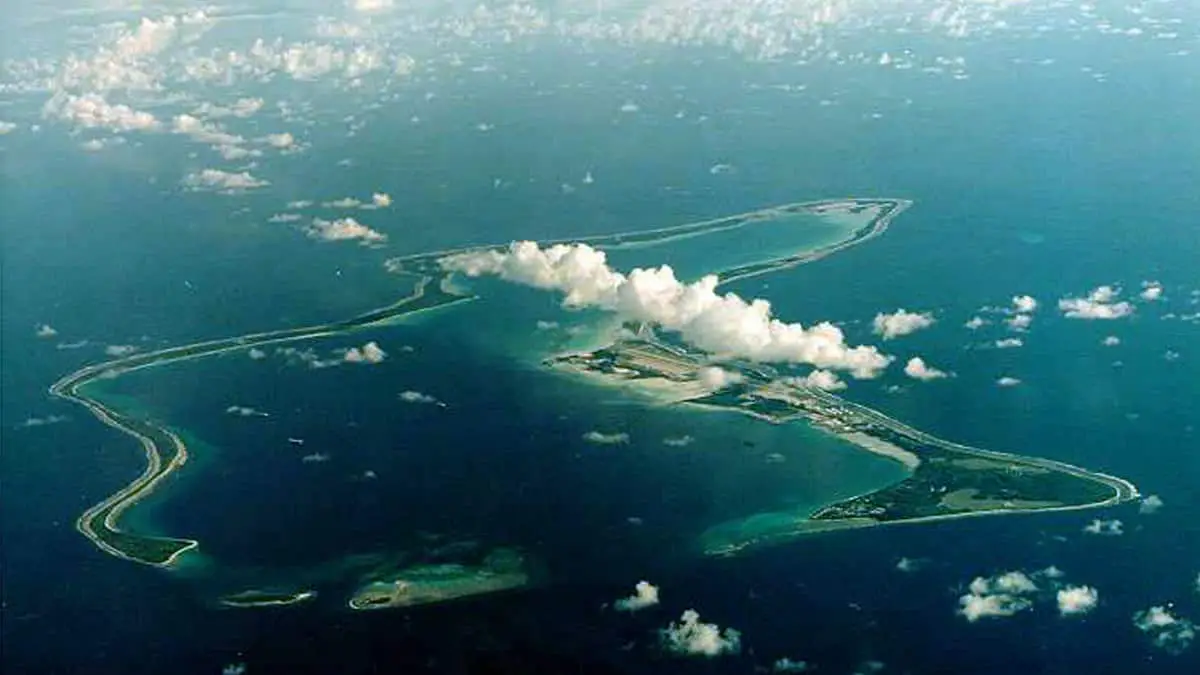
The Chagos Islands (which include Diego Garcia) are in the news of late due to their strategic location, the UK’s transfer of sovereignty to Mauritius in 2025, President Trump’s recent statements criticising the UK’s move and its impact on other important stakeholders, including India and the Maldives.
Strategic Location
Officially known as the British Indian Ocean Territory, the Chagos Islands are located in the Indian Ocean about 5,799 miles (9,332 km) southeast of the UK and about 1,250 miles northeast of Mauritius. Also known as the Chagos Archipelago, there are around 60 individual islands, grouped together in seven ring-shaped coral atolls. Initially, the French controlled these islands from 1715 to 1810, which the UK later took control of in the early 19th century and detached the Chagos Islands from Mauritius. The islands were separated from Mauritius in 1965, when Mauritius was still a British colony. In the late 1960s, Britain invited the US to build a modern and advanced military base in Diego Garcia under a 99-year lease agreement, forcibly removing thousands of people from their homes in the process. Provisions were also made for the lease to be renewed for an additional 40 years after the expiry of the 99-year period and even for a further extended phase, if it was so required.
Significance of Diego Garcia
Diego Garcia is the largest of the Chagos Islands. In the early 1970s, the UK and US had jointly operated a military base there along with air force facilities, advanced communications, surveillance capabilities and a deep-water port. It is nicknamed ‘Footprint of Freedom’ by the US Navy due to its shape and strategic location in the central part of the Indian Ocean. Diego Garcia is one of two major crucial US bomber bases in the Indo-Pacific region, alongside Anderson Air Force Base in Guam. During the US ‘war on terror’ after the 9/11 terrorist attacks, aircraft were sent directly from the island to carry out missions in Afghanistan and Iraq. In recent times, Diego Garcia has been in the news for US operations against the Houthis in Yemen in 2024 and 2025 and also attacks against the Taliban and Al-Qaeda in Afghanistan. Should President Trump order any military operations against Iran, the US Air Force may use Diego Garcia due to its vantage point.
Mauritius’ Viewpoint
When the UK purchased the archipelago for 3 million British pounds, Mauritius had argued that it was illegally forced to give Chagos away as part of a deal to grant independence, which Mauritius achieved in 1968. Since then, Mauritius has repeatedly claimed sovereignty over Chagos, maintaining that it is an integral part of its territory. Amid growing diplomatic pressure, the UK signed a controversial agreement to transfer control of the archipelago to Mauritius in 2025. Another sensitive area which is of concern to Mauritius has been the issue of placing nuclear weapons in the Chagos Islands, including that of Diego Garcia.
In 1996, under the Treaty of Pelindaba, which creates an African Nuclear Weapons Free Zone (ANWFZ) and which later on came into force in August 2009, the government of Mauritius had already signed and ratified the treaty. Mauritius is also a signatory to the NPT and IAEA safeguards. In the absence of any definitive information on the possible storage of nuclear weapons or warheads in Diego Garcia, it has been a matter of concern to Mauritius. Questions have arisen as the US, which has signed the Treaty of Tlatelolco that makes Latin America and the Caribbean a Nuclear Weapons Free Zone, is yet to ratify Pelindaba, which applies in the case of the Chagos Islands, including that of Diego Garcia.
US Stand
The US position on Chagos has undergone a flip-flop under the Trump Administration. Initially, President Trump and his top Cabinet officials had welcomed the UK’s deal as it was arrived at in May 2025 in handing over the sovereignty back to Mauritius, with the 99-year lease of Diego Garcia island as the US military base remaining intact. However, the US position changed in early 2026 when Trump termed the UK deal a ’big mistake’ and an ‘act of great stupidity’. Trump also stated that ‘the Chagos Islands should not be taken away from the UK, and, if it is allowed to be, it will be a blight on our Great Ally’. As a result of the changed US position, the transfer of sovereignty agreement from the UK to Mauritius is currently in a state of limbo and appears unlikely to be ratified in 2026.
India’s Stake
India is an important stakeholder in the Chagos Islands issue, as India has consistently supported the sovereignty of Mauritius and its claim to the Chagos archipelago, as was formulated in the 2025 transfer agreement with the UK. At the same time, India has maintained a balanced and nuanced view that US military bases in Diego Garcia provide a ‘safe and secure’ asset in the Indian Ocean, facilitating surveillance, intelligence sharing, access to crucial logistical hubs, and oversight of overt Chinese maritime activities in the region.
As India has been an ardent supporter of decolonisation, which ultimately led to Mauritius becoming an independent country in 1968, India’s credibility has been amplified due to its trustworthiness. Under Prime Minister Modi, India has launched the Mutual and Holistic Advancement for Security and Growth Across Regions (Mahasagar), which is an upgrade from the Security and Growth for All in the Region (Sagar) maritime initiatives. India positions itself as a net security provider in the Indian Ocean region through calibrated diplomacy and in consonance with its commitment to existing international norms as well as in ensuring robust partnerships with major powers. India takes its leadership role seriously, as it views order and stability as a very high priority objective in the Indo-Pacific and in the Global South.
Discordant Notes from the Maldives
While Chagos and the Maldives have had close and shared ethnic, cultural and historical ties, no governments of the Maldives until the present one under President Muizzu in Male have claimed sovereignty over the Chagos archipelago. Muizzu is also on record stating that should the Maldives government be accorded sovereignty over Chagos, it will allow US military bases in Diego Garcia to continue their operations unhindered. From the Indian standpoint, the prospect of a foreign military base operating from Maldives territory under its sovereignty could have serious implications in a strategic context.
Any miscalculation or escalation by the Maldives may create space for extra-regional powers to exert their presence in India’s coastal neighbourhood. Muizzu’s move may also entice China to expand its footprint in the larger Indian Ocean region, much to the detriment of India’s maritime strategy and operations. For India and Mauritius, Maldives’ rapid defence modernisation drive in recent times and its growing ties with countries such as China through the Global Strategic Initiative and Turkey through a $37 million deal for the procurement of military drones may also be viewed with some wariness in defence circles.
Conclusion
In the rapidly changing global and regional geopolitics, including in the Indian Ocean region with rival powers staking out to enhance their respective spheres of influence through overt and covert displays of hard and assertive military might, there is a compelling need for sober analysis as to how to manage and contain any possible fallout on the issues related to the Chagos Islands should the situation escalate and spiral out of control. The sooner it is handled deftly by all the relevant stakeholders, the better it is for maintaining strategic stability and predictability.
(Mohammed Badrul Alam is Director of Research; professor and former head, Department of Political Science, Faculty of Social Sciences, Jamia Millia Islamia University, New Delhi. The views expressed are personal and do not necessarily reflect Firstpost’s views.)
End of Article
