



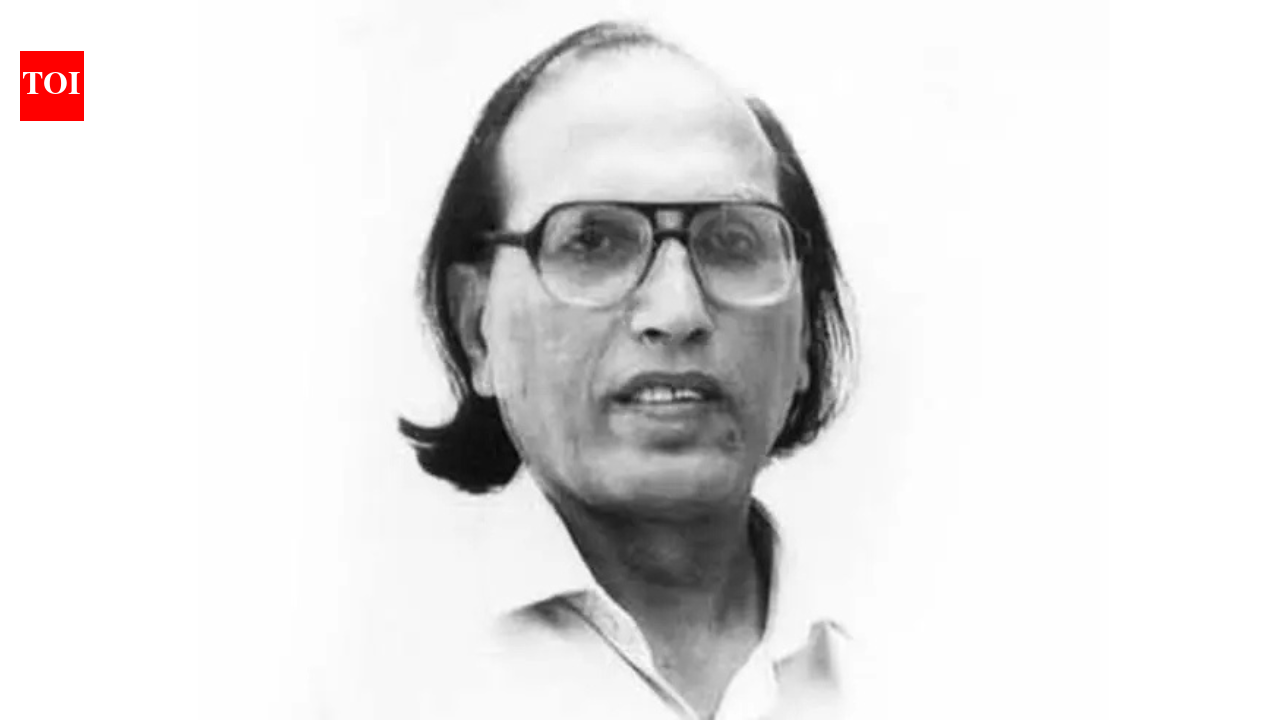
NEW DELHI/BHOPAL: Bashir Badr, whose Urdu poetry seamlessly blended the personal with the universal, whose self-assured, almost playful, ghazal recitals made him a major star at mushairas home and abroad, and who wrote without rancor despite his home being burnt down during the 1987 Meerut communal riots, passed away at his residence in Bhopal on Thursday. He was 91.“Today, our language Urdu has become a little poorer,” posted poet-film writer Javed Akhtar on X.Indeed, Indian literature is poorer without him. Dementia stole Badr’s memory and he withdrew from poetry soirees a decade ago, his son Taiyub Badr told TOI. But his couplets (shers) continued to speak for those messily in love but without the words to articulate the condition. Badr’s poetry also gave grief a place to go. His verses could turn emotions into scenes embossing them permanently in the listener’s memory. They were literary yet accessible, poignant and meaningfully quotable, always worth a plaudit, occasionally deeply philosophical.One of his most-frequently quoted verse is “Ujaale apni yaadon ke hamare saath rahne do // Na jaane kis gali mein zindagi ki shaam ho jaaye” (Let the lights of your memory stay / Before the evening of life sets in). The lines became a refuge for defeated lovers who had nothing but memories to cling on to. In an interview to DD, Badr once recounted that the actor-poet Meena Kumari was an admirer of the ‘sher’. “This couplet will always stay with me,” she had told ‘Star & Style’ film magazine, he recalled.Another elegy-like verse underlines Badr’s gift to talk about deprivation without self-pity: “Zindagi tune mujhe qabr se kam di hai zameen / Paon failaoon to deewar mein sar lagta hai.” “My life, you have given me less space than a grave / If I stretch my legs, my head hits the wall.”Born in Bukiyan village in present day Ambedkar Nagar district in Uttar Pradesh Badr was a bright student. But he had to quit studies after losing his father, a cop, in his early teens. Years later, he would enroll in Aligarh Muslim University where he post-graduated in Urdu coming first-class first and earning a gold medal. It was around this time that he earned his spurs in Lucknow radio station’s annual mushaira. “It was a turning point in his career,” says poet Iqbal Ashhar. He later received his doctorate, also from AMU.Badr broke free from the traditional frame of ghazals and expanded its range infusing it with a modern outlook, says Ashhar. “He even wrote a ghazal on pregnancy. His third collection of poems, “Aamad” (1985) is a remarkable piece of literary work,” says Ashhar.Badr’s home, including his personal library, was burnt to ashes during the 1987 Meerut communal riots. “Fortunately, he was away in Delhi, and his family members were given shelter in the house of a Hindu neighbour,” wrote journalist Askari H Zaidi in The Times of India. But the ghastly incident couldn’t infect his poetry with bitterness. It was awash with melancholy though. “Log toot jate hain ek ghar banana mein / Tum taras nahi khate bastiya jalane mein (People break themselves just to build a home / But you feel no mercy even burning down settlements,” he wrote. A few years later, he shifted to Bhopal.During the 1980s and 1990s when ghazals became extremely popular among the middle-class, Badr’s works were recorded by singers such as Jagjit Singh, Anup Jalota, Talat Aziz, Chandan Das, Roop Kumar Rathod and Hariharan. “Between the years 1980-2000, he was among the most popular ‘shayars’ of India,” Ashhar says.Badr’s poetry and voice became a magnet for listeners in the USA, Canada, Pakistan and the Middle east. His poetry influenced other areas of art as well. “They became themes around which dance dramas were constructed,” wrote writer-editor Kanhaiya Lal Nandan, editing a collection of his works. Both received the Padma Shri in 1999. His verses were also creatively used in films such as ‘Masaan’ (2015), ‘Dedh Ishqiya’ (2014) and ‘Bhaggmati’ (2005).Addressing Indo-Pak relations, Badr once wrote, “Dushmani jam kar karo lekin yeh gunjaish rahe / Jab kabhi dost ho jaaye sharminda na ho (Carry out enmity with all your might, but leave this much room / If you ever become friends again, you do not have to feel ashamed.” A couplet that remains timeless in relevance, much like its author.(With Ramendra Singh in Bhopal)

