




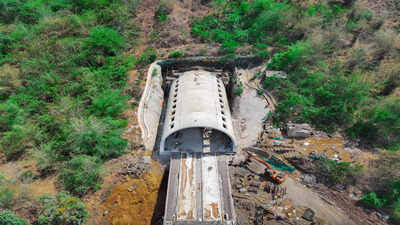
Train journeys in India are set to become much smoother and quieter, as a new high-speed rail experience takes shape under one of the country’s most ambitious infrastructure projects. For the first time, India has introduced tunnel hood technology in railway tunnels, which is being used in the mountain sections of the Mumbai–Ahmedabad Bullet Train Project. The route runs through difficult terrain and includes seven mountain tunnels in Maharashtra and one in Gujarat.The technology has been designed to manage the strong air pressure changes that occur when high-speed trains enter and exit tunnels. As a train rushes into a tunnel, it pushes a large volume of air forward, much like a piston inside a cylinder. This creates pressure waves that travel through the tunnel, and if not controlled, they can lead to loud booming sounds when the train comes out of the other side.Tunnel hoods function as a transition zone between the open environment and the enclosed tunnel space. By enabling air to enter and exit in a more gradual manner, they help regulate pressure changes and enhance the overall aerodynamic performance of the system.According to project details, the tunnel hoods on the Mumbai–Ahmedabad Bullet Train corridor have been designed to minimise tunnel boom and noise generated by high-speed train movement while exiting tunnels, lower disturbance to surrounding communities, and support the safe and efficient operation of trains travelling at very high speeds.In simple terms, the tunnel hood allows the train and the surrounding air to adjust to each other gradually rather than abruptly, making high-speed rail travel quieter, smoother and more comfortable.A key feature of the tunnel hoods is the inclusion of specially designed pressure-relief vents or windows. These openings allow a portion of the compressed air to escape gradually into the atmosphere as a train enters the tunnel. This reduces the intensity of pressure waves, minimises tunnel boom and helps maintain smoother airflow within the tunnel system.Tunnel hoods are commonly used in high-speed rail systems in countries operating bullet trains at speeds exceeding 300 kmph. Their adoption on the Mumbai–Ahmedabad Bullet Train Project reflects the use of advanced engineering solutions and international best practices aimed at achieving world-class standards of safety, comfort and environmental performance.
