



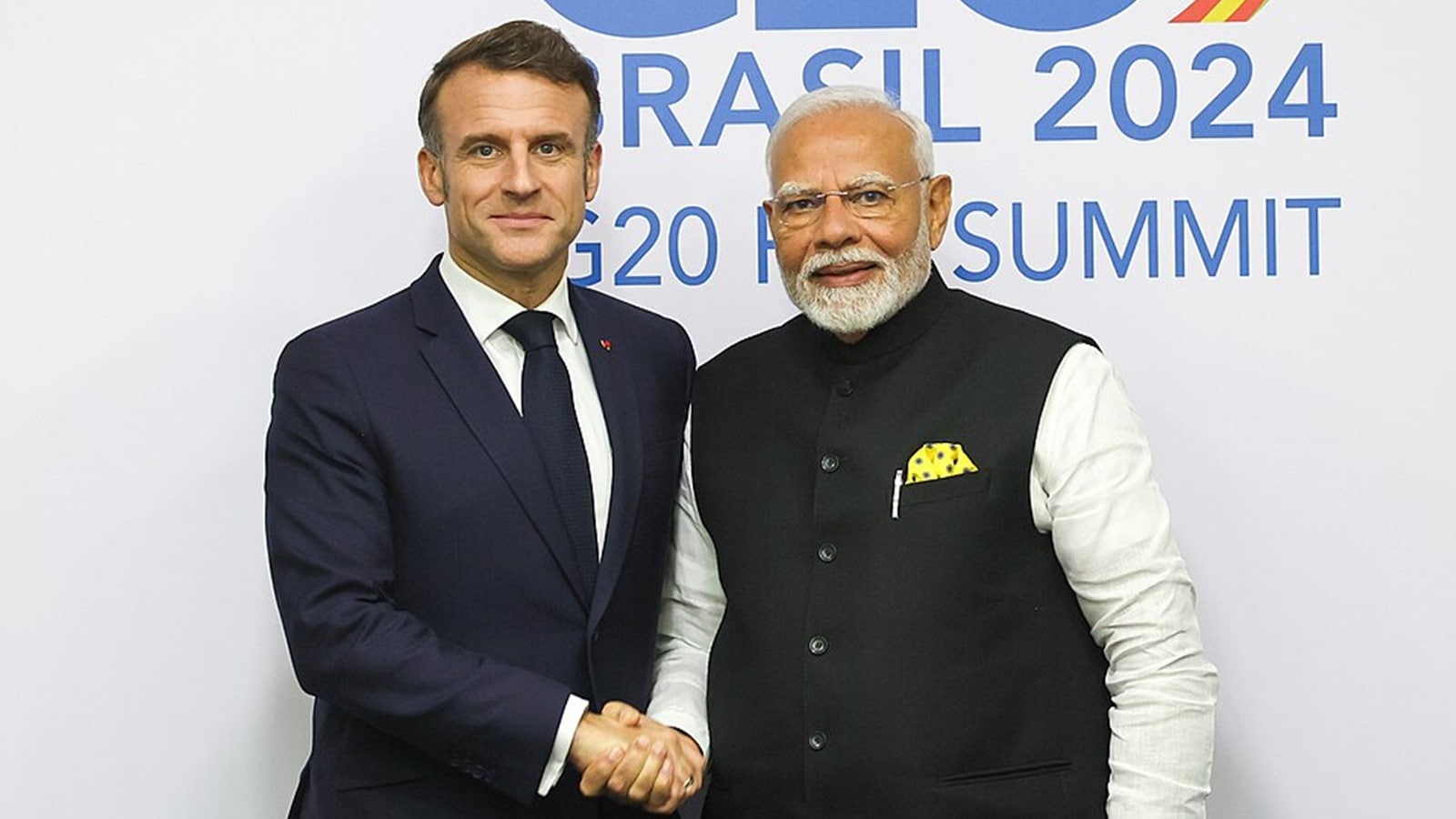
President Emmanuel Macron may not be riding high at home in France, but in Delhi, he draws immense political affection. Macron has carved out a distinctive place for Paris in Delhi’s strategic calculus. His visit to Mumbai and Delhi this week — his fourth to India since assuming office in 2017 — consolidates the significant transformation in bilateral ties in technology and defence, as well as the Indo-Pacific, over the last decade.
Prime Minister Narendra Modi’s sustained engagement with Macron has been part of India’s broader pivot to Europe in recent years. The visit of German Chancellor Friedrich Merz in January, the presence of the European Union leadership at this year’s Republic Day celebrations, and the signing of the long-negotiated free trade agreement underline the growing salience of Europe in India’s strategic thinking.

This column has long been sceptical of “multipolarity” as an accurate description of the global balance of power. The US remains pre-eminent, and China has been steadily catching up. A number of other nations — including India and France — are some distance away in terms of economic scale, military weight, and technological depth.
If there is any doubt, one need only look at the AI Impact Summit in Delhi this week. The business of artificial intelligence continues to be dominated by American technology giants, and Washington is likely to exert considerable influence over the outcomes of the summit. China is the other AI superpower. Yet, the political and market conditions for substantive India-China cooperation in this domain are limited for now. There is, however, considerable scope for India to work with Europe and the middle powers in the non-Western world.
The popular phrase in Delhi — the “quest for a multipolar world” — has served as a shorthand for India’s effort to maintain productive relations with all major powers. Since the end of the Cold War, that quest involved managing American primacy while sustaining cooperation with post-Soviet Russia and engaging a rising China. Today, that approach is being recalibrated. India’s multipolar strategy now runs through Europe.
Macron’s visit is not simply about deepening a robust bilateral partnership. It reflects India’s exploration of what might be called a “multipolar West”. Europe is no longer seen merely as an adjunct to Washington or a passive player in the arena of US-China rivalry. It is an important global actor in its own right, capable of contributing to India’s economic and technological transformation while widening Delhi’s spielraum — or the space for manoeuvre abroad.
It is worth recalling that France was among the earliest proponents of political activism in favour of a “multipolar world” — well before Russia and China made it a central theme of their diplomacy. Paris has also consistently advocated European “strategic autonomy”. This shared vocabulary has created a measure of comfort between Delhi and Paris.
Beyond rhetorical convergence, though, is the deepening practical cooperation under the Horizon 2047 framework that lends substance to the partnership. Horizon 2047, unveiled in 2023, is a long-term India-France roadmap committing both countries to collaboration in defence, technology, space, energy and the Indo-Pacific through 2047, when India marks a century of independence.
Recent agreements illustrate this trajectory. India’s decision to expand its Rafale fleet with the Air Force and the Navy, the French readiness to produce some of them in India, along with the planned assembly of helicopters and joint jet-engine cooperation, point to a consequential defence industrial partnership between the two countries. The Indian private sector is expected to play an expanding role in the transformation of the domestic aerospace ecosystem in collaboration with France.
As global debates over AI governance intensify, India and France have presented themselves as advocates of a “third way”. Between American corporate concentration and Chinese state-centric control, both seek regulatory frameworks that protect sovereignty while encouraging innovation. Whether this approach can shape global norms remains uncertain, given the US and China’s lead in AI development.
It is important to note that Delhi and Paris are not constructing their partnership in opposition to the US. Washington, in any case, is increasingly focused on regaining its dominance of the Western Hemisphere. Successive administrations in Washington have pressed their allies for more burden-sharing. Trump wants Europe and India to assume greater responsibility in Eurasia and the Indo-Pacific. This American emphasis on regional self-reliance creates space — and incentive — for Delhi and Paris, along with Brussels, to do more together in their shared neighbourhood.
What does all of this compute into?
First, Delhi now recognises that the idea of a “collective West” is a misleading one. There is considerable variation in interests within the West. A strong partnership with France — and a more geopolitically self-aware Europe — allows Delhi to diversify its engagement within the Western world.
Second, it reduces overdependence on any single capital in the Global North. Engaging a Europe that is rediscovering agency widens India’s strategic options. Cooperation among Delhi, Paris and Brussels can help mitigate shared economic and geopolitical vulnerabilities in a more complex global order.
The India-France strategic partnership has matured against considerable odds. That post-colonial India could build a stable and forward-looking partnership with a former imperial power embedded in the political West was once improbable. Over the last decade, France has deepened bilateral ties with India, played a key role in facilitating Delhi’s wider engagement with Europe and created conditions for a self-assured Indian engagement with America.
The Macron moment, therefore, is not merely about personal and bilateral warmth. It reflects a broader shift in Delhi’s geopolitical imagination — towards a more differentiated understanding of the West. It is also about the emergence of a wider network of alliances and partnerships that cut across the traditional divides of East-West and North-South.
The writer is contributing editor on international affairs for The Indian Express. He is associated with the Motwani-Jadeja Institute of American Studies, Jindal Global University and the Council on Strategic and Defence Studies, Delhi
