



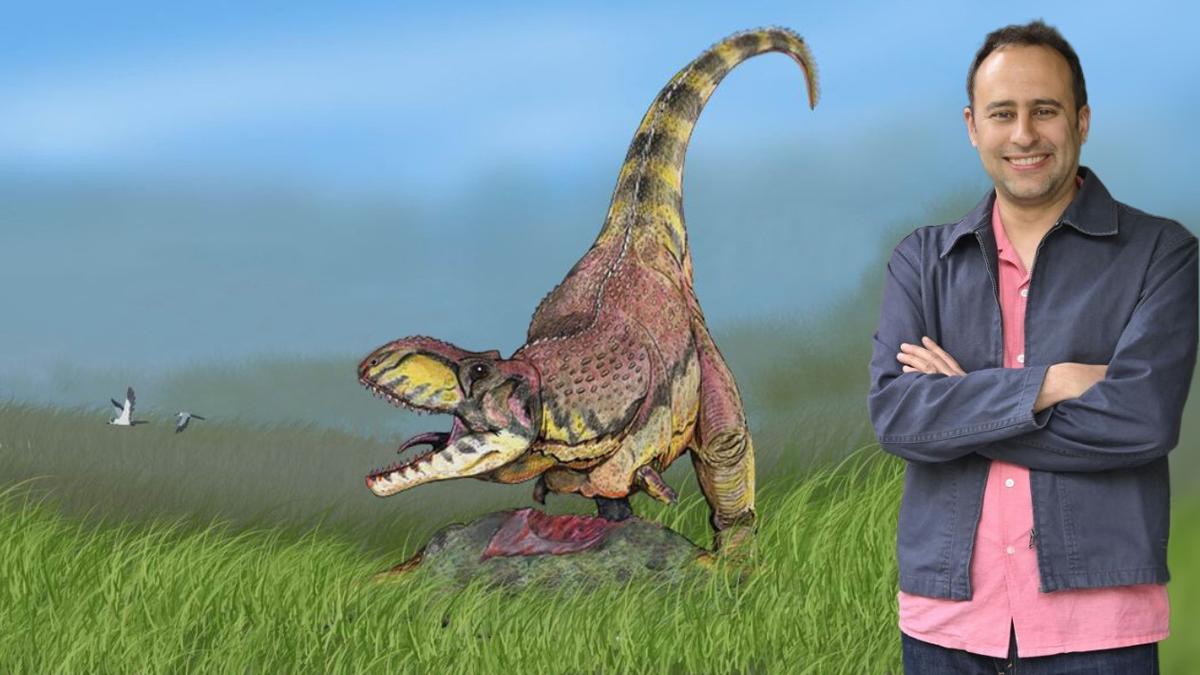
Roughly once a week, a creature dead for tens of millions of years is introduced to science for the first time. Around 50 new dinosaur species are named every year — a pace the species might have struggled to match even at their peak in the Cretaceous period, between 145 and 66 million years ago. Steve Brusatte, the University of Edinburgh palaeontologist who consults on the Jurassic World films and wrote the bestselling The Rise and Fall of the Dinosaurs (2018), calls it “a golden age”.
Brusatte was in Delhi recently — on only his second-ever trip to India — lecturing at the Lodha Genius Programme run by Ashoka University, to high-schoolers he calls “incredibly bright”, but with wrinkled optimism. The new discoveries are pouring out of China, Argentina, Brazil, Mongolia and South Africa — the big, fast-growing countries throwing young people at the rocks; however, India is conspicuously under-represented at the dig site, and not for want of fossils, which are “spectacular”.
Some of the oldest dinosaurs are Indian, from an era when the subcontinent was wedged into Pangaea, when Earth was a single continent, and sitting almost on the South Pole. These include long-necked giants that weighed as much as a Boeing 737, and Rajasaurus, a homegrown meat-eater nearly the size of a T. Rex, plus a celebrated trove of fossilised nests and eggs. “We need more from India,” Brusatte says. “The destiny is there waiting” — needing only a handful of good students with itchy pickaxes.

A reconstructed skull of the Rajasaurus.
| Photo Credit:
Wiki Commons

Birds and the dinosaurs
The bottleneck isn’t geology, it’s teachers — too few palaeontologists at Indian universities to show the next generation what a fossil even looks like. Moreover, fossils don’t only hide in cinematic badlands. Brusatte teaches at a fossil site inside Edinburgh; in China, a near-complete tyrannosaur he later helped describe — Qianzhousaurus, nicknamed “Pinocchio rex” for its absurdly long snout — was dug up by construction workers laying a building foundation. Development, it turns out, can also yield fossils. For a country building as fast as India, he reckons this is an unopened gift. Funding though is the perennial headache. Both Britain and the U.S., for instance, have less funds now than a decade ago. The Chinese boom is partly the story of a country deciding the lean years are over and investing in digs, says Brusatte.

Did birds evolve from dinosaurs? Yes, says Steve Brusatte, in his new book, The Story of Birds.
| Photo Credit:
Shiv Kumar Pushpakar

And the search has paid off in ways that have led to rewriting of textbooks — as Brusatte recounts in his latest book, The Story of Birds (Picador). In 1996, farmers in China’s Liaoning Province began turning up dinosaurs with feathers. Embalmed in lava, the landscape is a dinosaurian Pompeii with thousands of specimens across dozens of species, from creatures you could cradle in your arms to others nearly the size of a bus. Those findings, says Brusatte, firmly settled an intriguing speculation that had been floating around since Darwin’s time: did birds evolve from dinosaurs? Yes, and here’s why.
The original clue was the Archaeopteryx, found around 1861 — a beautiful, connective Yeti with feathers and wings but also teeth, claws and a long reptilian tail. Doubters piled in as the giant T. rex and Brachiosaurus skeletons emerged; surely those monsters couldn’t be related to a sparrow. The Chinese feathers settled it, and modern DNA agrees: birds sit right beside crocodiles on the family tree, closer than crocodiles are to snakes or lizards.

The neat way to picture it, Brusatte says, is that the bat is no bird but plainly a mammal, just a weird one that took to the air. A bird is the same trick run on dinosaurs. The asteroid that struck Earth 66 million years ago lopped off every other branch of the dinosaur evolutionary tree. Birds are the one twig still alive. Consequently, the pigeon — urban blight, rodent of the sky — is technically among the last surviving dinosaurs.

The pigeon comes from a long line of dinosaurs that also includes the T-Rex.
| Photo Credit:
Getty Images
Survival of the smallest
On the asteroid, Brusatte is firm, and India has skin in the game thanks to the Deccan Traps’ colossal volcanic eruptions — among Earth’s largest, centred on Maharashtra and spilling across Madhya Pradesh, Gujarat and Karnataka — that began a few million years before the asteroid hit. The impact of the asteroid ended the dinosaurs, and scientists have long disputed the cause.
One camp argues the Traps did it, belching climate-wrecking gases that poisoned the air and seas; Brusatte sides with the rival camp. Dinosaurs were thriving right up to the end, he notes. They were found among the very lava flows the early eruptions laid down, until the asteroid with energy exceeding a billion nuclear bombs. The blast vapourised everything for thousands of kilometres, but the real culprit was the aftermath: years of darkness as soot blotted out the sun wrecking food chains. The Deccan eruptions may have piled on, but they didn’t pull the trigger, he underlines.
Survival came down to being small, quick and nutritionally indiscriminate: anything bigger than a decent-sized dog was doomed once the larder emptied. The birds that made it were tiny, strong-winged and fast-breeding; the surviving mammals were mouse-sized burrowers. Being big and scary, Brusatte notes drily, became a liability once the rules changed.
What does Brusatte say about artificial intelligence that’s threatening to make dinosaurs of humans? Brusatte is allergic to the hype, with no wish to see large language models pump out “slop” such as images of dinosaurs with 13 toes and all. But trained tightly, the tools shine. He and Gregor Hartmann, a German computer scientist, have built an algorithm fed only black-and-white silhouettes of footprints from Scotland’s Isle of Skye; with no human labels, it worked out how best to sort them. Now, anyone can photograph a track in an app and learn which dinosaurs left its closest cousins. The machine spots the pattern and the human reads the meaning. “The best science is interdisciplinary,” he says — but it is also, he’d insist, still mostly about going outside and looking down.
jacob.koshy@thehindu.co.in
Published – June 20, 2026 06:35 am IST

