



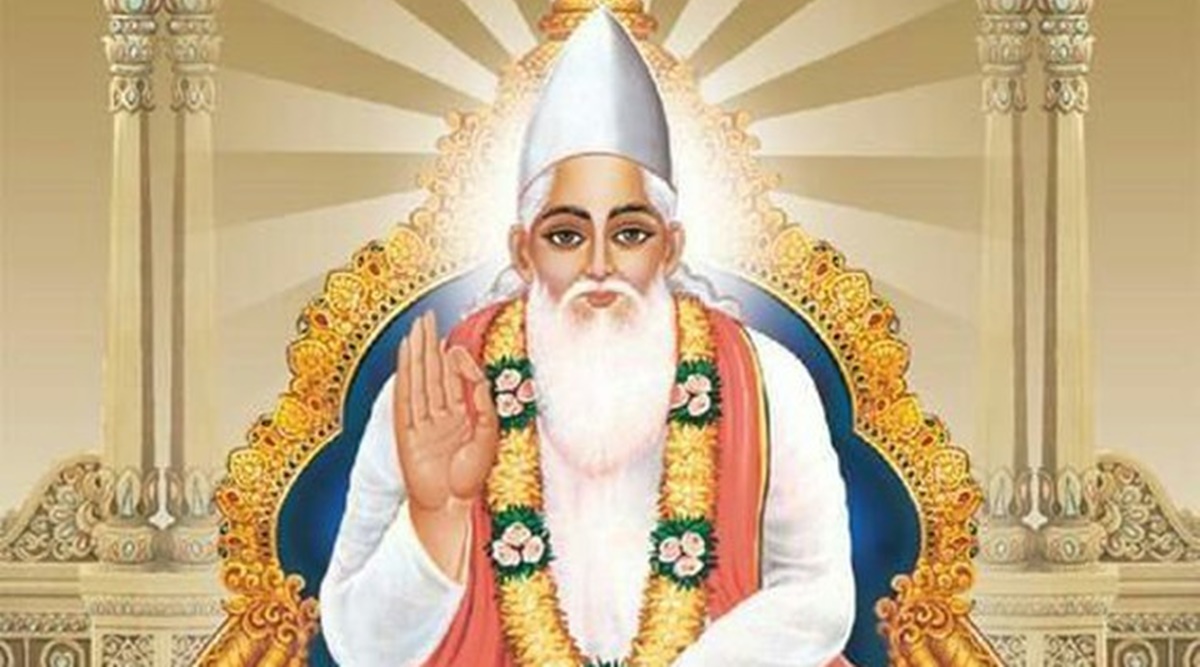
Recently, there has been a renewed interest in Indian Knowledge Systems (IKS), not only in India but around the world. When one talks of IKS, one immediately thinks of classical Sanskrit texts and elite academies. There is no denying the value of these traditions, but our understanding of IKS should also include literature from people at the periphery. Otherwise, we miss the chance to understand the empirical and far more people-centric, democratic branch of Indian philosophy, which was engineered not by academic elites but by a 15th-century working-class weaver from Varanasi in today’s Uttar Pradesh, named Kabirdas.
Sant Kabir, as he is called, is a towering force in India’s intellectual history. In his compositions, we see attempts to pull philosophy down from the remote heights to make it more accessible. Kabir fused absolute non-dualism with the practicality of ancient yoga. A fierce critic of social gatekeeping, he foregrounded the need for social democracy. Through his nirguna bhakti, he democratised the search for truth. His life and work are the ultimate proof of how IKS can be applied in everyday life.

Kabir’s contribution to Indian thought and knowledge systems was his approach to pramana — the classical philosophical concept of valid evidence and authority. Since ancient times, orthodoxy clung tightly to shabda pramana, a framework that treats scriptural authority and mastery of these texts as the only legitimate gateway to the truth. For most people, access to this vast repertoire of knowledge was blocked. Kabir broke the barrier by replacing scriptural compliance with anubhuti — direct, living experience, making use of the senses. Kabir captured this by asserting that while others spoke of what was written down in books, he spoke only of what his own eyes had witnessed in his day-to-day life.
This marked a tectonic shift in how knowledge was perceived and understood. For Kabir, knowledge was truth. It was not an inheritance one derives at birth, nor something to be memorised or restricted to specific ghettos. It was a reality to be actively tested, experienced, lived, and made accessible to all. He treated his workshop as a laboratory for understanding the cosmos. Kabir’s empirical, human-centric approach paves the way for decoding IKS.
Historian Purushottam Agrawal demonstrates in his pathbreaking work, Akath Kahani Prem Ki, that viewing Kabir as a marginal, reactionary dissenter is a huge disservice to him. He argues that in Kabir, the “weaver” represents a confluence of robust “indigenous modernity” and “spiritual universalism”. For Agarwal, Kabir represents the voice of a dynamic, reflective public ethos. Hence, Kabir’s voice is unique in that he prioritises individual agency, placing morality over vapid institutional labels. This can be understood when Kabir weaves regional dialects like Braj Bhasha into his songs (shabads) and couplets (dohe). He uses these techniques to anchor and simplify complex metaphysics for the masses.
One of Kabir’s most famous verses goes: “Jhini jhini bini chadariya, kahe kai tana kahe kai bharni, kaun tar se bini chadariya.(Finely, so finely is the cloth woven; what is the warp, what is the weft, and with what thread is the body woven?).” In these lines, he turns manual labour into a sacred act of cosmic inquiry. For Kabir, anyone could engage with the deep mysteries of existence while earning an honest living. One can see the confluence of two streams here: The absolute non-dualism (advaita) of the Upanishads and the practical, bodily training of the Nath Sampradaya and Hatha Yoga. Kabir stripped non-dualism of its purely abstract nature and turned it into a practical science grounded directly in the human body. His verses portray an internal spiritual anatomy. They awaken the kundalini, which balances the subtle breath channels and guides the central ascent up the spine to hear the inner unstruck resonance (anahata nada) of the cosmos.
Kabir thus offers an incredibly democratic vision of humanity. This can be seen in his point that every human being possesses the same physical and internal infrastructure, irrespective of gender or creed. To deliver these basic human truths, he chose Sadhukkari — a rustic, vibrant blend of regional vernaculars, with Braj Bhasha playing a prominent role. He ensured that his verses could be easily memorised, sung, and transmitted orally. Also, Kabir frequently utilised ulatbansi, his famous upside-down or paradoxical verses designed to shock the listener and awaken them from their slumber. He regularly targeted the conceptual category of maya, the grand illusion that distorts human perception.
Kabir breaks down conventional logic through these sharp idioms. He forces the human mind to abandon superficial dogmas and engage in critical self-inquiry. Hence, this precise combination of rigorous empirical testing and passion for radical equality explains why modern reformers, most notably Dr B R Ambedkar, claimed Kabir as one of their primary intellectual gurus. Ambedkar recognised that Kabir was not merely a composer of devotional hymns, but was instrumental in foregrounding a deeply rational, scientific temper within the Indian tradition.
Even today, Kabir’s voice remains remarkably fresh. His compositions offer an essential lesson in how we comprehend the Indian knowledge systems. After reading and grasping the essence of Kabir’s compositions, one understands that true knowledge is never a tool for gatekeeping, exclusion, or division. True knowledge is a universal fabric, and its potential lies in how well it binds together substantive equality, lived truths, and radical empathy for all living beings to ensure a dignified living experience.
The writer is associate professor, Dr Ambedkar International Centre
