




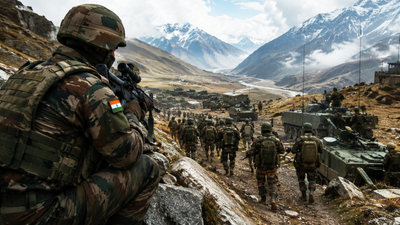
The Indian Army on Wednesday undertook one of its most significant structural reforms in recent decades with the creation of five Integrated Battle Groups (IBGs) and one dedicated Fire Support Group (FSG).Six major generals assumed command of these newly raised formations, which are designed to deliver faster, leaner and more decisive military responses.The rollout marks the first large-scale implementation of the IBG concept, long discussed within the Army, and is intended to replace cumbersome mobilisation procedures with integrated, mission-ready combat formations capable of responding to threats at short notice.The pilot project is being tested under the 17 Mountain Strike Corps, which will serve as the proving ground for the IBG and FSG model.Each IBG is self-contained, fusing infantry, mechanised forces, armour, artillery, engineers, air defence, signals and logistics under one commander.This structure allows the formation to move and fight as a cohesive whole rather than being assembled piecemeal during a crisis.A key institutional change is the introduction of the Chief Operations Officer (COO), a Brigadier-level appointment designed to act as the operational nerve centre, coordinating planning, intelligence, logistics, firepower and battlefield execution.This enables the major general in command to focus on broader strategic and operational decisions.The motivation behind the IBG structure is speed. By pushing authority down to field commanders and shortening the chain of command, the Army seeks to respond to tactical developments more rapidly and mobilise combat power in a shorter time frame.On the other hand, the Fire Support Group will consolidate long-range artillery, rocket systems and other precision-strike capabilities, as well as surveillance assets, under one commander.This will provide concentrated firepower to support operations of the IBGs.This reform is part of a larger transformation and modernisation drive as the army seeks to be leaner and more lethal in light of recent experiences.The Army is moving towards agile formations, deeper jointness with other services, integration of drones as well as loitering munitions, expansion of network-centric warfare and decentralisation of command.The IBG and FSG rollout, along with other changes and tech infusion, represents a decisive step in building a future-ready force.

