



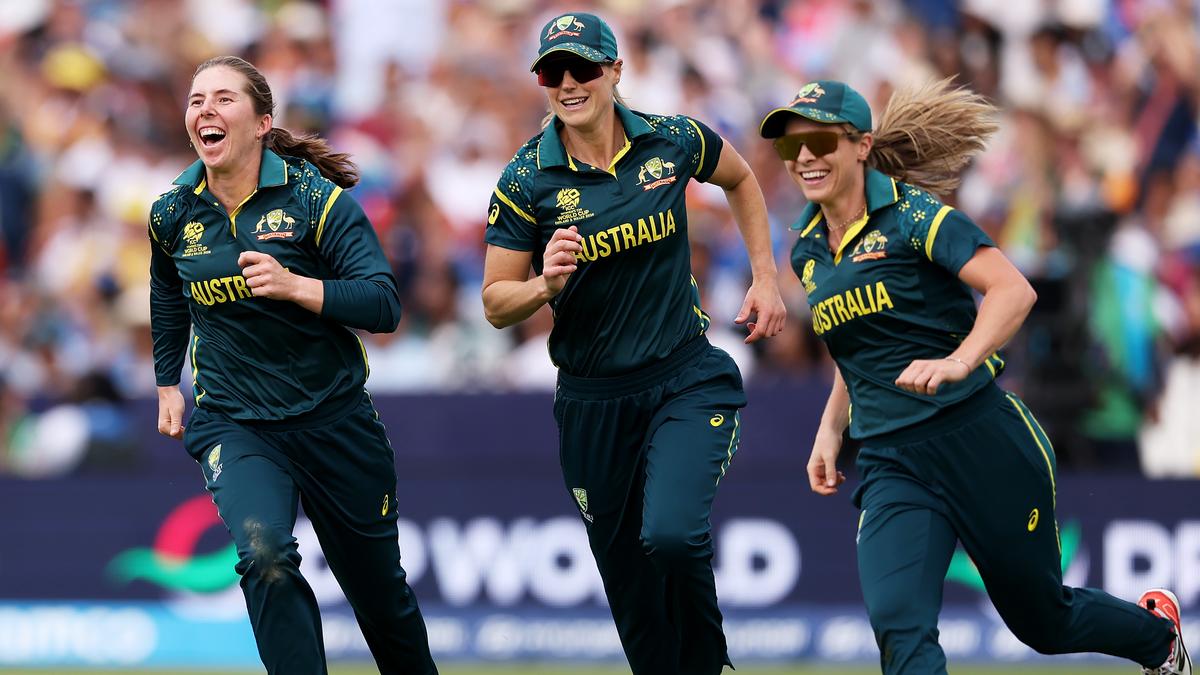

The ICC on June 22, 2026 announced a framework to assist women players who are returning to the sport after pregnancy and child birth.
| Photo Credit: Getty Images
The story so far: The International Cricket Council (ICC) on June 22, 2026 announced a framework to assist women players who are returning to the sport after pregnancy and child birth. The Return to Play Post-Pregnancy Guidelines can be used by the boards of member countries of the ICC to design their own policies in line with local laws for the welfare of the cricketers.
What does the policy say?
The guidelines, drafted by a team led by Dr. Philippa Inge, ICC Medical Advisory Committee member, and Australia Team Doctor, focuses on “practical, physical and psychological considerations” to support return to play. It calls for the appointment of a case manager (usually a doctor or a physiotherapist) who will serve as the primary point of contact.
Centering the welfare of the mother and child, it urges flexible and focussed communication. While recommending exercise during pregnancy, it also highlights the lack of evidence on designing programmes for elite athletes. The board recommends that players stop competing at the end of their first trimester.
For return to play, the guidelines outline the 6 Rs framework: Ready (0-6 weeks), Review (6-8 weeks), Restore (8-16 weeks), Recondition (12-16+ weeks), Return and Refine which includes addressing social barriers such as child care, and mental well-being of the player.
Practical assistance such as access to child care, facilities such as space to change/ rest the baby, space for breast feeding, travel considerations and access to alternate employment opportunities also find a place in the guidelines.
Which countries have maternity policies?
Among the cricket playing countries, Australia has a comprehensive policy which includes paid leave, benefits and support till the child is four-years-old and contract extension guarantees. Other countries such as New Zealand, South Africa, England, Pakistan and the West Indies too are covered by maternity policies offering varying levels of support.
While India, Sri Lanka and Bangladesh do not have dedicated norms, women in Taliban-led Afghanistan are not allowed to take up the sport.

Players like Bismah Maroof (Pakistan), Afy Fletcher (West Indies), Amy Satterthwaite (New Zealand), Megan Schutt (Australia) and Masabata Klaas (South Africa) are some of the mothers who competed at the global stage. The 2022 Women’s ODI World Cup saw the participation of eight mothers, including a few who even captained their side.
In India, while there are no mothers in the national side, Sneha Deepthi played at the domestic level and the Women’s Premier League (WPL) after giving birth to her daughter.
Why is such a policy necessary?
During the 2022 World Cup, a video of Indian players interacting with Pakistan captain Bismah Maroof and her daughter after a game went viral. What is striking is that such scenes are uncommon as women players have historically been forced to choose between their careers and starting a family.
The “motherhood penalty” which plagues women across sectors is prevalent in sports too with players having to face the additional burden of making a physical comeback after pregnancy. Balancing motherhood and professional sports is an uphill battle for women, with many of them being forced into an early retirement. Research into reproductive health of players also remains woefully underdeveloped and scarce, thus limiting the scope of a players performance.
These unfair situations persist due to lack of systemic support, protections and failure to take into account the practical realities of parenthood for players. A strong and robust maternity policy will not only support players but will also help retain a talented pool of cricketers which will benefit the sport.
“No player should have to choose between motherhood and representing her country at the highest level,” said ICC Chairman Jay Shah, speaking about the guidelines.
As the sport goes global with its return to the Olympics, fixed policies are the need of the hour to help players make informed and secure choices about their futures. The timely release of the guidelines is a step in the right direction for ICC’s “commitment to building a game where women can thrive, both on and off the field.”
Published – July 02, 2026 10:53 am IST

