



When Isaac Newton wrote Opticks, published in 1704, he divided the colour spectrum into the now famous VIBGYOR, a set of seven colours (the decision was not, as such, scientific because Newton’s choice was dictated by ‘7’ being a significant number in alchemy.) What Newton observed was a series of hues merging into one another, rather than discrete parcels. The Irish chemist Robert Boyle, who inspired Newton through his experiments, had observed the same spectrum when he pinched refined quicksilver in a “syrup of violets”, but spoke of only five colours. Many of Newton’s readers were not really sure if they could tell indigo from blue or violet at all. And yet Newton insisted that there were seven. The number was alchemically significant. It echoed the musical scale, the number of (visible) planets, and other harmonies of yore based on which Newton intended to structure what we now see as early modern thought.
Colour was being ordered, and this ordering was optical and administrative. Newton, who later served the British crown as Warden and Lord of Mint, stabilised colour into a sequence that could be taught, reproduced, and enforced.
A journey of the blues
Long before this abstraction, blue appeared in the Rig Veda, one of the earliest surviving bodies of liturgy, through Varuna, the god of cosmic order, oath, and surveillance. Varuna is described as syama and kṛṣṇa (meaning dusk-coloured and dark), terms that signal depth and enclosure rather than surface hue. The Indologist Michael Witzel has described Varuṇa as a figure of an early vedic kingship, a “nocturnal sovereign” whose power lies in distance, binding, and the night sky.
What is striking is that this chromatic marker of sovereignty co-evolves with a profound religious transformation. In the Mahābhārata and Itihasic-Purāṇic traditions, śyāma and kṛṣṇa become the most common names of Vāsudeva Kṛṣṇa, who emerges not merely as a heroic figure but as the lord of the cosmos itself. Across this shift, from ritual order of the vedas to the bhakti of Puranas, blue remains a sign of totality and command.
The Greek world, by contrast, hesitated before blue. Karissa St. Clair, in her book Secret Lives of Colours, notes that in Homer’s Iliad and Odyssey, blue is conspicuously absent. The sea is “wine-dark,” and the colour of the skies is unmentioned. Nineteenth-century thinker and politician William Gladstone famously remarked that Greeks could not see blue. And of course, this is not true. Colour theorists and historians have pointed out that in Homer’s epics, colour was organised around brightness, texture, and emotional force rather than hue.
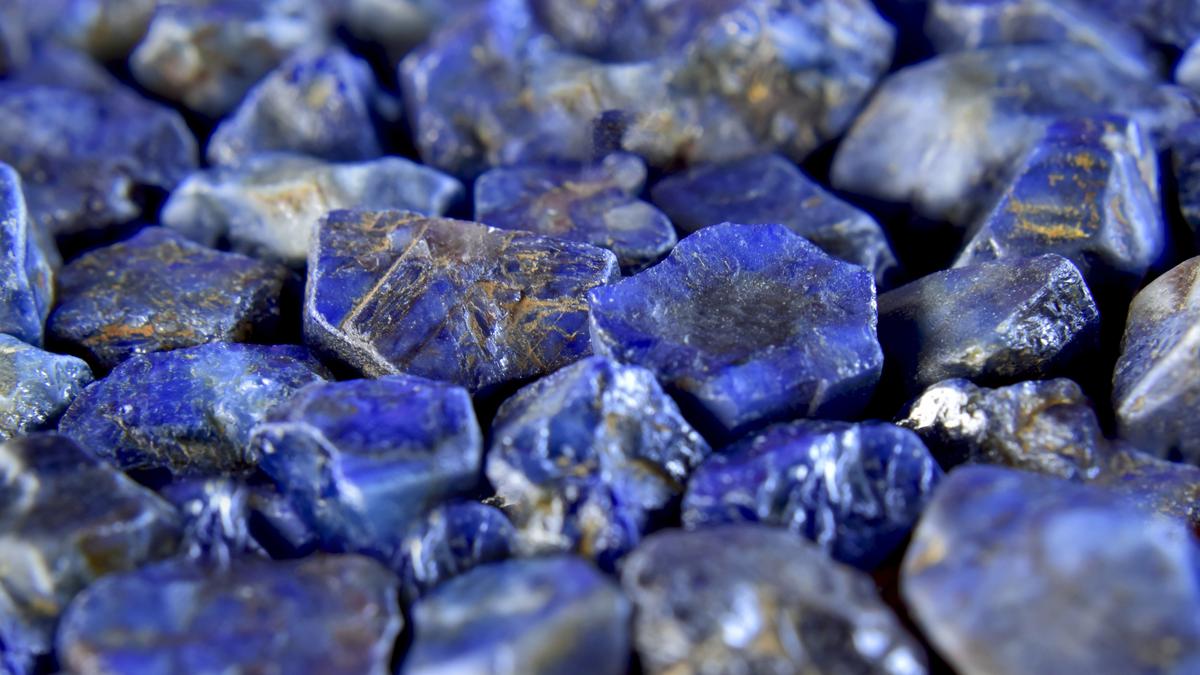
But a few thousand years before ancient Greece, the value of blue was negotiated materially through stone, right from the earliest stages of the Bronze Age. Lapis lazuli, deep blue and flecked with gold, travelled thousands of kilometres from the mines of Badakhshan in present-day Afghanistan to connect Mesopotamia, Egypt, the Indus Valley and China in trans-continental trade. Archaeological finds at the earliest agricultural sites such as Mehrgarh and Bhirrana (6th Millennium BCE) include lapis beads imported through these long-distance trade routes. In ancient Sumer, lapis was sacred to Inanna and in Egypt, it adorned divine brows and funerary masks apart from featuring in statuettes and seals. Lapis Lazuli marked divinity because it was rare, costly, and difficult to command.
Visibility co-evolves with value, but the tension which separates the two has always been observable. Even by the early Bronze Age, Egypt was successful in locally producing their own synthetic colour pigments, Ceruleum, from copper, limestone and silica to reproduce the colour of lapis marking the earliest known instances of synthetic colour production on an industrial scale under government regulation. By the axial age, Mesopotamians were importing Indigo from distant India to colour their royal robes in the colour of Lapis while China created its own synthetic blue, from barium, copper, and silicon to colour its terracotta army in Lapis so the army could serve its emperor in the afterlife.
‘Stimulation of nothingness’
Seen this way, Newton’s spectrum marks not the beginning of colour, but the final abstraction of a long process. When blue became a wavelength, something older was lost: its connection to effort, danger, devotion, and power. In an effort to preserve the values associated with the colour value, Goethe, in his Theory of Colours (1804) wrote, “The blue colour is a kind of contradiction between excitement and repose. It is a stimulation of nothingness. Hence we feel a certain pleasure in gazing at blue, because it draws us after it.”
Satwik Gade is a Chennai-based writer and illustrator. This article is part of a series on the history and development of colours.
Published – February 25, 2026 08:30 am IST

