



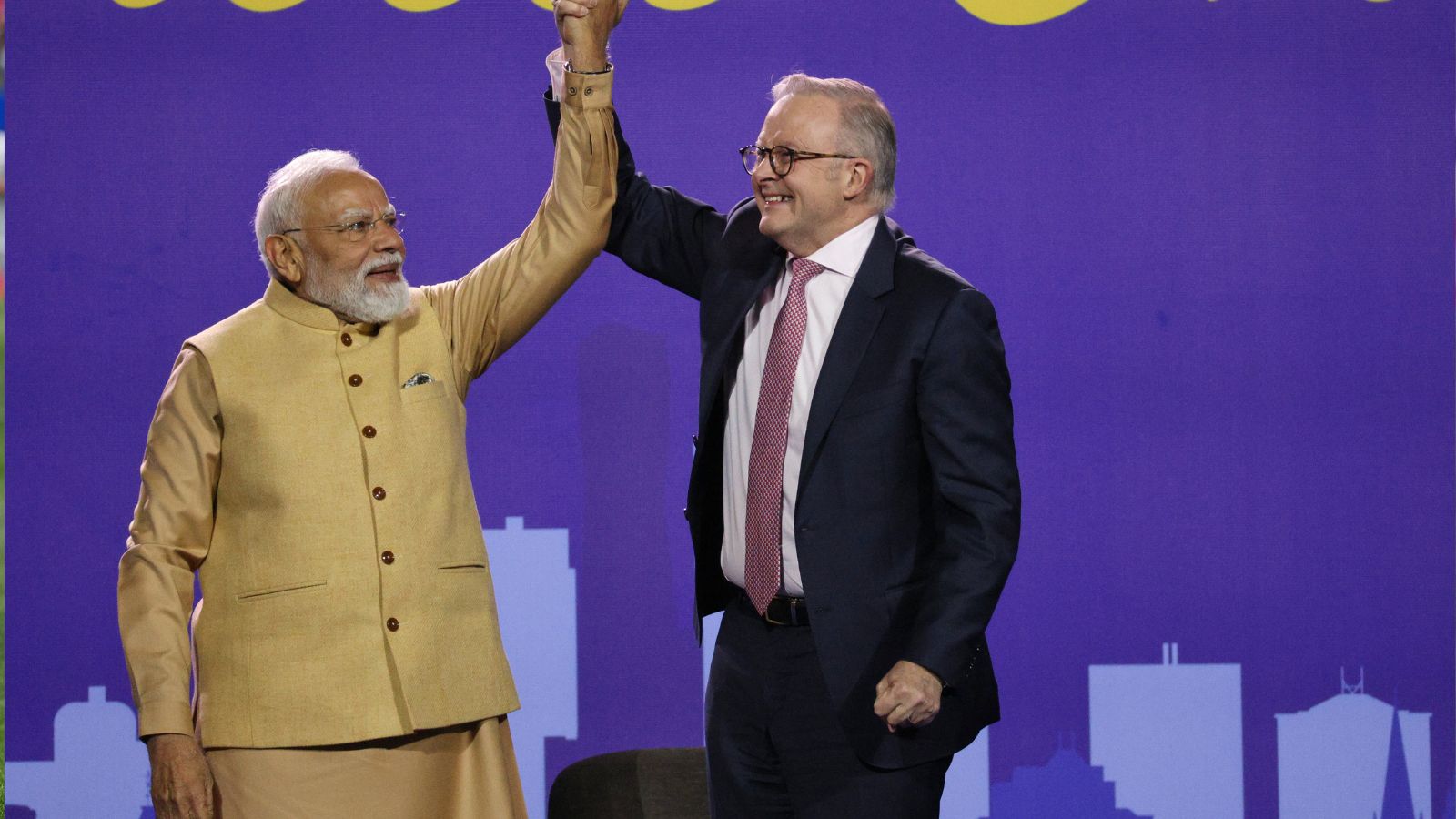
As strategic uncertainty deepens across the Indo-Pacific — with the United States stepping back, the Quad’s future in question, and President Trump embracing the prospect of a G2 with China — Prime Minister Narendra Modi’s visit to Indonesia, Australia and New Zealand sought to reaffirm India’s commitment to an open, stable and inclusive regional order.
Beyond its tangible outcomes — including a Strategic Partnership and Roadmap 2030 with New Zealand, expanded defence, security, cyber and critical minerals cooperation with Australia, and a $630 million missile deal with Indonesia — the tour underscored India’s determination to deepen defence, economic and technological partnerships with key Indo-Pacific countries.

Far from being isolated achievements, these outcomes reflect the cumulative impact of India’s long-term strategic framework, built around the Look East/Act East policy, Indian Ocean initiatives, the Indo-Pacific vision, and the SAGAR and MAHASAGAR initiatives.
Although New Delhi concluded free trade agreements with ASEAN, Japan and South Korea years ago, the economic pillar of its regional strategy has been further strengthened through FTAs with Australia and, most recently, New Zealand. An FTA with New Zealand is the logical follow-up to India’s agreement with Australia, as Australia and New Zealand have operated as a deeply integrated economic space under ANZCERTA since 1983.
Although Indo-Pacific countries, particularly ASEAN member states, Australia, New Zealand, Japan, and South Korea, remain deeply integrated with the Chinese economy, they have embraced the Indo-Pacific narrative to expand their strategic manoeuvring space.
India now has free trade agreements with many major Indo-Pacific economies. However, China moved much earlier, concluding FTAs with ASEAN, Australia, and New Zealand. Moreover, all these countries — including Japan and South Korea — are members of the Regional Comprehensive Economic Partnership (RCEP). Australia, New Zealand, Japan and South Korea also belong to the 12-nation Comprehensive and Progressive Agreement for Trans-Pacific Partnership (CPTPP). Indonesia, too, is expected to join the CPTPP next year.
Despite growing strategic concerns about China, economic interdependence across the Indo-Pacific remains deep. ASEAN–China trade has surpassed $1 trillion, while China’s bilateral trade with Japan and South Korea each exceeds $300 billion and with Australia more than $200 billion. Even New Zealand exports around $20 billion worth of dairy products, timber and meat to China, contributing to bilateral trade of more than $40 billion.
Amid growing uncertainty over US commitments and the imposition of new tariffs on partners — including those in the Indo-Pacific — India has emerged as an increasingly attractive partner, driven by the domestic size of its economy and its demonstrated ability to scale up technologies through initiatives such as its Digital Public Infrastructure (DPI).
Although India’s trade with China has reached around $150 billion, with imports accounting for more than $130 billion, it remains far less integrated with the Chinese economy through investment, technology and global value chains than most other Indo-Pacific countries.
To play a larger role in the evolving Indo-Pacific economic architecture, New Delhi will need not only to find ways to engage more pragmatically with the Chinese economy but also to seriously consider joining the CPTPP and, in due course, perhaps even re-engaging with the RCEP. As part of its Indo-Pacific pivot, even the United Kingdom has joined the CPTPP, while both the United States and India remain outside the region’s two major trade blocs — the CPTPP and the RCEP. The Indo-Pacific Economic Framework (IPEF) — the US-led economic initiative in the region — has yet to gain significant traction, while India opted out of its crucial trade pillar from the outset.
If Indian policymakers and industry are confident of concluding a third-generation free trade agreement — and, hopefully, an investment protection agreement — with the European Union, despite its high regulatory standards, they should also be able to view the CPTPP more positively.
It is becoming increasingly clear that New Delhi will have to navigate the Indo-Pacific’s evolving economic and strategic landscape largely on its own. Most of its key Indo-Pacific partners are US security allies, deeply integrated with the Chinese economy, and members of mega-regional trade agreements such as the RCEP and the CPTPP. India, by contrast, is neither a US ally nor economically integrated with China, and remains outside these trade blocs.
Yet these mega trade agreements will shape the regional economic order irrespective of India’s participation. If New Delhi seeks to influence the emerging Indo-Pacific economic architecture, it will need to deepen its economic engagement with all major economies in the region, including China, prepare for eventual participation in broader trade arrangements, and build the domestic competitiveness required for such integration. Without becoming part of the value chains driving the region’s dynamic growth, maritime and defence cooperation with key partners alone will not be sufficient to shape the evolving regional order.
The region may not be evolving into the “G minus 2” construct, as C Raja Mohan has argued in these pages. Instead, India has the opportunity to emerge as a “G2 plus 1” — but only if New Delhi is bold enough to integrate more deeply with Asia’s existing economic architecture.
The writer is Professor and Jean Monnet Chair at the School of International Studies, Jawaharlal Nehru University
