



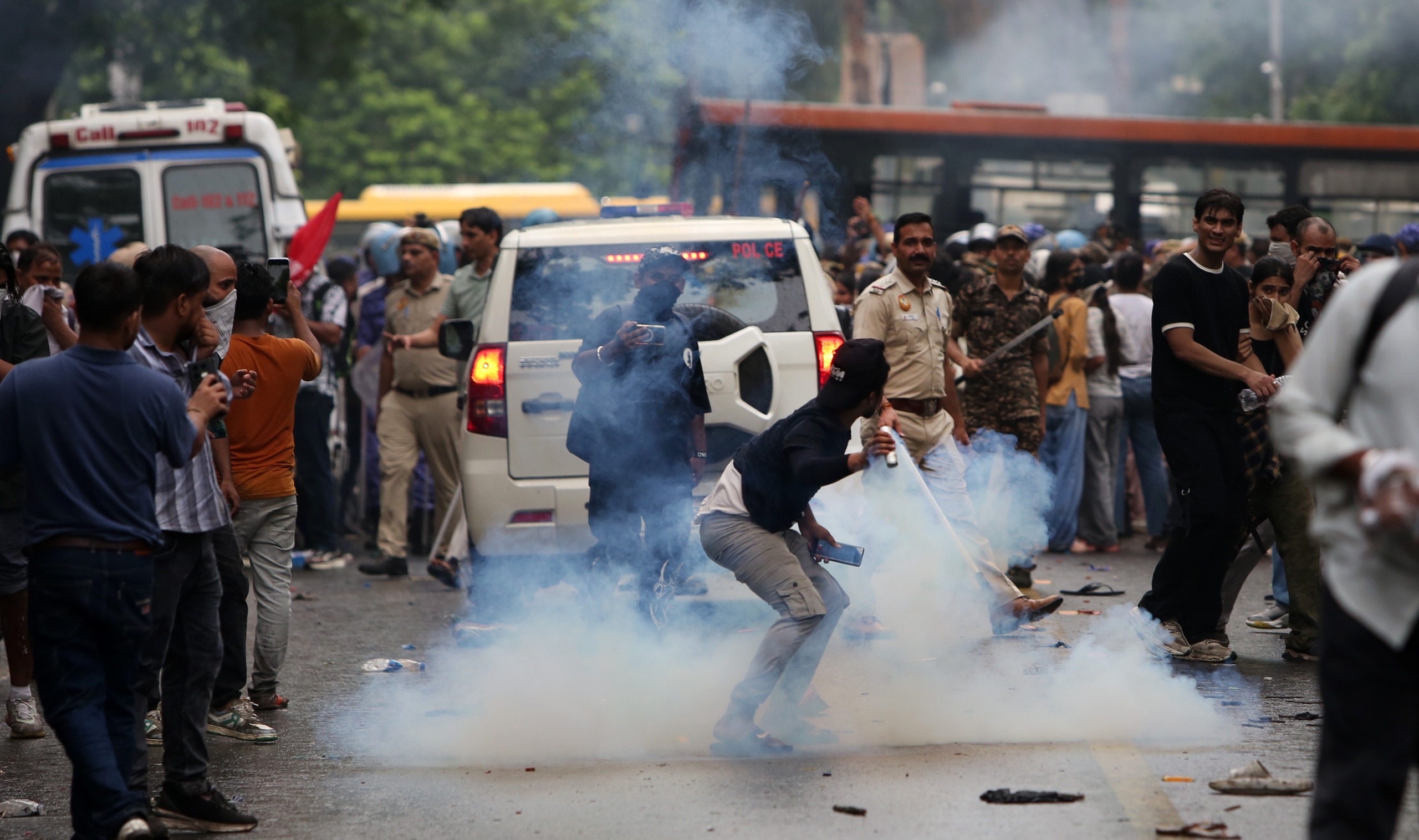
The true measure of a constitutional democracy lies not in the authority it wields to enforce compliance, but in the humility with which it engages dissent. A secure republic treats peaceful protest as an opportunity to look into a mirror reflecting the anxieties of its citizenry. A fragile executive, by contrast, treats that same mirror as an enemy, shattering it with lathis and turning a blind eye when the glass pieces fall on the streets outside the gates of power, cutting the veins of its citizens.
What the nation has witnessed in recent days on the streets of the national capital is a deeply troubling demonstration of democratic atrophy. Citizens, primarily young students and peaceful activists, many inspired by the symbolic leadership of the fasting Sonam Wangchuk, gathered to demand accountability on issues touching their very futures. The response from the apparatus of the state was not a dialogue, but a crackdown, silencing their voices with violence and detentions.

Lathi charges broke through crowds of non-violent demonstrators, sending nearly a hundred young men and women to hospital emergency wards with fractures, contusions, and trauma. The sight of police officers wielding batons against unarmed youth, while internet blackouts throttled the flow of information, felt less like the routine maintenance of public order in a constitutional republic and more like the heavy-handed oppression of a police state. I spoke to a young man at Jantar Mantar who had been hit on the head and below the eye with a lathi and still wore a large bandage to stanch the bleeding. My heart broke to see what the custodians of law and order had done to a youth peacefully distributing water to the protestors.
Equally jarring has been the government’s disgraceful manhandling of the protesting Leader of the Opposition and the environmentalist-educator Sonam Wangchuk’s hunger strike. For three weeks, Wangchuk sat in quiet, disciplined fast at Jantar Mantar, a historic venue designated precisely for the public expression of grievance. His method was classically Gandhian: Self-abnegation as an appeal to the conscience of the state. The smart thing for the government to do would have been to send a minister with a glass of nimbu-pani and the assurance of a discussion in Parliament, to urge him to break his fast.
Yet, rather than engaging in a spirit of constructive conciliation, the state chose the path of coercion. Under the cloak of medical necessity, police forces descended upon the protest site to forcibly remove the frail 59-year-old activist to a government hospital. The line between medical intervention and state custody became dangerously blurred, and even here the government was found wanting in basic humanity. The appalling treatment of Rahul Gandhi, who was bodily lifted and dragged into detention, was a betrayal of the democratic compact.
A state that fears the moral authority of an unarmed protestor reveals a profound lack of confidence in its own narrative. The pattern of suppression, the targeting and arrest of student leaders, and the physical intimidation directed at protest organisers speak to a broader political strategy: Render the movement leaderless, criminalise its protests, and wear out public outrage.
The scene on the streets represents a failure of governance; the response inside the halls of Parliament represents a systemic failure of legislative duty. As central Delhi burned with frustration and tears, one might have reasonably expected the sacred precincts of the Lok Sabha and Rajya Sabha to reverberate with urgent debate. The Opposition moved numerous notices demanding a suspension of business to discuss the breakdown of law and order, the grievances of the protesting youth, and the excessive force used by law-enforcement.
These notices were met with summary rejections, procedural stonewalling, and unyielding governmental indifference. The message conveyed to the nation was unmistakable: The grievances echoing across the streets outside were unwelcome on the carpeted floors inside. When the executive insulates itself from parliamentary discussion, it strikes at the fundamental design of parliamentary democracy — a system where the executive is accountable to the legislature, representing the sovereign will of the people.
If Parliament is not the forum for the nation’s elected representatives to ventilate public grievances, interrogate executive overreach, and seek solutions to pressing social crises, then what purpose does it serve? It cannot be reduced to a glorified notice-board for ministerial announcements, nor an administrative rubber stamp to pass the government’s Bills.
When a government closes the door to parliamentary debate and deploys police lathis on public streets, it creates a dangerous vacuum. Dissent does not disappear simply because it is beaten out of public sight; it merely turns inward, festering into cynicism and alienation among the young, like the female students at Jantar Mantar who told me in shocked disbelief of being manhandled by policemen and witnessing demonstrators being assaulted with savage brutality.
Democracy is sustained not by the enforcement of silence, but by the welcoming of open debate. The right to peaceful assembly under Article 19(1)(b) of our Constitution is not a privilege conceded by the state at its convenience; it is a foundational right forged in our freedom struggle. To treat peaceful demonstrators as security threats or law-and-order nuisances is to forget that the very architects of our republic were themselves courageous protesters who chose the weapon of satyagraha over submission.
The path forward to preserve our democratic compact requires an immediate course correction. An independent judicial inquiry must be instituted into the excessive use of force, pellet injuries, and lathi-charges against non-violent protesters. Accountability is essential for wrongdoing both here and in the conduct of examinations: The government must unconditionally engage with representatives of the protesting students rather than relying on police containment. And the Speaker and the Treasury benches must allow uninhibited discussion on the public’s grievances on the floor of the House. That is what Parliament is for, and it must reclaim its pride of place as the deliberative sanctuary of the republic.
It is time to prove to the youth of India that their voices need not be battered and bruised on the streets to be heard in the corridors of power.
The author is a fourth-term Congress MP from Thiruvananthapuram
