



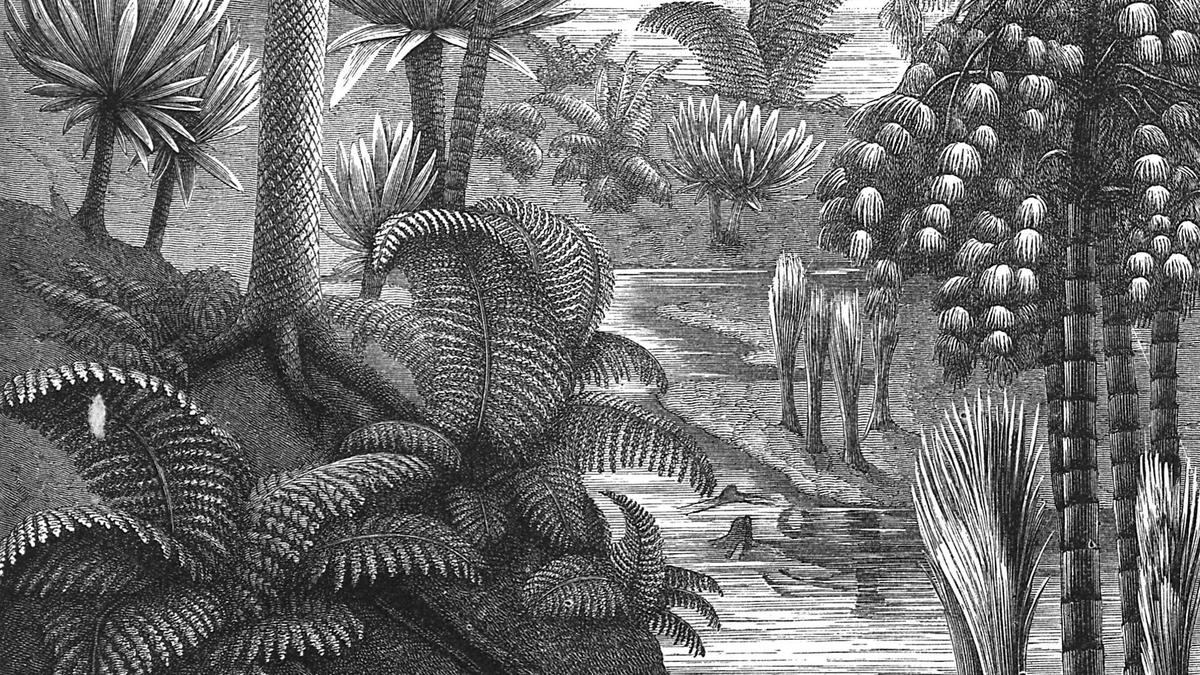

Many of the world’s coalbeds formed during the Carboniferous era, depicted here, from 359 million to 299 million years ago.
| Photo Credit: Public domain
— Vivek Keshri, Patna
A: Scientists identified fossil fuels to be the remains of ancient life using physical and chemical evidence. Early on, some scientists thought oil was a mineral ‘sweated’ out of the earth’s interior. But in the 16th century, naturalists found imprints of leaves and tree trunks inside coal seams, suggesting that coal is compressed plant matter.
Modern chemists also found molecules in crude oil that are only produced by living organisms, such as hopanoids and steranes. Finally, plants prefer to use the lighter isotope of carbon (carbon-12) during photosynthesis — and fossil fuels are highly enriched in carbon-12 relative to carbon of inorganic origins.
Fossil fuels are almost never from dinosaurs. In 1930, the Sinclair Oil Corporation used a dinosaur in a marketing campaign to emphasise the ancient and natural qualities of its oil. They also sponsored a dinosaur exhibit at the 1933 Chicago World’s Fair.
Further, the word ‘fossil’ originally meant anything dug up from the ground, and was used in the 1700s to refer to coal or oil deposits. Oil and natural gas are mainly from plankton and algae. Coal comes from ancient forests and swamps.
Published – July 22, 2026 09:30 am IST
