



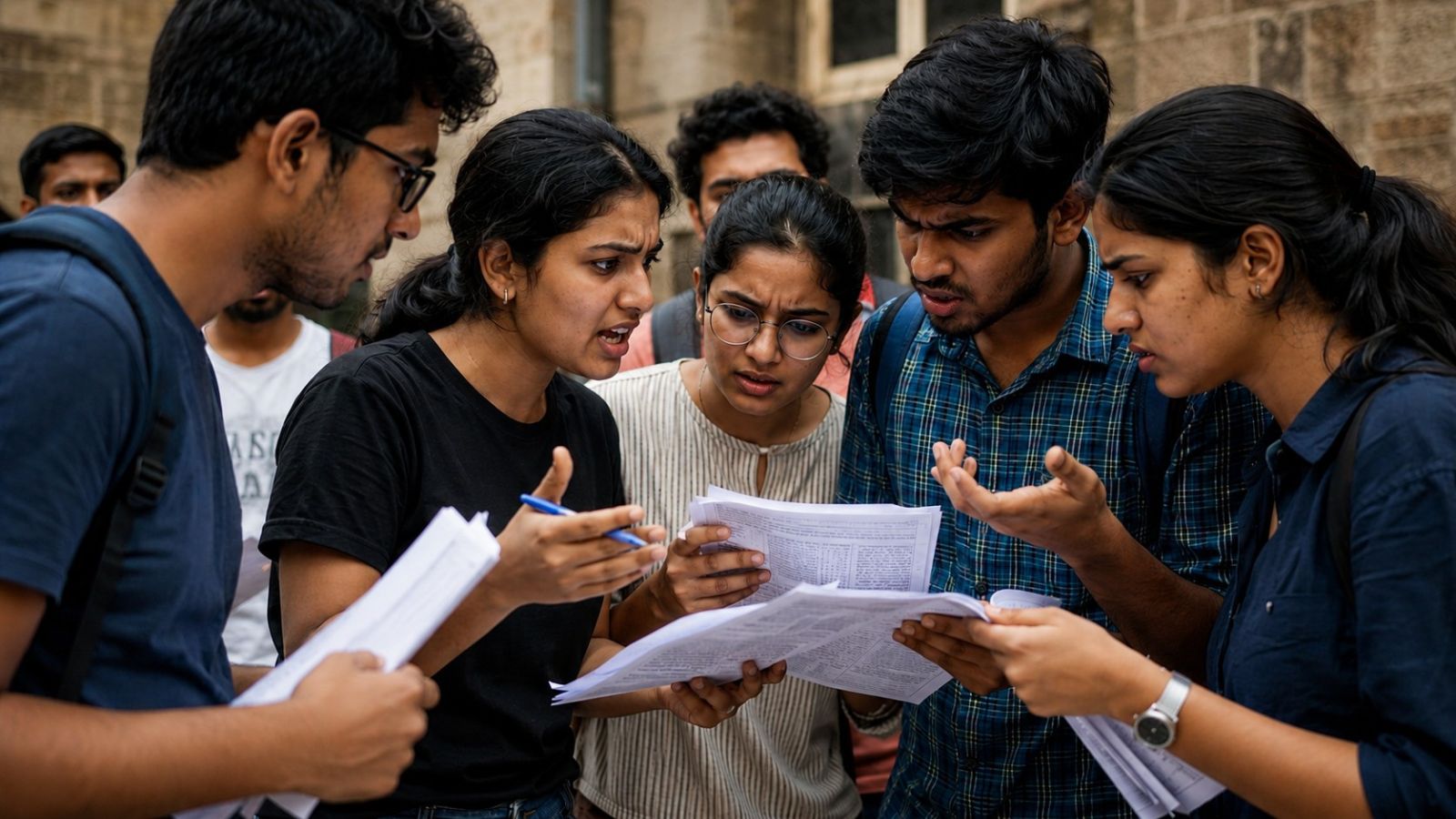
An examination leak is a grave failure and demands accountability. But reducing India’s current education debate to one demand — “Dharmendra Pradhan must resign” — risks obscuring a far larger transformation.
In the Mahabharata, the decisive struggle began before Kurukshetra. It began in the sabha, where narratives determined legitimacy and power. Today, too, the deeper contest is over who will shape the Indian mind: Its textbooks, languages and pathways to opportunity.

Three government initiatives deserve to be judged on their substance, not drowned in the noise surrounding one controversy.
First is the restoration of India’s intellectual inheritance. NCERT’s new Class IX mathematics textbook gives greater space to ancient Indian knowledge traditions and scholars such as Baudhayana, Brahmagupta and Madhava. Generations of students encountered Euclid and Newton without adequately learning about the Sulba Sutras, India’s number traditions or the Kerala school of mathematics. This is not a rejection of Western knowledge. It is the correction of an inherited imbalance.
The same principle applies to history. India’s past should be presented through evolving archaeological, genetic, linguistic and textual evidence — not through colonial assumptions frozen into doctrine. Re-examining older narratives is not “rewriting history” in a sinister sense. History is always refined when new evidence emerges.
Second is multilingual education. CBSE’s move towards three languages recognises a profound truth: Language is not merely a subject but a vessel of memory and thought. Bengali, Tamil, Marathi, Odia, Gujarati, Kannada and India’s other languages carry civilisational knowledge that English alone cannot preserve.
When implementation concerns emerged, the government introduced transitional relaxations and school-based assessment for the third language. That is responsive governance, not retreat. The objective should remain additive multilingualism — strong Indian-language foundations alongside competence in English as a global bridge.
Third is examination reform. The K Radhakrishnan Committee proposed stronger data security, greater state and district involvement, more reliable examination centres, biometric safeguards and a gradual transition towards computer-based testing. The latest breach does not invalidate this direction. India cannot protect examinations through technology alone, but neither can it secure them without modernising an outdated, vulnerable system.
There is also a commercial dimension that polite debate often overlooks. One private market-research estimate valued India’s coaching-classes market at approximately Rs 64,244 crore in 2022 and projected it to approach Rs 1.80 lakh crore by 2030. Separately, Ministry of External Affairs data recorded approximately 12.54 lakh Indian students in foreign universities and tertiary institutions as of January 1, 2025; the broader figure rises to 18.82 lakh only when Indian pupils studying in overseas schools are included. Overseas education, admission consultancy, testing, publishing and examination services constitute substantial commercial ecosystems.
Any reform that improves Indian institutions, reduces dependence on coaching, strengthens Indian languages or challenges inherited academic narratives will inevitably unsettle established revenue streams. This does not make every protester compromised or every critic anti-national. Many students have genuine grievances. But it would be equally naïve to imagine that every campaign against reform is free from political, ideological or commercial interests.
The government must identify failures, punish those responsible and protect affected students. But accountability should strengthen reform, not become a pretext for abandoning it. Ministers and hashtags will pass. Textbooks will shape memory, languages will shape consciousness, and examination systems will distribute opportunity for decades.
“Satyam eva jayate”. Truth alone triumphs. But first, we must be allowed to teach it.
Joshi is a Mumbai-based endocrinologist. Samajdar is a Kolkata-based clinical pharmacologist
