



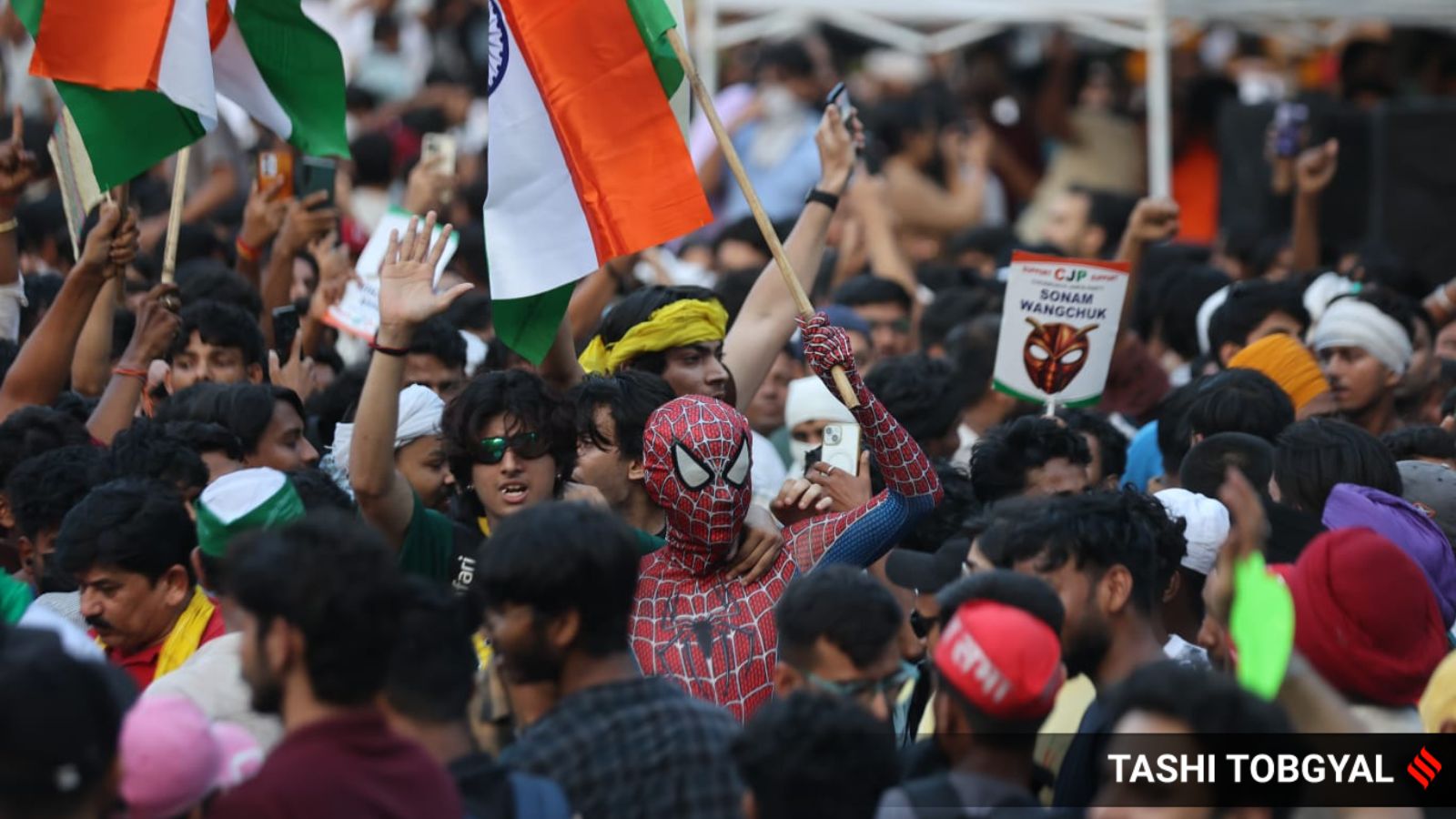
Last night, just a few minutes shy of 8.30, the police resorted to tear gas to disperse a swelling crowd near one of the entry points to the Jantar Mantar (JM) protest site. What I witnessed afterwards was remarkable, though not entirely surprising given the course of the last 72 hours. The crowd scattered, only to return in even larger numbers, sitting down where the tear gas had been fired and refusing to move. When it finally did move, it broke into smaller groups — some people walked towards the main protest site, others chanted slogans, while a few danced to the beat of a dhol.
If the July 20 crackdown was the state’s strategy to deter citizens from protesting, the days that followed suggest it has had the opposite effect. Not only had the JM protest site re-established itself within hours of being cleared on Monday, but it drew a steady stream of people throughout the following day. By Tuesday evening, the gathering had swelled to the point where the queue outside was at times nearly as large as the crowd inside. Wednesday evening drew even bigger crowds. Volunteers formed human chains to regulate the flow of people into the site.

Amid chants demanding education reform, snacks, juice and water were distributed and music blared from loudspeakers to keep those waiting occupied. Full meals, ordered through delivery apps by supporters in Delhi and beyond, arrived throughout the evening, while others quietly cleared the garbage as it accumulated.
All these are signs that the protest has begun to sustain itself, relying no longer solely on its organisers but on the thousands who have made it their own. As someone who has made half a dozen trips to JM since Sonam Wangchuk began his hunger strike — today being Day 25, with the educationist still in hospital — I have watched the Cockroach Janta Party-led demonstrations grow in phases. Participation increased gradually before ballooning on July 18 when Wangchuk was forcibly removed from the site, and eventually exploding on July 20, the day he had called for the Sansad Chalo march.
Yet July 20 — and the willingness of people to return in the days that followed — could not have become what it did without drawing in a constituency that stood largely outside organised politics. These were people who had remained observers until deciding over the weekend that they had had enough. Security officials acknowledged to this newspaper that they had not prepared for a protest of this scale. I spent much of July 19 answering fewer phone calls about where to watch the World Cup final than questions about the location, timing and what to carry for Sansad Chalo. Open Instagram, and it seems as though it exists for little besides protest updates, livestreams and memes from JM.
This isn’t to say that India is witnessing a new political awakening. Protests, both big and small, come and go. Some of them succeed in making the state accept their demands, but many do not culminate in any kind of institutional reform. But the story is not that people protested; it is that people who ordinarily do not “do politics” suddenly wanted to participate. For many, the NEET paper leak and the government’s handling of it made the issue intensely personal. But the size of the July 20 gathering and the decision of many to return to JM despite witnessing the police crackdown raise a different question: What made people cross the threshold from observer to participant?
It is impossible to provide a definitive answer. But political theory offers two frameworks that help explain the protest’s sudden momentum.
In Private Truths, Public Lies (1995), economist Timur Kuran advances the theory of “preference falsification”: People often privately hold views they do not express, whether to avoid backlash, preserve social standing or conform to what they perceive to be the majority view. A sufficiently significant public event, however, can alter that perception. Suddenly, people are willing to reveal preferences that had been hidden all along. July 20, then, may simply have been the first day many felt it was socially acceptable — perhaps even worthwhile — to translate private grievance into public expression.
That theory, however, does not explain why participation snowballed. There is a step between a person deciding to let it out and deciding to get out there. In his Threshold Model of Collective Behaviour, sociologist Mark Granovetter argues that individuals join collective action only after their own threshold has been crossed — that is, after enough other people have visibly acted first. People do not simply decide to protest; they also judge whether sufficient numbers of other people have already done so. Once enough people act publicly, those with higher thresholds begin to join, producing a cascade. The usual observers, seeing their peers prepare for the July 20 march, may have concluded that the perceived social and personal costs of participation had fallen. That, in turn, may help explain the unusually broad cross-section of protesters, and not just a few interest groups, at JM this week.
If Kuran and Granovetter are right, then July 20 may have been the day participation became socially contagious. The significance of Sonam Wangchuk and the CJP, therefore, lies not only in the demands they raised but also in the constituency they drew in. Even around 3.30 am on Wednesday, when I left JM, volunteers were still thanking people for coming. Others stood fanning exhausted protesters, some of whom had settled down to sleep on chatais. Young men and women appeared eager to sing, speak, document, smile at strangers, share jokes and shrug off the police officers standing guard. More than anything, they just seemed happy to be there.
July 20, then, suggests that the participation itself may deserve as much attention as the outcome of this protest. These young people may not have undergone an ideological transformation overnight, but even if only briefly, they ceased to be politically absent.
The writer is deputy copy editor, The Indian Express. saptarishi.basak@expressindia.com
