



5 min readFeb 27, 2026 06:24 AM IST
First published on: Feb 27, 2026 at 06:23 AM IST
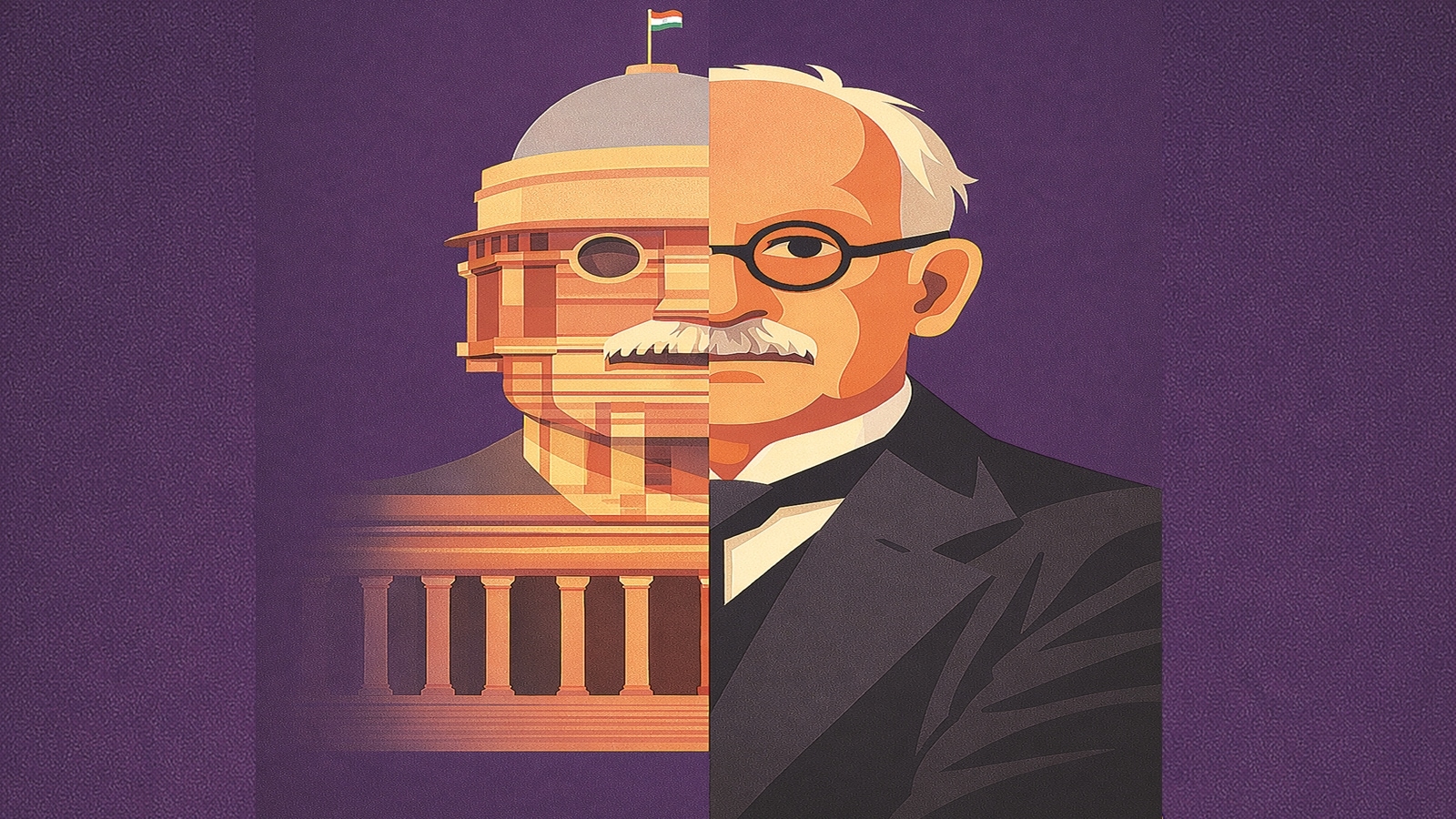
As Viceroy’s House, which we now know as Rashtrapati Bhavan, was nearing completion early in 1929, its architect, Edwin Lutyens, wrote to his wife that he was happy with how good it looked, and that it was “original in that it is built in India for India, Indian”.
In describing the building as “Indian”, Lutyens was referring to the many ways in which it drew inspiration from the long and rich tradition of Indian architecture. Rashtrapati Bhavan’s monumental dome is closely modelled on the ancient Buddhist Great Stupa at Sanchi. The chhatris (cupolas) that adorn the parapets are typically Indian forms, as is the prominent chhajja (drip stone) that extends right around the building. There are jaalis (carved pierced stone screens) that are near copies of those in the Mughal Red Fort. The sculpted elephants that guard the entrances could never have looked at home in the architect’s native Britain.

To arrive at this moment in his creative journey, Lutyens needed to cover a considerable distance, metaphorically speaking. It was a long way from his initial conviction that imperial architecture in the new British Indian capital needed to be inspired by the classical traditions of ancient Greece and Rome. A newcomer in India, he had to visit historic sites to overcome his initial reservations about Indian architecture. His talent as an architect lay in that ultimately he did not superficially graft on Indian features and decorative motifs, but adapted them creatively into an organic structure.
Lutyens is generally acknowledged as one of the greatest architects of his time, and within his large body of work, it is his buildings in New Delhi that are perhaps most admired for their striking originality. But we must not lose sight of the process through which this end was achieved, for it was not simply a product of Lutyens’s genius. Lutyens was responding to the very specific demands of his clients — Charles Hardinge, Viceroy of India, and George V, the British monarch, who insisted that the town plan and architecture of New Delhi should pay homage to Indian history and architectural traditions.
This imperative, in turn, was the outcome of political developments of the late 19th and early 20th centuries, which had led up to the transfer of the capital from Calcutta to Delhi. The government had tried to stem the rising tide of the national movement, but its attempt to divide the people on communal lines through the partition of Bengal in 1905, or to suppress free speech through the Press Act of 1910, had failed miserably. Pushed to the wall, the authorities in India and Britain realised that they would have to give in to at least some of the demands of the Indian people, and to try and make the empire more acceptable in their eyes.
The colonial state, therefore, set out to rework the empire along new lines. One was constitutional — devolution of greater power to the provinces, and admitting more Indians to representative bodies. The other was powerfully symbolic — the transfer of the capital to Delhi, a city that had historically served as the capital of several successive dynasties that ruled over large parts of India. The British would build a new capital here, just as a series of Indian powers had. It was also decided that the town plan and architecture of this city would explicitly reflect the history and traditions of Delhi and India. To this end, New Delhi’s main avenue, or Central Vista, was laid parallel to the main ceremonial avenue of the Mughal city — the street we know as Chandni Chowk. The Central Vista also connected Viceroy’s House to Purana Qila, which was, in popular tradition, believed to be the site of ancient Indraprastha.
It was in this context that Lutyens, along with the architect Herbert Baker, was engaged and instructed to design the major government buildings in a style that was recognisably Indian. This political background is crucial to understanding how Lutyens, while working for a colonial government, nevertheless designed for Viceroy’s House a building that he described as “Indian”, a building that was later considered eminently suitable for the place of work and residence of the President of independent India.
Whenever I have passed by Lutyens’s bust in Rashtrapati Bhavan, I have thought of this. The spirit of India is resilient and indomitable, and found expression even during colonial rule, through the work of a British architect.
The writer is a Delhi-based historian

