



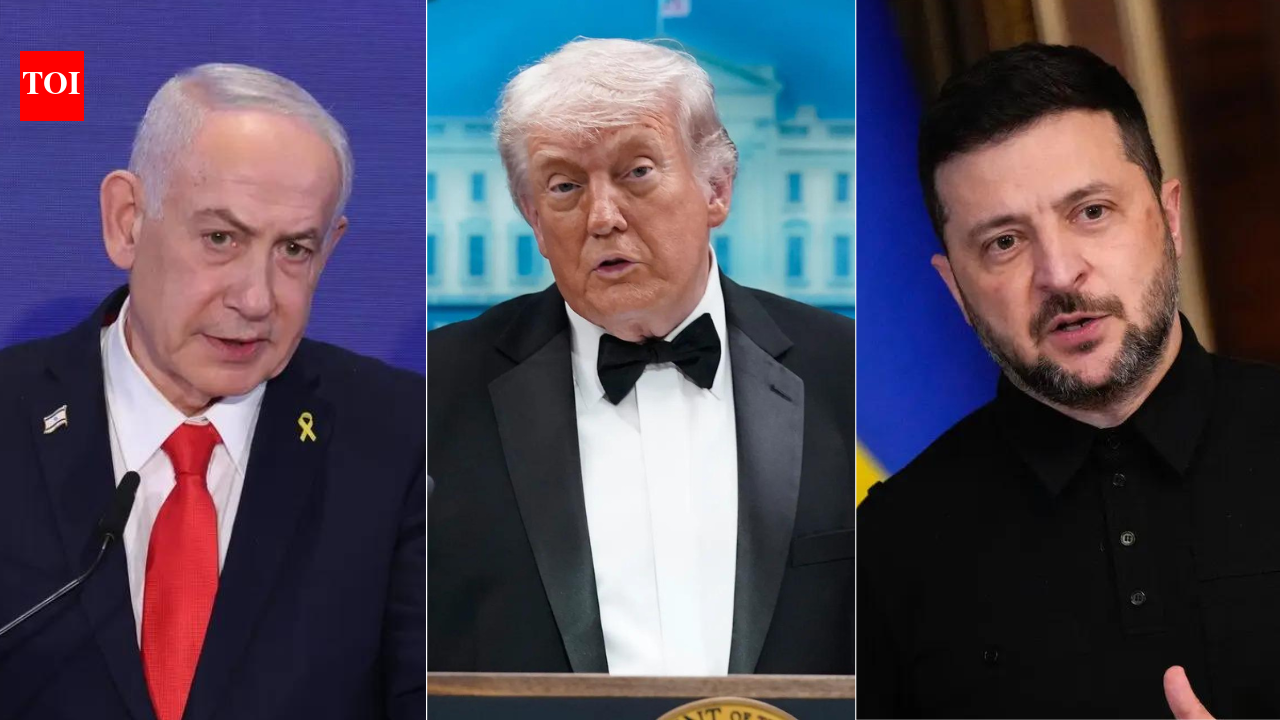
TOI correspondent from Washington: For more than three years, the war in Ukraine and the conflict between Israel and Iran have unfolded as separate geopolitical dramas. On Tuesday however, the two appear closer than ever to becoming chapters of the same story.Ukrainian President Volodymyr Zelenskyy and Israeli Prime Minister Benjamin Netanyahu arrived in Washington around the same time for the funeral of the late Senator Lindsey Graham — a staunch advocate of both Ukraine’s war effort and a hard line against Iran — with the White House finding itself at the intersection of two conflicts that increasingly overlap.Whether that convergence remains political and contained or turns into something more kinetic and expansive could become one of the defining foreign-policy questions confronting President Trump. Already, some historians and diplomats have begun invoking the pre-1914 period of World War I as an analogy because they see similarities in the way separate regional crises risk becoming interconnected through alliances, miscalculation, and escalation.The immediate trigger is a new confrontation in the Caspian Sea, the world’s largest inland body of water, where, according to Zelenskyy, Ukrainian forces carried out long-range strikes against vessels allegedly transporting military cargo between Russia and Iran. Ukraine’s Security Service said it targeted ships involved in moving Iranian drones and military supplies, as well as other Russian military assets.Iran rejected that characterization, with Foreign Minister Abbas Araghchi accusing Ukraine of striking an Iranian commercial vessel, killing a sailor, and warning that Kyiv’s actions “cannot go unanswered.” Tehran summoned Ukraine’s charge d’affaires, even as Iranian officials suggested the attack was intended to draw Europe and Nato deeper into Israel vs Iran. Ukraine, for its part, is unapologetic, with the country’s foreign minister Andrii Sybiha countering that Iran “has no standing to pretend to be a victim,” while arguing that Tehran has been supplying Russia with Shahed drones and other military technology since 2022 – weaponry that he said has killed Ukrainian civilians. Kyiv insists Iran became a participant in the Ukraine war years ago by arming Moscow.“Iranians and North Korea have already attacked us,” Zelenskyy said in an interview to Sky News, referring to Tehran’s drone transfers and North Korea’s military assistance to Russia. While maintaining that Kyiv wanted to avoid opening “a new front,” he argued that Ukraine had every right to strike military supply chains supporting Russia’s war. Western analysts say Russia-Iran military partnership has deepened considerably, and the relationship has increasingly blurred the lines between the European and Middle Eastern theaters. For Zelenskyy, the emerging linkage serves an obvious political purpose. Some analysts argue that Kyiv hopes to convince Washington that helping Ukraine is no longer simply about defending Eastern Europe but also about weakening one pillar of Iran’s regional military network. Trita Parsi of the Quincy Institute has suggested that Ukraine may be attempting to merge the two conflicts strategically, making support for Kyiv inseparable from the broader confrontation with Tehran. Remarkably, it is President Trump who has sought to lower the rhetorical temperature. Responding to Zelenskyy’s assertion that Russia may have assisted Iranian targeting of US military facilities with satellite intelligence, Trump said on Monday that he intended to discuss the allegation with Russian President Vladimir Putin. “I don’t think they’ve been doing it, certainly not at a high level,” he told reporters, adding that if such assistance had occurred, it appeared to have been “very unimpactful.” He is also said to be pushing back against Israeli intelligence feeding Washington about Iranian nuclear assets in Pickaxe mountains, asserting the US has its own intel to make a determination. That measured response reflects Trump’s broader diplomatic balancing act. Unlike Senator Graham, whose long career was marked by robust support for military interventions from Iraq to Ukraine and, more recently, Iran, Trump campaigned on avoiding new American wars while simultaneously projecting strength, even as his MAGA supporters say he is being dragged into the wars and he should resist it. Yet critics increasingly question whether his foreign policy reflects a coherent grand strategy or a series of transactional decisions driven by immediate political calculations. His simultaneous efforts to maintain ties with Netanyahu, pursue negotiations with Russia, reassure Nato allies while pressing them to shoulder greater burdens, and cultivate Turkey as a regional partner have created an impression of strategic ambiguity, While his supporters call it flexibility, critics call it improvisation. Trump, meanwhile, must decide for now whether two distant wars can still be managed separately – or whether history has already begun merging them into one.
