



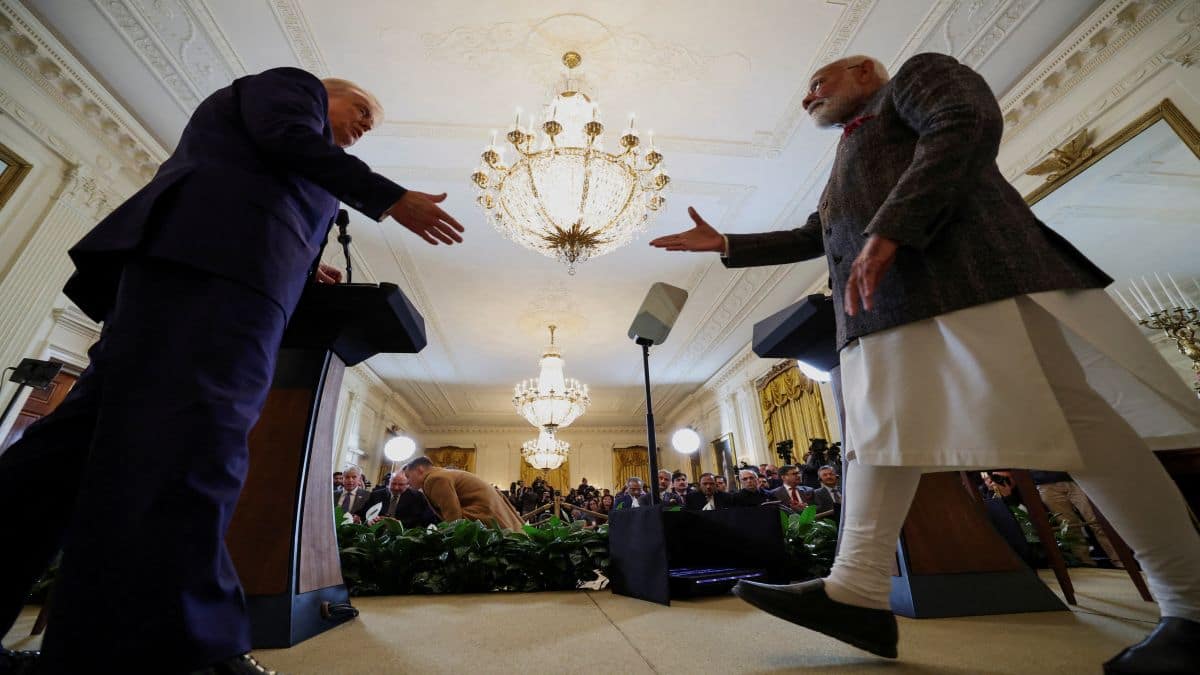
Hailed as a ’landmark’ by proponents and criticised as a ‘concession’ by detractors, the newly unveiled India–US trade agreement signals a decisive shift in bilateral economic ties. The deal lowers US reciprocal tariffs on Indian exports to 18 per cent, a sharp reduction from earlier effective levels that touched nearly 50 per cent once the Russia-linked punitive surcharge was factored in. The announcement, however, raises a pivotal question: has India finally secured its seat at the high table, or does it come at the cost of diluting the country’s long-held commitment to strategic autonomy?
Export Gains and Market Re-Entry: The Economic Upside
At its core, the agreement reflects a strategic realignment rather than a rupture. Lower US tariffs are expected to improve the price competitiveness of Indian goods in the American market, strengthen trade balances, and create opportunities for reciprocal policy engagement.
India’s labour-intensive export sectors, particularly textiles, engineering goods, gems and jewellery, leather and footwear, and marine products, are poised to significantly benefit. India’s exports to the US market were valued at approximately $86.5 billion in 2024–25, with textiles and apparel alone accounting for about $11 billion, or roughly 28 per cent of that category’s total exports to the US before the tariff reset.
The deep tariff cut is expected to restore Indian exporters’ price competitiveness relative to key Asian rivals such as Vietnam and Bangladesh—whose duties to the US are near 20 per cent—and provide Indian exporters better access to the US market. Similarly, India’s engineering exports to the US were valued at approximately $20.1 billion in 2025. About 62 per cent of these exports—roughly $12.46 billion—will now be covered under this reduced duty regime.
This creates a strategic opening for India to expand its manufacturing base and accelerate production under the Make in India initiative. Broader economic indicators responded positively: the Indian rupee recorded notable gains, and domestic equity indices rose sharply on expectations of stronger export momentum and improved investor sentiment.
Energy Dependencies and Russia Question
Critics, however, see the agreement as a lopsided pact forced under unequal pressure, raising serious concerns regarding sovereignty, strategic autonomy, and long-term financial consequences. The deal’s success appears contingent on India significantly reducing its reliance on Russian oil and incrementally raising purchases of US crude and LNG. The implicit linkage between tariff relief and India’s energy choices exposes a deeper, more calculated geopolitical strategy at play.
India currently imports nearly 85 per cent of its crude oil consumption. Russia has emerged as a major supplier in recent years, accounting for around 30–40 per cent of imports, followed by the Middle East. Yet the structure of India’s crude basket is gradually evolving. The Economic Survey 2025–26 notes that the United States accounted for about 8.1 per cent of India’s total crude imports during April–November 2025, nearly double the level recorded a year earlier. However, compared with discounted Russian oil, US crude involves higher shipping and processing costs, implying that any near-term shift could add upward pressure to India’s oil import bill.
Agriculture, Dairy, and the Limits of Market Access
Along with the Russia pivot, India faces a dilemma in the dairy and agricultural sector. A July 2025 State Bank of India analysis warns that opening India’s dairy market to highly subsidised
US products could trigger a 15 per cent drop in milk prices and annual revenue losses of over INR 1 lakh crore for dairy farmers, threatening livelihoods in a sector that engages millions nationwide. Although Indian officials assert that core interests in agriculture and dairy remain protected under the current framework, industry voices caution that broader market concessions to the United States could jeopardise rural livelihoods. The primary concern is that American producers, supported by significant government subsidies, could undermine national food security if market access widens beyond industrial goods.
Supporters of the deal argue that India has, in fact, preserved its autonomy. There is no formal commitment to end Russian oil imports or set rigid timelines for energy shifts. The Government of India has reaffirmed its strong commitment to protecting and promoting the domestic dairy and agricultural sectors.
Commerce Minister Piyush Goyal has emphasised that while the tariff reduction is aimed at boosting bilateral trade and enhancing market access for Indian exporters, sensitive sectors such as agriculture and dairy have been fully safeguarded through negotiated exemptions and safeguards, ensuring that domestic farmers and milk producers are not exposed to disruptive import competition.
A Calculated Bet, Not a Final Verdict
As with most consequential economic and diplomatic bargains, the truth lies in neither celebration nor alarmism—but in a careful assessment of trade-offs. India’s economic size, growth trajectory, and emergence as a primary alternative in global supply chains give New Delhi significant bargaining power on the world stage, a sharp contrast to its position a decade ago.
The true measure of success for India’s latest trade manoeuvres, however, will lie in execution. If India leverages improved market access to accelerate its manufacturing, broaden its export portfolio, and attract investment into high-tech industries, it could pave the way for long-term economic resilience. However, if tariff relief is viewed as a final victory rather than a tool for growth, the opportunity will dissipate while the constraints remain.
(Jaydeep Mukherjee is a professor of economics at the Great Lakes Institute of Management, Chennai. Views expressed in the above piece are personal and solely those of the author. They do not necessarily reflect Firstpost’s views.)
End of Article

